
Reading Gay Love Stories Side by Side
Kinship with a stranger, without saying a word

I’ve drawn a lot of inspiration from Ross Gay’s “The Book of Delights,” a series of essays written daily, about something delightful. I often do something similar, which stimulates my creativity and deepens my gratitude practice. Here is one such “delight” I wrote in early-2020, which feels like a nice companion to the article I published recently about “Call Me By Your Name”.
Riding home across the Manhattan bridge, the world outside was blushing, rosy cheeked and glowing. The sun hung heavy in the evening sky — a mouth-watering peach, dribbling syrup on the glistening sea. It was so epic, I couldn’t look away. But to my surprise, most of the other people on the train were buried in their phones, bobbing their heads, asleep.
It got me thinking about how little we know of each other. Every day, I see hundreds of people on the train or the street, and every one of them has silent chatter banging in their head — always a complete mystery.
So, I crave the moments that bring us together — something external that’s so dynamic, it creates a shared emotional experience. I thought the sunset might have been one of those things, but like I said, everybody was just on their phones.

Before the train came up above ground, I was reading “Maurice,” the classic E.M. Forster novel about two young English schoolboys who fall in love. I don’t know why it took me so long to pick it up. It’s been filling me to the brim with rapturous glee. When the train went back underground, and the sunset faded from view, I started reading again.
At the first stop in Brooklyn, a lot of people crowded onto the train. I was sitting in a corner seat at the front end of the car, with a narrow bit of space to my left. A young woman shimmied into the empty space beside me, and took out a copy of “Call Me by Your Name” by Andre Aciman.
This synchronicity delighted me. Our two books are often mentioned in the same sentence — lyrical, sensual, nostalgic coming-of-age romances about gay men. James Ivory directed the film adaptation of “Maurice” and wrote the screenplay adaptation of “Call Me By Your Name,” so the former is often sited as a major influence on the latter.
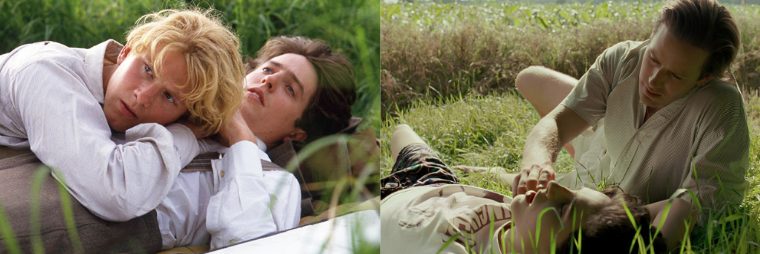
I’ve often thought about how lucky I am to live in a city where I can read a queer book in public and not feel in the least bit afraid. There are plenty of other places in the world where flashing the cover of a gay romance would invite ridicule and potential violence. And if I dared to take the risk, I bet another person taking out a similar book would feel like a sign of allyship. But here in New York, it just struck me as a delightful coincidence.
And I tried to catch the lady’s eye, so we could share in this serendipity, but she was so engrossed in her book, I let her be and returned to mine. Even though we never spoke and knew nothing else about each other, I knew the silent chatter in her head was a rhapsodic account of fleeting summer love. I knew we were dreaming of young men by a river in each other’s arms.
I knew we were on the same page.
If you enjoyed this piece, check out my story about finding Maurice and Call Me By Your Name among other titles on the queer literature table at Barnes and Noble, and how it contributed to one of the best dates of my life!


