avatarJim Dee, OG Web3 Dev & Generative NFT Code Expert

Free AI web copilot to create summaries, insights and extended knowledge, download it at here

2788

Abstract

hen we get to doing testing and, based on the above setup, the comment I’ll get from clients quite a lot is: “Gee, there are a LOT of bricks in the set, and a lot of STRIPES, too. Can we make those less common?”</p><p id="d886">And so we tweak the numbers again. But, really, clients quite often wind up wishing some of the rarer items would be a bit more common, and vice-versa — which is to say, they like the more aesthetic variety that comes up when the distribution is more even.</p><p id="8068">So, rarity is basically a battle between getting decent diversity on the one hand (flat distribution) and not seeing too many of a given trait on the other (steeper distribution).</p><h1 id="d9b1">🤔 What Can Be Done?</h1><p id="43e0">Well, a lot can be done about it. And for me, <b>after having coded about 140,000 NFTs so far</b> in my short career as a generative programmer (which have sold for a total of $46 million so far, by the way!), here’s the short, and possibly obvious (to some) answer: <b>Make more traits!</b></p><p id="67bb">So, let’s have a look at our trait list once we’ve doubled the traits to 20. Note that, in this example, I’ve kept BRICKS as the most common one, with a 9.8% distribution goal. So, we’ve just about cut that original 19% distribution for that one in half, making it quite a bit less common (even if it’s still the most common background).</p><figure id="3d89"><img src="https://cdn-images-1.readmedium.com/v2/resize:fit:800/1*HD8L2jRbgqrpz1412Qju4Q.png"><figcaption></figcaption></figure><p id="1993">A set like this is going to be a LOT more visually striking, as you’ve got lots of goodies going on, including some highly uncommon ones. That GOLD background, which we set at 0.2%, for example, would come up about 20x out of a 10,000 NFT set.</p><p id="0c46"><b>Quirky side note:</b> I did a set recently that included a GOLD element like this, and it wasn’t even the most rare element. But STILL … people on the secondary market routinely paid MORE for the GOLD-element items within the set. Interesting, no? People ascribe value to GOLD, even when it’s not the most uncommon trait!</p><h1 id="8778">☑️ Bottom Line</h1><p id="9cd4">The above shows how adding traits to just ONE property in a set can really alleviate some of the aesthetic problems that NFT sets can have. But remember: Most sets have 10–15 (or so) properties. So, if you take a set of, say, 13 properties at 10 traits per property (130 traits) to 13 properties at 20 traits per property (260 traits), you <b>really </b>get into some exponential wonderment when it comes to the possibilities of what’ll come out.</p><ul><li>Having more traits makes rarity table creation much easier.</li><li>Having more traits allows NFT collectors to focus on special niches (think “floor pr

Options

ices” for each trait you create)!</li><li>Having more traits exponentially increases your set’s visual variety.</li><li>Having more traits usually leads to delightful surprises in the set, as no one can fully envision the many billions (or trillions) of possibilities that could happen when you’ve got so many moving parts.</li></ul><p id="0d57">And, yes, it’s twice as much work for your artist. So pay him or her very well! But, in the end, the effort always be worth it.</p><p id="d59b">One approach that I find works well is to have the artist tackle the core layers initially — make 10+ of each thing, and <b><i>then </i></b>have the artist do another run-through and add onto the originals. Sometimes, yes, you can bulk up the trait numbers by doing basic variations (<i>e.g.,</i> color a “red shirt” blue and call it “blue shirt” — which helps, but I recommend limiting that approach to some reasonable level).</p><p id="a7f6">It’s good, though to come back to a set in progress and add onto it rather than planning it all out from the beginning because, in my view, this prevents a feeling of overwhelm. Moreover, it allows the artist to follow the natural course of inspiration, inventing new traits as he/she discovers the opportunities for them.</p><h1 id="033c">⚠️ You can STILL Overdo It, Though!</h1><p id="b2ed"><b>Keep this in mind: </b>The sweet spot is when you’ve got maybe 15–35 options (traits) within each layer or property, in my experience. Because, at that level, you can still have a reasonable range of things in the sub-1% range and some up in the 7–10% range, if needed.</p><p id="1ddd">If you really go to town, though, and have like 50 traits per property, you’re entering into a whole other area of rarity table trouble, which is to say that EVERYTHING becomes highly rare, and you’re asking for a lot of problems most likely (<i>e.g.,</i> the same problems pinning down distribution goals, new problems with traits not showing up if they’re too rare, unknown potential problems with the rarity bots not ranking the set as you’d prefer, and quite often unforeseen logical issues).</p><p id="cc08">Keep it in the sweet spot and you’ll be a-okay. When you’ve got it all dialed in and need a generative programmer to bring your creations to live (via generative coding, smart contracts, and minting pages), give us a holler. It’s what we do all day every day. 🐈</p><figure id="da50"><img src="https://cdn-images-1.readmedium.com/v2/resize:fit:800/0*qdA0d0yIHWORcFDs"><figcaption>Jim Dee is a prolific writer, developer, and multi-media creator from Portland. You can find him, his businesses, his books, and more at <a href="https://jpd3.com/">JPD3.com</a>. Thanks for reading! Cat image here courtesy of Midjourney AI.</figcaption></figure></article></body>

NFTs, Generative Programming

Rarity Tables Made Easy When Planning Generative NFT Sets

The more traits, the better — to a degree.
Photo by Jingming Pan on Unsplash. People LOVE gold items. Read about that below. :-)

If you’re new to making rarity tables for generative NFT sets, I recommend reading my previous article on what they are and how to set them up before reading this one. That article is here:

Okay, so now you know what a rarity table is. Let’s look at some of the more common issue that crop up when NFT artists start planning out the rarity. Let’s imagine, for now, that the artist has come up with 10 traits for the BACKGROUND property. If we just list them in order (and, as I mentioned in my previous article, I find it SUPER helpful if you list them in alphabetical order), and assign them all an equal percentage, it looks like this:
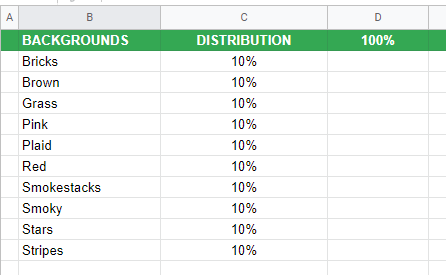
At this setting (10% each), you’re telling the code to basically just pick one at random. Out of each 100 picked, there’ll be around 10 of each background that’ll show up in your generative NFT set.

Sometimes that’s okay, too. You don’t ALWAYS need a hierarchical setup. But, most of the time, you DO want hierarchy, as that’s the whole fun of generative programming. So, a lot of people start by making things more common and more rare, and they wind up with a listing like this:
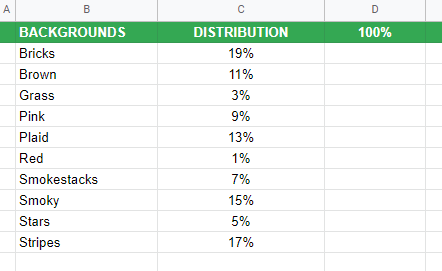
And yeah, that spreads things out a lot more. But then we get to doing testing and, based on the above setup, the comment I’ll get from clients quite a lot is: “Gee, there are a LOT of bricks in the set, and a lot of STRIPES, too. Can we make those less common?”

And so we tweak the numbers again. But, really, clients quite often wind up wishing some of the rarer items would be a bit more common, and vice-versa — which is to say, they like the more aesthetic variety that comes up when the distribution is more even.

So, rarity is basically a battle between getting decent diversity on the one hand (flat distribution) and not seeing too many of a given trait on the other (steeper distribution).

🤔 What Can Be Done?

Well, a lot can be done about it. And for me, after having coded about 140,000 NFTs so far in my short career as a generative programmer (which have sold for a total of $46 million so far, by the way!), here’s the short, and possibly obvious (to some) answer: Make more traits!

So, let’s have a look at our trait list once we’ve doubled the traits to 20. Note that, in this example, I’ve kept BRICKS as the most common one, with a 9.8% distribution goal. So, we’ve just about cut that original 19% distribution for that one in half, making it quite a bit less common (even if it’s still the most common background).
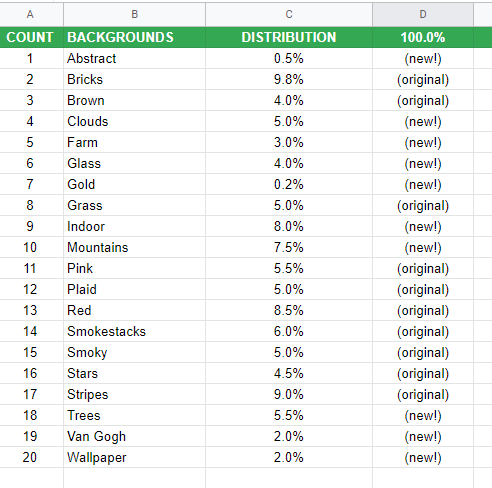
A set like this is going to be a LOT more visually striking, as you’ve got lots of goodies going on, including some highly uncommon ones. That GOLD background, which we set at 0.2%, for example, would come up about 20x out of a 10,000 NFT set.

Quirky side note: I did a set recently that included a GOLD element like this, and it wasn’t even the most rare element. But STILL … people on the secondary market routinely paid MORE for the GOLD-element items within the set. Interesting, no? People ascribe value to GOLD, even when it’s not the most uncommon trait!

☑️ Bottom Line

The above shows how adding traits to just ONE property in a set can really alleviate some of the aesthetic problems that NFT sets can have. But remember: Most sets have 10–15 (or so) properties. So, if you take a set of, say, 13 properties at 10 traits per property (130 traits) to 13 properties at 20 traits per property (260 traits), you really get into some exponential wonderment when it comes to the possibilities of what’ll come out.

  • Having more traits makes rarity table creation much easier.
  • Having more traits allows NFT collectors to focus on special niches (think “floor prices” for each trait you create)!
  • Having more traits exponentially increases your set’s visual variety.
  • Having more traits usually leads to delightful surprises in the set, as no one can fully envision the many billions (or trillions) of possibilities that could happen when you’ve got so many moving parts.

And, yes, it’s twice as much work for your artist. So pay him or her very well! But, in the end, the effort always be worth it.

One approach that I find works well is to have the artist tackle the core layers initially — make 10+ of each thing, and then have the artist do another run-through and add onto the originals. Sometimes, yes, you can bulk up the trait numbers by doing basic variations (e.g., color a “red shirt” blue and call it “blue shirt” — which helps, but I recommend limiting that approach to some reasonable level).

It’s good, though to come back to a set in progress and add onto it rather than planning it all out from the beginning because, in my view, this prevents a feeling of overwhelm. Moreover, it allows the artist to follow the natural course of inspiration, inventing new traits as he/she discovers the opportunities for them.

⚠️ You can STILL Overdo It, Though!

Keep this in mind: The sweet spot is when you’ve got maybe 15–35 options (traits) within each layer or property, in my experience. Because, at that level, you can still have a reasonable range of things in the sub-1% range and some up in the 7–10% range, if needed.

If you really go to town, though, and have like 50 traits per property, you’re entering into a whole other area of rarity table trouble, which is to say that EVERYTHING becomes highly rare, and you’re asking for a lot of problems most likely (e.g., the same problems pinning down distribution goals, new problems with traits not showing up if they’re too rare, unknown potential problems with the rarity bots not ranking the set as you’d prefer, and quite often unforeseen logical issues).

Keep it in the sweet spot and you’ll be a-okay. When you’ve got it all dialed in and need a generative programmer to bring your creations to live (via generative coding, smart contracts, and minting pages), give us a holler. It’s what we do all day every day. 🐈

Jim Dee is a prolific writer, developer, and multi-media creator from Portland. You can find him, his businesses, his books, and more at JPD3.com. Thanks for reading! Cat image here courtesy of Midjourney AI.
Nft
Nft Collectibles
Programming
Tech
Marketing
Recommended from ReadMedium