
Raising hackles with ‘Ricky Nelson: Idol for a Generation’ scribe Joel Selvin
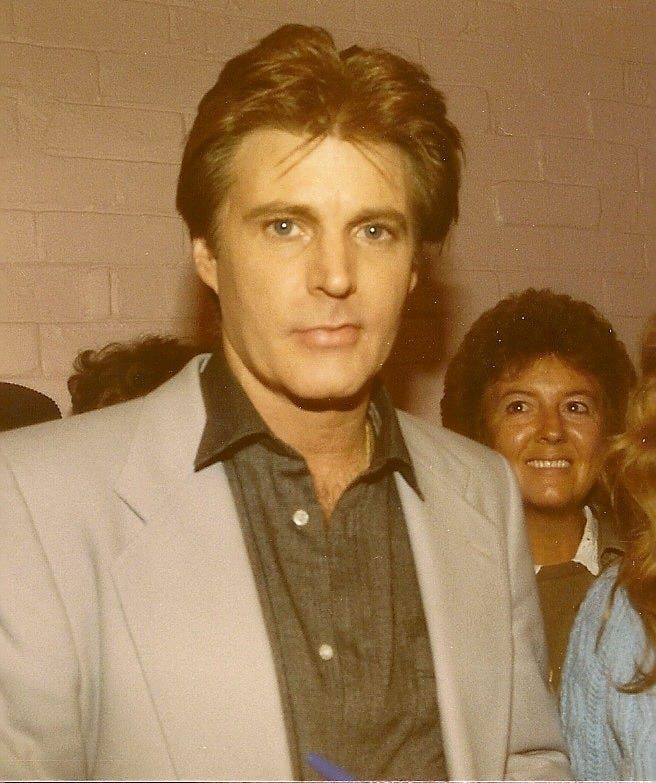
In acknowledgement of rock ‘n’ roll musician Rick Nelson’s octogenarian footing if a malfunctioning cabin heater had not caused his antiquated DC-3 airplane to descend in flames on New Year’s Eve 1985, Joel Selvin permits his first interview about the Rock and Roll Hall of Famer in over two decades. Condemned among Nelson’s family and devotees for making his dirty laundry public in Ricky Nelson: Idol for a Generation, perhaps the sting is not so potent 30 years later. America’s boy next door on the iconic Adventures of Ozzie and Harriet sitcom was a flawed human being after all. Idol for a Generation preceded Philip Bashe’s rival, more empathetic biography by two years and stands as the longtime San Francisco Chronicle pop music reviewer’s first of soon-to-be 20 tomes.
“I always liked Rick’s records and consider them to be California rockabilly,” attests Selvin. “I resonated with his desire to break away from the teen pop idol yoke and record — and eventually compose — music that mattered to him. If it didn’t sell, so be it. I could see an elemental challenge, a struggle, that was inherently built into Rick’s life and career. When he died in such dramatic, tragic circumstances, immediately my journalist brain went, ‘Oh man, what a great biography.’”
Recognizing that his memories of the “Garden Party” composer might be a little rusty, the San Francisco State University faculty member nevertheless summons an eight-year span observing Nelson on the road at Del Webb’s Sahara Tahoe, San Franscisco’s Old Waldorf, and co-headlining with Fats “I’m Walkin’” Domino. Selvin also lends weight to Nelson’s introverted stage persona, the awful Ricky Nelson: Original Teen Idol VH1 TV movie adapted from his book, and Hollywood Eden [how rock ’n’ roll accelerated in L.A. in the late ’50s]. Brace yourself for Selvin’s uncompromising account.
The Joel Selvin / Rick Nelson Interview
Before we plunge into Ricky Nelson: Idol for a Generation, how are you handling the COV-19 epidemic?
Everything’s fine. I do this all the time anyway — stay indoors [laughs]. I live in my office here in San Francisco. Rust in Peace: The Inside Story of the Megadeth Masterpiece, an as-told-to book that I did in collaboration with Dave Mustaine, came out in September 2020 via Hachette. He is a heavy metal guitar player best known as the frontman for Megadeth.
In mid-March I finished Hollywood Eden: Rock ’n’ Roll and the Myth of the California Dream and tossed it at the publisher [House of Anansi Press]. I worked on it for quite awhile. It takes place in Los Angeles in the late ’50s and early ’60s and explores how rock ’n’ roll came to the City of Angels through the lens of the Beach Boys [i.e. Brian Wilson], Jan & Dean, the Byrds, Nancy Sinatra, the Mamas & the Papas [i.e. John Phillips], and more.
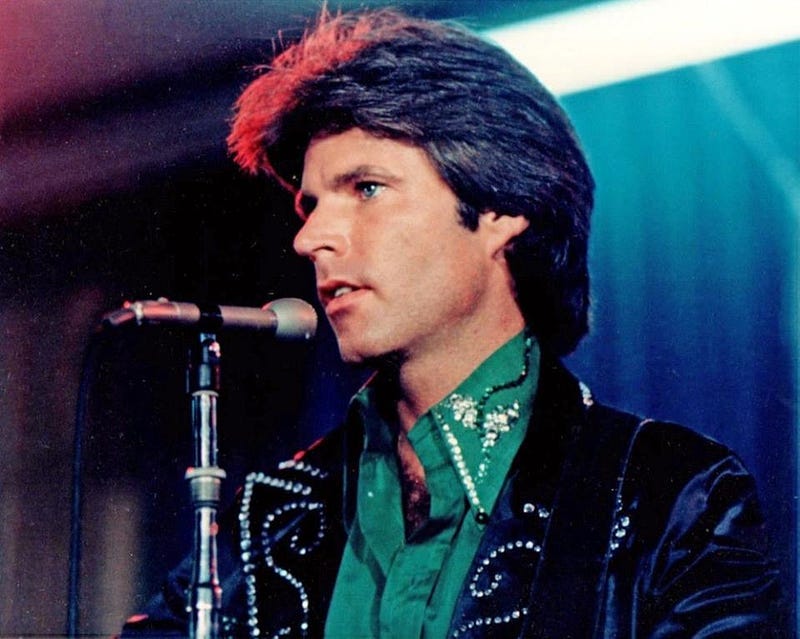
Did you catch Rick onstage?
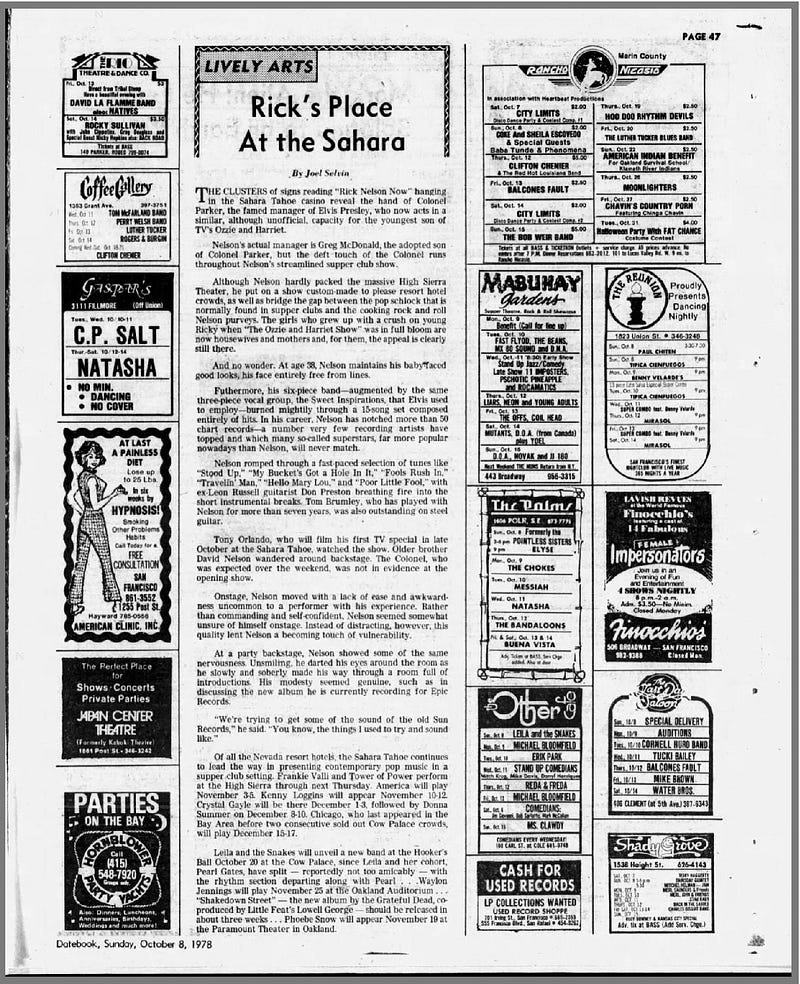
I saw Rick a number of times. I met him backstage at Del Webb’s Sahara Tahoe. Jim Parsons was the head of publicity, so I was always welcome [Nelson’s debut engagement at the High Sierra Theater occurred between March 4 and 6, 1977. He returned on October 28 for a weekend and completed a third and final residency from September 29-October 5, 1978. Selvin’s concert review, dubbed “Rick’s Place at the Sahara,” premiered in the October 8, 1978, edition of the San Francisco Examiner which pinpoints his Nelson encounter].
Greg McDonald, a protégé of Colonel Tom Parker, was Rick’s manager during the last nine years of his client’s life. As a teenager McDonald went into the Colonel’s Palm Springs house to repair an air conditioner and came out in show business. They were trying to build Rick up as a substitute Elvis in Tahoe [Presley hosted five engagements in the High Sierra between July 1971 and May 1976]. Elvis was a big attraction in Tahoe — the ski crowd loved Elvis. The Colonel always did major huckstering. There would be billboards all over the lobby and casino saying, “Elvis Now!” You’d go to Tahoe to see Rick, and the whole place was covered with “Rick Nelson Now!” posters. You’d go, ‘Ah, the Colonel’s men have been at work here.’ The Colonel’s touch was obvious. Even the Sweet Inspirations sang.
[Seven weeks after Presley’s demise, his African American backing vocalists for the previous eight years returned to live performances, joining Nelson’s show between October 3 and 5, 1977, at the Ark-La-Miss Fair in Monroe, Louisiana. Future Oscar-nominated Ray director Taylor Hackford helmed a documentary of the proceedings. As late as April 21, 1979, Myrna Smith, Sylvia Shemwell, and Estelle Brown were still on the road with Nelson at the Broadway Theater in Pittman, Pennsylvania. In spite of Brown being replaced by Gloria Brown, the soul-stirring trio graduated to arenas and bigger paychecks when the Bee Gees selected them to open on their $10 million-grossing North American Spirits Having Flown Tour that commenced on June 28, 1979, in Fort Worth, Texas].
I went backstage to a very nice hospitality area set up for entertainers, basically a greenroom with a little bar. Guests would wait there for the artist to get finished in their dressing room. I spotted David Nelson sitting at the bar. I walked up, introduced myself, and started hangin’ out with David. He was in a particularly interesting frame of mind. I’d come to know him much better a decade later when I was researching Idol for a Generation. When I asked him what he was doing, he divulged that he was a professional has-been. Like, ‘Eat lunch with David Nelson. Look at this real estate development.’ Swear to God, that’s what he said. So we were hanging out backstage at the bar bullsh**in’. No more than a dozen people were in the room. It wasn’t really crowded and was very secure and private.
Rick walked in from his dressing room, and David waved him over. “Man, you gotta meet this guy. He’s a big fan.” Rick came over, and he couldn’t keep his jaw still. His eyes were unfocused and going, dart, dart, dart, dart. He was checking out everybody, like an antenna constantly sweeping the room. Rick was not too engaged in our brief conversation. Those were tell-tale signs that he had had some blow [cocaine] that had been laced with some potent s**t. Drugs were part of the scene, and on another night it could have been me whacked out of my brain.
I went to see Rick at the Old Waldorf [Nelson notched two shows at the San Francisco club on March 6 and October 30, 1981]. That was really goofy. Rick was way out on drugs and could barely make it happen that night.
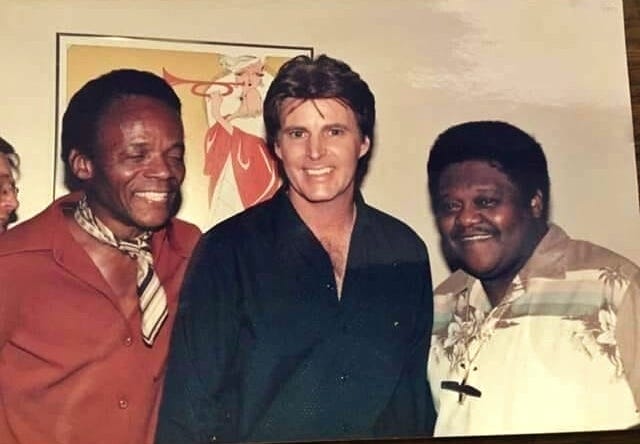
Just a few months before Rick’s death I caught him with Fats Domino [August 18, 1985, at the Concord Pavilion in Selvin’s San Francisco base is the most plausible date. Four days later Nelson and Domino commandeered the Universal Amphitheatre in Los Angeles, incidentally filmed for a syndicated 60-minute TV special. Nelson was the contractual headliner but graciously agreed to let the “Blueberry Hill” icon close each show of the three-week West Coast trek].
I went with my late friend Steve Douglas, who was the saxophone player in the Wrecking Crew. Fats’ band had five saxophone players, and every time one took a solo, Steve sorted through his life and wondered if he should retire. I’ll never forget Fats’ band. Wow! Fats’ primary songwriting partner and bandleader Dave Bartholomew was on trumpet, and Herb Hardesty and Lee Allen were in the saxophone section. It must have been a good period when Dave and Fats were getting along.
Rick was cool and rocked the place. Fats brought him back to duet on “I’m Walkin’” [Nelson’s pop cover served as his second hit, peaking at No. 17 in 1957]. Rick was obviously thrilled to be singing with the Fat Man and earning his appreciation. Fats was a force of nature, and Rick was a shy Hollywood High School kid. It was a mismatch in some respects but nevertheless a fantastic evening.
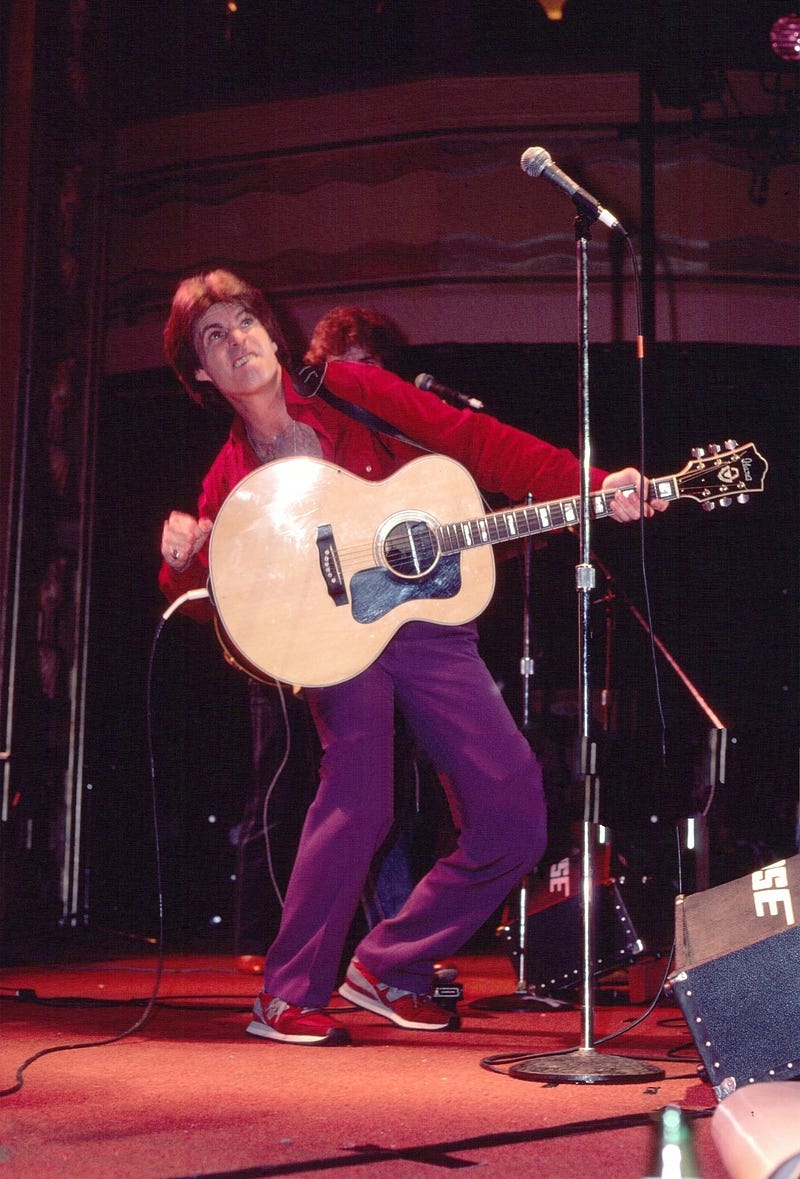
What about Rick’s introverted stage persona? Did it evolve by the end of his life?
The shows I saw over an approximately eight-year period were not markedly different, but by the time I attended Rick’s 1985 concert he had fully immersed himself in rockabilly and was at peace with his legacy. Rick was perpetually handsome, yet he could barely look an audience in the face. He could barely say more than thank you. He never, ever looked comfortable onstage. He always looked like he could hardly wait to get off. A deer-in-the-headlights predicament. Linda Ronstadt and Van Morrison have exhibited similar stage issues.
You wonder why Rick played so many gigs, but it was his decision [maintaining a certain lifestyle and supporting ex-wife Kris Harmon and four kids kept him shackled to the road]. He wasn’t a failed TV actor. He wasn’t his father Ozzie’s costar. Rick was a rock ’n’ roll musician. He accepted horrible gigs when that was his only option. In the public’s mind there was no difference between Rick, Bobby Rydell, Fabian, and Frankie Avalon. He was just a teen idol whose day had long gone. Very few people had figured out that there was something vital about Rick Nelson’s trip. Some did, especially in L.A. when the rockabilly renaissance occurred with James Intveld and the Blasters [younger brother Ricky Intveld was poached by Nelson to join his band on drums, debuting at the November 12, 1983, Richard Nader-sponsored recreation of Nelson’s career-rejuvenating Madison Square Garden show that precipitated “Garden Party”]. Rick’s audiences were largely married women that had been glued to their black and white TV sets as 14 or 15-year-old teenagers to see Rick sing his latest hit on Ozzie and Harriet.
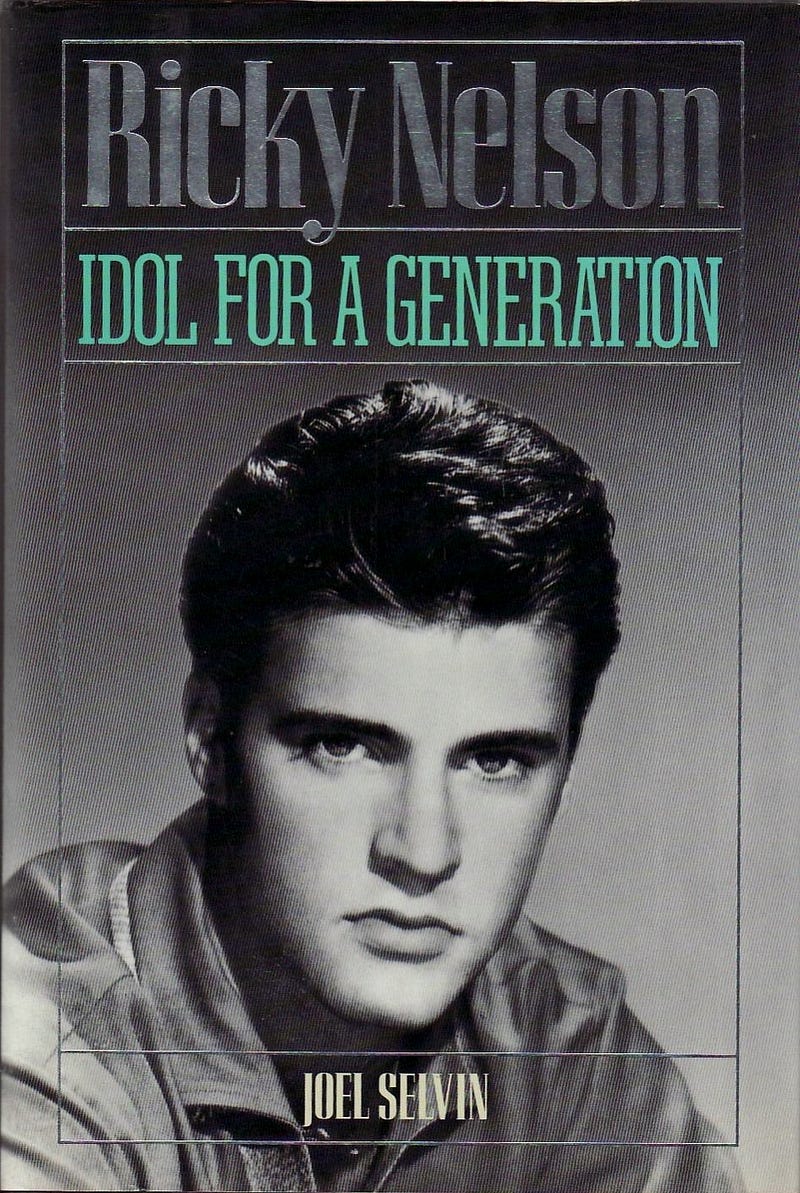
What prompted you to pen Idol for a Generation in 1990?
I’ll never forget Rick’s early days on The Adventures of Ozzie and Harriet and when he became a big star on Imperial. I always liked his records and consider them to be California rockabilly. I resonated with Rick’s desire to break away from the teen pop idol yoke and record — and eventually compose — music that mattered to him. If it didn’t sell, so be it. I could see an elemental challenge, a struggle, that was inherently built into Rick’s life and career. When he died in such dramatic, tragic circumstances on New Year’s Eve 1985, immediately my journalist brain went, ‘Oh man, what a great biography.’ Several years later I decided, ‘I’ve gotta act on my idea.’
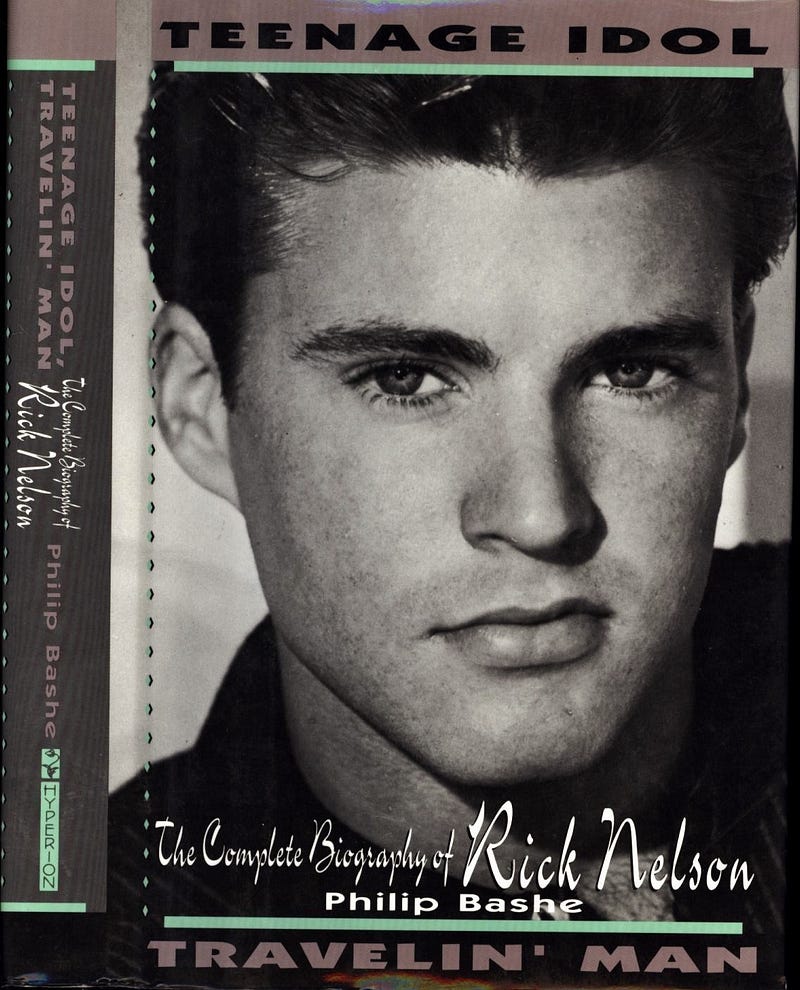
Were you aware that a rival biography was in the works?
There’s a ridiculous bunch of dance steps involved with finding an agent and landing a publishing deal. After signing with the Chicago-based Contemporary Books, I found out that McDonald and writer Philip Bashe had sold the authorized Teenage Idol, Travelin’ Man: The Complete Biography of Rick Nelson for big bucks to a major firm — Random House — unless my memory is failing me. Everywhere I went, Bashe’s reputation preceded me. “Didn’t I already talk to you?” and all that kind of stuff.
Bashe’s book was scheduled to be published the same day as my tome, which was Rick’s 50th birthday [May 8, 1990]. Publishers love that sort of s**t [Three years earlier Nelson was among the sophomore alumni of the Rock and Roll Hall of Fame. His twin sons Gunnar and Matthew dropped the No. 1 A-side “[Can’t Live Without Your] Love and Affection” and the Top Ten follow-up “After the Rain” in 1990, and eldest child Tracy Nelson was costarring in Father Dowling Mysteries. It was the perfect summer to target fans with a thorough Nelson chronicle]. I assumed I was gonna be the also-ran or the B-boy on the small label. Sometime before my book was published, we heard that Random House had rejected the Bashe manuscript as a whitewash. Two years later Bashe wound up on Hyperion [now Hachette Books], Disney’s attempt to establish a publishing house.
They were searching for celebrity manuscripts and paying big bucks, too. A friend of mine named Dave Marsh [a frequent Rolling Stone contributor] got a deal for ‘Louie Louie:’ The History and Mythology of the World’s Most Famous Rock ’N’ Roll Song [1993]. Because Hyperion was a new publishing company and Disney was behind them, they were paying twice what everybody else was paying. McDonald and Bashe did okay on the advance. I don’t know how much they had to rewrite the book because it’s not exactly a puff piece. But it was apparently too much of a hagiography when it originally landed at Random House. McDonald did talk to me — off-the-record and at the last minute — to do some damage control.
How well did Idol for a Generation do?
It received a ton of coverage and sold — I think the technical term is — a s**tload of books. If Bashe’s project had come out simultaneously with mine, I’m not sure what the outcome would have been. And what if I had been signed to a big publisher in New York? The guys from Contemporary Books were brand new and trying to establish themselves. They bought a biography of Arnold Schwarzenegger for 10 times what they paid me. They guaranteed Wendy Leigh that it was gonna be a New York Times Best Seller. Funnily enough, I outsold Arnold, An Unauthorized Biography by a substantial amount. Not only did they not get on the NY Times Best Seller List but this other little book that they bought about Rick Nelson was their big seller that quarter. Turns out my idea to commit to paper Rick’s life story was terrific.
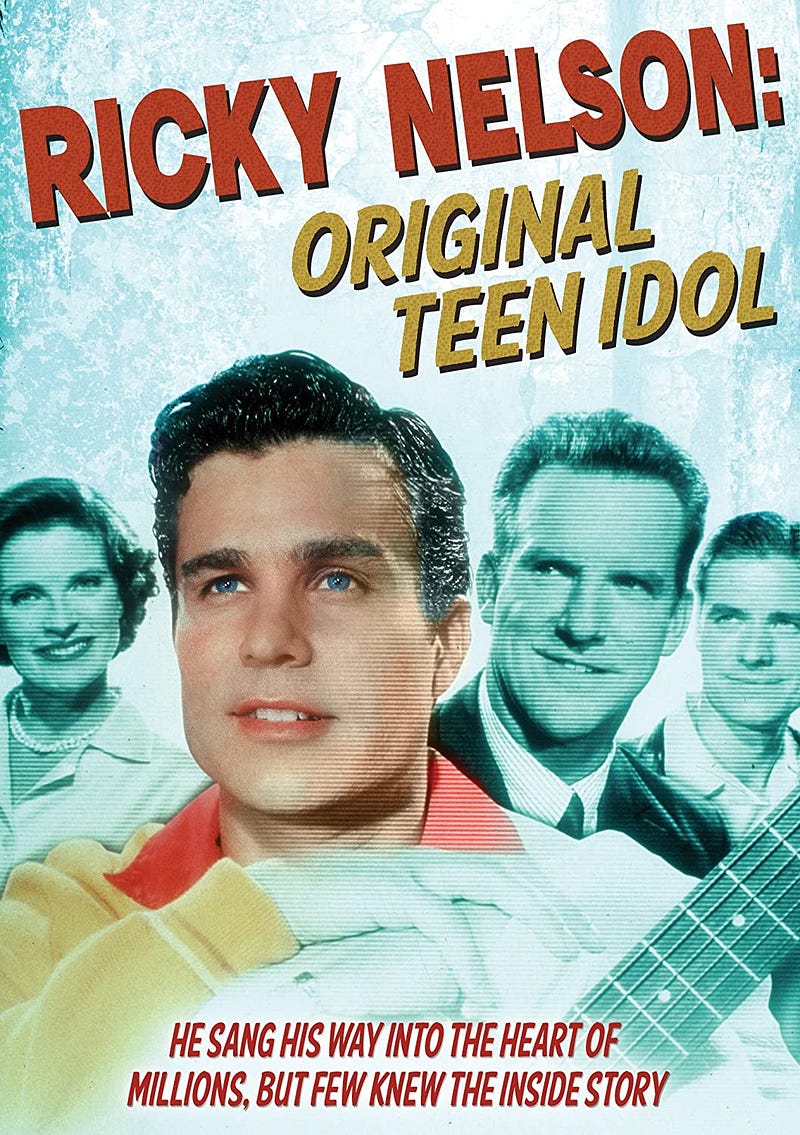
Unavailable in any streaming format, the 1999 VH1 TV movie Ricky Nelson: Original Teen Idol was adapted from your tome and is so far the only celluloid depiction of Rick.
That’s pretty hilarious in itself. They paid me enough money to make that TV movie that my ex-wife Keta Bill actually thought it was good. As far as it not being available online, yippie-ki-yo-ki-yay. The guy called me and told me that he wanted to make the deal [Michael Jaffe was the executive producer so it’s reasonable to assume that it was him]. He called me again and said he’d made the deal. He called me a third time and said he’d made the movie.
He told me he made six movies a year. Somebody in the movie business who thought this producer was a hot shot said, “Oh, he’s a scumbug.” I replied, “You gotta be kidding me. He did everything he said he was going to do, when he said he was going to do it, and the checks were all good. Don’t call him a scumbag — he’s an honorable movie producer” [laughs]. I never visited the set and was not consulted for the script.
Original Teen Idol was the second-ever VH1 movie. [Over the course of two consecutive Sunday evenings in August 1999] VH1 premiered Sweetwater: A True Rock Story [starring Amy Jo Johnson] about the first band to perform at Woodstock followed by Original Teen Idol. Sweetwater had a compelling story, but the Rick movie was horrible. They didn’t even bother to get somebody that resembled Rick to play the part [Gregory Calpakis]. They couldn’t license any of Rick’s songs because the family controlled the publishing. That’s what you get for a $2 million movie shot in Canada.
© Jeremy Roberts, 2020. All rights reserved. The Joel Selvin interview was condensed and edited for clarity. To touch base, email [email protected] and mention which story led you my way. I appreciate it sincerely.


