
Rabato / Robata
Not really a case of tomay-to, tomah-to
Today’s New York Times Spelling Bee letters:
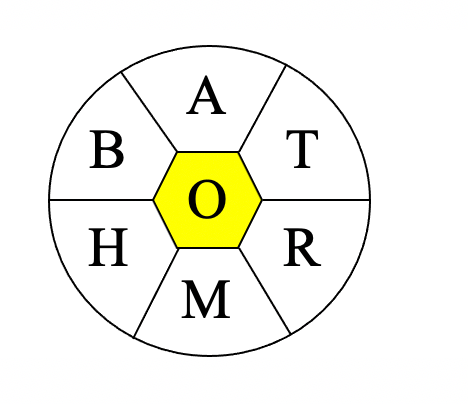
A, B, H, M, R, T, and center O (all words must include O)
Merriam-Webster says…
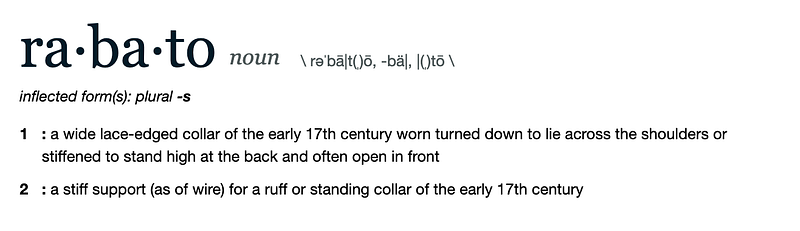
Silly little dictionary! Don’t you know that rabato can’t possibly be a word if the New York Times says it ain’t?
For further fascinating facts, check out the Spelling Bee Master.
What’s your favorite dord* from today’s puzzle?
My Two Cents
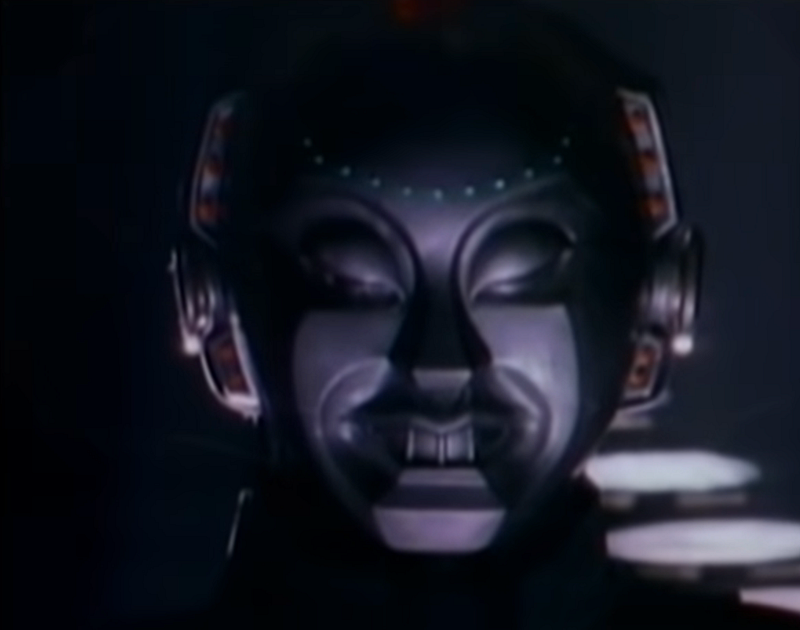
We have a trifecta of words today, although only two appear in the title. The third one is hinted at in the photo, although you could be forgiven for not “getting” the reference. It’s almost forty years old!
Vintage fashion
Rabato is a modification of the Middle French rabat, meaning “turndown collar”, itself from rabattre, “to turn back down”. Which is related to the term rebate that companies gave hoping you’d forget to mail in the coupon.
This wide collar often frilled with lace was designed to stand up at the back of the head. It was worn by both men and women in the 16th and early 17th centuries as an item of high fashion. Of course it was, coming from the French!
The rabato could be turned downwards, or “turned back”, and used as a base for a ruff, the crimped collar that you typically see in paintings of that era. This was more popular in the earlier 16th century and started disappearing in the first half of the 17th.
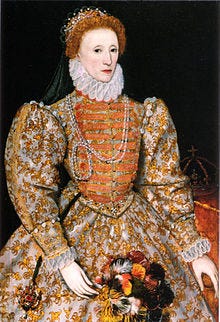
The above is the Darnley Portrait of Queen Elizabeth I, painted around 1575, showing her with a ruff.
In this one, below, we can see her with a rabato.

And I think this one is a rabato, too:

The rabato had some offshoots, like the smaller rabat collar and the rabatine collar, which was used as a short cape.
That’s about all I could find about this 400+-year-old article of clothing.
The lesser-known Japanese grill
Robata is short for robatayaki, a Japanese term meaning “fireside grilling”. Neither robatayaki nor its shortened form appears in Merriam-Webster or dictionary.com. So I can’t tease them about including a word that the New York times does not accept.
Robata originated in northern Japan, where fishermen would grill seafood over a communal charcoal hearth, called irori, which also served to keep them warm. Later the system was adapted into stone boxes so that the fishermen could safely cook food on their boats. Soon this became popular all over the country and restaurants started opening.
Even in restaurants the grill is sometimes set up in a central position around which the diners sit. This can be done as a sandpit hearth or level with the bar or table, as shown below.
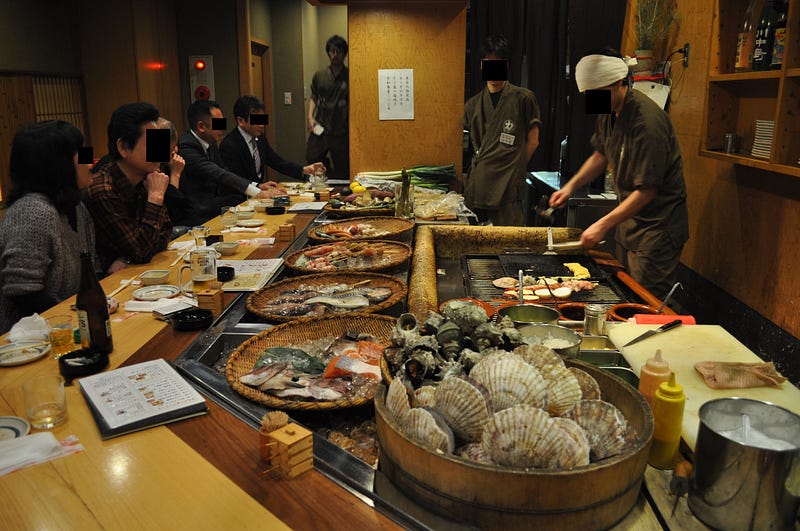
I do not recommend wearing blindfolds like the people in the photo are doing. Doing so while cooking or eating robata makes it much more challenging… and potentially dangerous.
If the second half of the word robatayaki sounds familiar, it’s because yaki is used in other terms related to Japanese cuisine. There is teriyaki, or “grilled shiny” (in reference to the glaze brushed on the food), kushiyaki —skewered meats that are grilled — , and teppanyaki, meaning “grilled on a metal plate”. The latter is also popularly known as hibachi grilling.
Kilroy was here
In February of 1983 the rock band Styx released their eleventh studio album, titled Kilroy Was Here. The name was a reference to the iconic World War II graffiti purportedly scribbled all over Europe, accompanied by this doodle:
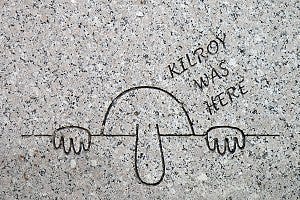
There are several disputed origin stories to this “meme before memes”, including one explaining how he may have been derived from the Australian expression “Foo was here” used in World War I.
Styx and other bands had been targeted by certain Christian religious groups for “backward masking” (secretly hiding satanic messages that could be heard when playing the vinyl record backward). This rock-opera-ish album was the band’s response to that.
In a short movie connected to the record’s live show, a demagogue named Dr. Righteous turns his own cable network into a potent political base. Hmmm… pretty spot-on critique of the future, considering this was done almost 40 years ago. Dr. Righteous eventually manages to ban rock in the United States.
The main character of the album is Robert Orin Charles Kilroy (R.O.C.K.). He is falsely accused of murder and imprisoned. In jail he meets an underground leader who helps him escape.
Four music videos were made for the album (MTV had launched not two years before — and actually played music back then). Because they were shot at the same time as the mini-film, they incorporated some footage from it. One of those music videos was for the song “Mr. Roboto”, which was also released as a single.
“Mr. Roboto” was not the most popular single from Kilroy Was Here, it became one of the band’s signature songs. According to some pop culture experts, it brought the phrases “domo arigato” and “domo arigato, Mr. Roboto” into the American vernacular. That’s because the song’s beginning lyrics are in Japanese,
どうもありがとうミスターロボット (Dōmo arigatō misutā robotto) また会う日まで (Mata au hi made) どうもありがとうミスターロボット (Dōmo arigatō misutā robotto) 秘密を知りたい (Himitsu o shiritai)
which translates to…
Thank you very much, Mr. Roboto. Until the day we meet again Thank you very much, Mr. Roboto, I want to know your secret.
I remember being fascinated by both the song and the video. I had heard of “arigato” before, but not “domo”. The video was hauntingly cryptic to me. Or cryptically haunting. Most likely because I didn’t get to hear the whole album or see that short movie the band made.
Understandably, Mr. Roboto — even without the “Mr.” — cannot be on the list of valid words for today’s Spelling Bee game. Strike one! And robata? Nope, not in the dictionary. Strike two! How about robata, which is in the dictionary? Strike three! We’re out! This trifecta paid zero dividends. Zilch. Nada. That’s because the editors of the New York Times decided that rabato and robata are dords.*
You can check out my previous entry on another dord* here:
*What the heck is a dord, you ask? Here’s the answer: