avatarPKR-Peasy

Free AI web copilot to create summaries, insights and extended knowledge, download it at here

1987

Abstract

ron is approximately 9.109×10⁻³¹ kg.</p><figure id="c111"><img src="https://cdn-images-1.readmedium.com/v2/resize:fit:800/1*Gln2PqSRHzXNV6Gshyxg5A.png"><figcaption></figcaption></figure><p id="6f50">Let’s compute these values to understand the scale of photon energy conversion necessary for creating an electron’s mass in both the visible and gamma spectrums.</p><p id="1e3d">The calculations yield the following results for the violet end of the visible spectrum (400 nm) and for a typical gamma-ray wavelength (1 pm):</p><h1 id="3663">Visible Spectrum (Violet Light, 400 nm):</h1><ul><li>Photon Energy: 4.97×10⁻¹⁹ Joules</li><li>Mass Equivalent of a Single Photon: 5.52×10−36 kg</li><li>Number of Photons Needed for an Electron: Approximately 164,967 photons</li></ul><h1 id="1435">Gamma Spectrum (1 pm):</h1><ul><li>Photon Energy: 1.99×10⁻¹³ Joules</li><li>Mass Equivalent of a Single Photon: 2.21×10⁻³⁰ kg</li><li>Number of Photons Needed for an Electron: Approximately 0.41 photons</li></ul><p id="bea2">These results illustrate the dramatic difference in energy density between the visible and gamma-ray spectrums. In the visible spectrum, specifically at the violet end, it takes roughly 165,000 photons to match the mass of an electron. This number showcases the substantial amount of light energy required when considering the relatively lower energy per photon in the visible range.</p><p id="29e5">Conversely, in the gamma-ray spectrum, the energy per photon is significantly higher due to the much shorter wavelength. The calculation suggests that less than one photon (in practical terms, this means a single gamma-ray photon can have more energy than necessary to match the rest mass energy of an electron, showcasing the immense energy carried by gamma-ray photons.</p><p id="91ff">These calculations not only highlight the incredible conversion scale of photon energy to mass but also provide insight into the processes that could have been instrumental in the early univ

Options

erse for the creation of matter from light. They bridge the quantum world of photon energy with the tangible reality of mass, illustrating the profound principles that govern the cosmos.</p><p id="2c55"><a href="https://readmedium.com/unveiling-the-photon-centric-cyclical-universe-a-journey-through-my-photon-band-waveform-model-96113697c541"><b>Part 1</b>: <b>Unveiling the Photon-Centric Cyclical Universe: A Journey Through My Photon Band Waveform Model</b></a></p><p id="3ef6"><a href="https://readmedium.com/diving-into-the-universes-light-spectrum-a-trip-beyond-what-we-can-see-d13282d38b60"><b>Part 2</b>: <b>Diving Into the Universe’s Light Spectrum: A Trip Beyond What We Can See</b></a></p><p id="149f"><a href="https://readmedium.com/quantum-illumination-exploring-photon-energy-conversion-to-mass-in-visible-and-gamma-ray-spectrums-35bf7a9aa893"><b>Part 3</b>: <b>Quantum Illumination: Exploring Photon Energy Conversion to Mass in Visible and Gamma-Ray Spectrums</b></a></p><p id="07c9"><a href="https://readmedium.com/unveiling-the-illusion-of-matter-866a575cf6fb"><b>Part 4:</b> <b>Unveiling the Illusion of Matter</b></a></p><p id="fdfa"><a href="https://readmedium.com/the-photon-band-waveform-model-a-revolutionary-framework-92e9e6b30644"><b>Part 5:</b> <b>The Photon Band Waveform Model: A Revolutionary Framework</b></a></p><p id="992e"><a href="https://readmedium.com/exploring-consciousness-the-light-within-980bebea21b0"><b>Part 6: Exploring Consciousness: The Light Within</b></a></p><p id="3666"><a href="https://readmedium.com/embracing-non-duality-through-the-photon-band-waveform-model-5deb95c1e1e6"><b>Part 7: Embracing Non-Duality through the Photon Band Waveform Model</b></a></p><p id="0626"><a href="https://readmedium.com/diving-deeper-into-quantum-consciousness-the-still-mind-as-a-universal-quantum-computer-e13d338a7886"><b>Part 8: Diving Deeper into Photonic Consciousness: The Still Mind as a Universal Quantum Computer</b></a></p></article></body>

Quantum Illumination: Exploring Photon Energy Conversion to Mass in Visible and Gamma-Ray Spectrums

To elucidate the process of matter creation from energy, particularly focusing on how many photons are needed to match the mass of an electron in the visible and gamma-ray spectrums, we incorporate specific calculation steps and necessary equations. This approach will illuminate the quantum-to-classical transition and provide a clearer understanding of the energy-mass interplay in these spectrums. Here is a detailed explanation including these aspects:

Step 1: Determine Photon Energy

First, we use Planck’s equation to calculate the energy of a photon in both the visible spectrum and the gamma-ray spectrum.

E=hν=hcλ​

  • EE is the energy of the photon.
  • h is Planck’s constant (6.62607015×10⁻³⁴ J s).
  • c is the speed of light (3.00×10⁸ m/s).
  • λ is the wavelength of the light (in meters).
  • ν is the frequency of the light (in hertz).

For the visible spectrum, we consider the wavelengths ranging from violet (approximately 400 nm) to red light (approximately 700 nm). For gamma rays, we consider a much shorter wavelength, typically less than 1 picometer (pm) or 1×10−121×10−12 meters, to represent high-energy photons.

Step 2: Calculate Mass Equivalent of Photon Energy

Next, we apply Einstein’s mass-energy equivalence principle to convert the photon energy into its mass equivalent.

m=Ec2​

Step 3: Calculate Number of Photons for an Electron

To find the number of photons required to match the mass of an electron, we divide the mass of an electron by the mass equivalent of a single photon in each spectrum.

Number of photons=Mass of an electronMass equivalent of a single photon

The mass of an electron is approximately 9.109×10⁻³¹ kg.
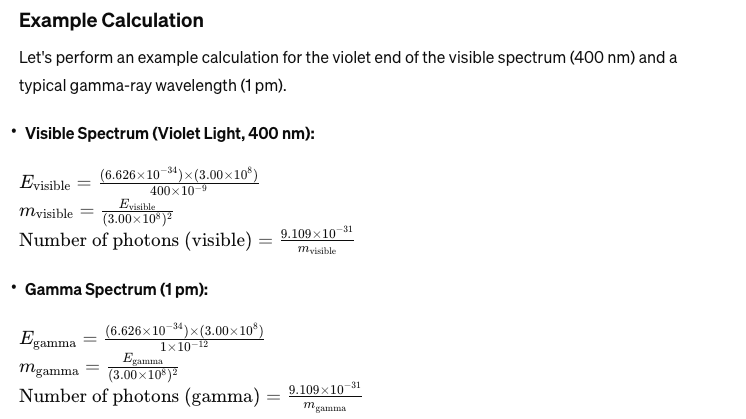
Let’s compute these values to understand the scale of photon energy conversion necessary for creating an electron’s mass in both the visible and gamma spectrums.

The calculations yield the following results for the violet end of the visible spectrum (400 nm) and for a typical gamma-ray wavelength (1 pm):

Visible Spectrum (Violet Light, 400 nm):

  • Photon Energy: 4.97×10⁻¹⁹ Joules
  • Mass Equivalent of a Single Photon: 5.52×10−36 kg
  • Number of Photons Needed for an Electron: Approximately 164,967 photons

Gamma Spectrum (1 pm):

  • Photon Energy: 1.99×10⁻¹³ Joules
  • Mass Equivalent of a Single Photon: 2.21×10⁻³⁰ kg
  • Number of Photons Needed for an Electron: Approximately 0.41 photons

These results illustrate the dramatic difference in energy density between the visible and gamma-ray spectrums. In the visible spectrum, specifically at the violet end, it takes roughly 165,000 photons to match the mass of an electron. This number showcases the substantial amount of light energy required when considering the relatively lower energy per photon in the visible range.

Conversely, in the gamma-ray spectrum, the energy per photon is significantly higher due to the much shorter wavelength. The calculation suggests that less than one photon (in practical terms, this means a single gamma-ray photon can have more energy than necessary to match the rest mass energy of an electron, showcasing the immense energy carried by gamma-ray photons.

These calculations not only highlight the incredible conversion scale of photon energy to mass but also provide insight into the processes that could have been instrumental in the early universe for the creation of matter from light. They bridge the quantum world of photon energy with the tangible reality of mass, illustrating the profound principles that govern the cosmos.

Part 1: Unveiling the Photon-Centric Cyclical Universe: A Journey Through My Photon Band Waveform Model

Part 2: Diving Into the Universe’s Light Spectrum: A Trip Beyond What We Can See

Part 3: Quantum Illumination: Exploring Photon Energy Conversion to Mass in Visible and Gamma-Ray Spectrums

Part 4: Unveiling the Illusion of Matter

Part 5: The Photon Band Waveform Model: A Revolutionary Framework

Part 6: Exploring Consciousness: The Light Within

Part 7: Embracing Non-Duality through the Photon Band Waveform Model

Part 8: Diving Deeper into Photonic Consciousness: The Still Mind as a Universal Quantum Computer

Physics
Cosmos
Cosmology
Science
Universe
Recommended from ReadMedium