
QAnon Fights Imaginary Cabals
Explained in Will Sommer’s ‘Trust the Plan’
Back when Obama took office in 2008, internet users were posting conspiracy theories about all sorts of things, but, as investigative reporter Will Sommer observes, QAnon has become the only U.S. conspiracy theory that currently galvanizes believers to take to the streets.
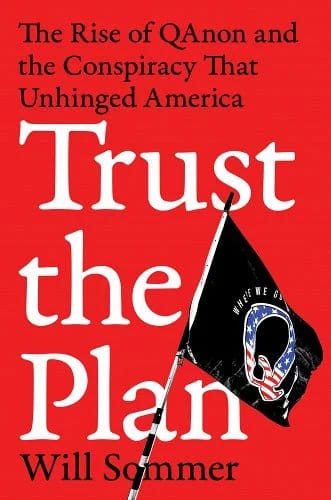
His book Trust the Plan: The Rise of QAnon and the Conspiracy That Unhinged America came out in February 2023. He traces the history of the movement.
QAnon’s Core Beliefs
According to QAnon, this has long been the situation, since at least 2016:
Movie stars, Democratic politicians, and international bankers torture children with Satanic rituals in underground tunnels, chasing a hit of adrenochrome.
Allegedly, pain causes the children’s blood to produce adrenochrome (yes, as in Doctor Sleep), which the kidnappers drink to maintain eternal youth (yes, as in The Dark Crystal). Yes, this is the antisemitic blood libel.
(Sommer notes that anyone, in reality, can make adrenochrome, which is oxidized adrenaline, by opening an EpiPen and exposing the adrenaline to the air. No one does this because adrenochrome doesn’t make you immortal.)
Allegedly, this evil vampire cabal is also hiding cures for disease and is the source of all war. The U.S. military knew about all this and hoped to receive orders to fight it.
QAnon itself appeared in 2017, centering Donald Trump as a hero. Supposedly, the military asked him to run for president. Under Trump’s “god-emperor” presidency, the military blew up some pedophile lairs. (Those vibrations were what most people assumed to be earthquakes.) Supposedly, covid gave Trump a pretext to launch more military assistance for healthcare; the military took this opportunity to treat the rescued kids. Soon, Trump will vanquish his political enemies (by execution or prison) in an event called “The Storm.” When this happens, all disease will be cured, all war will end, and all debt will be forgiven.
Obviously, this is nonsense.
…obviously, right?
Neither the Rothschilds nor I are using space lasers to ignite wildfires.
Unfortunately, a staggering number of people find this plausible. In September 2020, an online poll asking simply “Are you a supporter of QAnon?” was affirmed by 7 percent of respondents. That poll is still ongoing; the number is currently at 3 percent, which is still a lot of people. And when the question is phrased differently — as whether someone shares the same beliefs that QAnon holds — those numbers are much higher. As of March 2021, 15 percent of USAmericans believe there are “Satan-worshipping pedophiles” and 20 percent believe that the Storm is coming to “restore the rightful leaders.” White evangelical Christians are even more likely to agree with QAnon beliefs.
How Facebook Set the Stage (2015)
Social media was “setting the stage for a superconspiracy like QAnon to take them all over,” Sommer writes.
Renée DiResta, a researcher of disinformation, tried joining a conspiracy theory group on Facebook and discovered that the platform began showing her random conspiracy theories. Once she clicked on one false narrative, the platform tried to send her down the rabbit hole of all the falsehoods.
Pizzagate Beginnings (2016)
In October 2016, Sommer took note of the outlandish (and inexplicably popular) conspiracy theory of Pizzagate.
This conspiracy theory followed the leak of the Podesta emails by WikiLeaks. Pizzagate held that, when top figures in Hillary Clinton’s presidential campaign ordered a pizza at a popular Washington, D.C. restaurant, “they were actually ordering a child to sexually abuse at the restaurant.” The coherence of the narrative hinged (at least in part) on the restaurant actually having a basement, which it did not. That December, a true believer shot up the restaurant with an AR-15, seeking to bravely liberate nonexistent children from the nonexistent basement.
Some Pizzagate believers also believed in adrenochrome. That’s what they were worried about.
But that wasn’t QAnon quite yet.
QAnon Begins (2017)
QAnon started when an anonymous person called “Q” appeared on the 4chan message board in October 2017, toward the end of Donald Trump’s first year in office. Q claimed that Hillary Clinton would be arrested that month. Obviously, this was a failed prediction. But as we know from history, whether a cult grows doesn’t always seem to hinge on whether the leaders’ predictions prove true. “Those 4chan threads,” Sommer says, “were an early sign that Pizzagate had never stopped.”
A month later, Q moved to 8chan, where “users behaved even worse.”
Q-related talk is gamified. First of all, Q’s “gibberish” messages prompt followers to share clues, develop “an entire language around the clues,” and stay up late searching for hidden meaning. Further, Q’s identity remains unknown—in fact, there is “a thriving parallel conspiracy theory community devoted to finding Q.”
QAnon Develops (2018–2019)
While initially pretending not to know what QAnon was, Trump retweeted QAnon supporters hundreds of times. Alex Jones of InfoWars was an early booster of QAnon. So was a blogger called Neon Revolt.
By the spring of 2018, QAnon was frequently tweeted about by right-wing accounts, and “QAnon believers started showing up at Trump rallies.” QAnon believers marched on Washington that April, chanting “Where we go one, we go all.” They were protesting the Mueller special counsel investigation into the possibility that Trump had encouraged Russian election interference for his benefit. Sommer thought this protest would be the most that QAnon had to give, “but a few months later, a crazed QAnon believer driving an armored truck blocked a bridge near the Hoover Dam,” and “QAnon supporters even started running for Congress.”
The Mueller investigation wrapped up in early 2019. In May 2019, QAnon was still breathing, as believers seized on an innocuous comment by the former FBI director and decided he was plotting violence against a school.
Then in August, following a mass shooting, Cloudflare took 8chan offline, and this—incidentally—made QAnon homeless. Was it over?
QAnon During Covid
Covid came to the United States, and conspiracy theories blazed. QAnon acted to undermine public trust in the agencies that stepped up to the crisis.
In March 2020, Austin Steinbart made a video in which he claimed to be Q. He soon achieved “the most visible devotion of any QAnon promoter yet” and accepted significant money from his followers (who would later dissipate while he was briefly jailed).
In June 2020, a QAnon follower stirred up suspicion about overpriced furniture at Wayfair that labeled the types of furniture with girls’ names, deciding that Wayfair was offering the opportunity “to buy those exact children.” One of the girls whom QAnon claimed was missing was then 19 years old, not actually missing, and spending time “insisting to strangers online that she wasn’t trapped in a cabinet.”
In July 2020, Michael Flynn showed himself taking the QAnon oath. Additionally, Trump, in a meeting with the Senate majority leader, referred to QAnon supporters as “people who want good government.” And in August 2020, regarding QAnon, he told a reporter that “I understand they like me very much, which I appreciate.”
In October 2020, Facebook deleted over “5,600 groups and 50,000 Facebook profiles” that were QAnon-affiliated. They’d let that go on too long.
January 6, 2021 Attack on the Capitol
On the day Biden’s victory was to be certified, Sommer was outside the Capitol as a reporter, speaking to QAnon supporters who made themselves highly visible among the rioters. Notable QAnon rioters that day included Ashli Babbitt and Jacob Chansley, aka the “Q Shaman.”
Have You Heard?
I digress from the book for a moment:
At a September 2022 Republican rally, the QAnon song was played. Except it shouldn’t be a QAnon song. It was stolen.
For Trump’s entrance music, organizers played “Mirrors,” a royalty-free track by Will Van De Crommert. Contacted by reporters, the composer clarified: “I do not support Donald Trump, and I do not support or espouse the beliefs of QAnon.”
Van De Crommert further complained that his track was “unlawfully retitled, repackaged, and redistributed to streaming platforms by Richard Feelgood” under the title “wwg1wga” (the QAnon slogan). That is why, when “Mirrors” was played at the rally, attendees recognized it as “wwg1wga” and raised their fingers in the one-finger QAnon salute.
Why People Are Drawn to QAnon
QAnon is a “violent fantasy,” and like any conspiracy theory, Sommer says, it seems to “explain a chaotic world” and give a “shared understanding” of what has to happen, which lets them form community around their beliefs. QAnon picks up where the 1980s Satanic Panic left off. Followers excuse themselves from thinking about policies that seem relatively less important, things that will just “have to wait” until the vampires are vanquished.
Previously, I wrote: “Why People Believe in Conspiracy Theories”
How They Leave QAnon
You can’t make them do it. They have to do it for themselves and for their own reasons. Sommer says this.
If they’re into QAnon, they’re not in a fact-motivated phase. Showing them facts won’t make them care about facts. When they decide that facts matter, they’ll quit.
It also helps if they feel that non-QAnon people still care about them and that they have a place to return to in that community.
Previously, I wrote: “Why Bother to Debunk What’s Obviously False?”
It Reminds Me of the Problem of Guns
Though Sommer doesn’t make the argument in quite this way, I find his book helps to explain why it’s so difficult to restrict guns in the US.
The reason is this: QAnon is a mythic narrative within the current iteration of a national philosophy that has long centered guns. This narrative stokes political violence with the false claim that someone has already initiated a particular act of violence that must now be responded to. As Sommer does say, QAnon understands that a violent coup would be “justified on the grounds that Democrats and other liberals are child-eating pedophiles.” If someone believes that this kind of coordinated violence against children is happening literally underground with government approval, they’re likely to believe that violence is justified. Their gun (or their right to have one) means something specific to them.
It Reminds Me of the Problem of Transphobia Too
And although Sommer doesn’t mention transphobia, I find that his book helps to explain that too. Republicans and white evangelical Christians are demographics that are likely to embrace Q beliefs and also to be transphobic. There’s overlap. If you go on those forums where you’re most likely to encounter QAnon, you’ll also see the most antisemitic, most transphobic words.
“Q believers,” he says, imagine themselves “in a fantasy world where children are shipped in Wayfair cabinets and eaten in pizzeria dungeons.” Yes, and transphobia is a similar level of nonsense. Supposedly, trans people are stuck in fantasy-land, doing the shipping/eating and also being shipped/eaten, for no one is really trans but anyone can be transed, and allegedly this is how we reproduce, in a Wayfair cabinet, using pizza code words to call to each other. It is very, very hard to respond to this level of willful misunderstanding and blood libel. We’re living through a pandemic of lies.


