
In ‘Dark Crystal’, Are the Podlings Made Into Eunuchs?
When the Skeksis drain the Podlings of their “vital essence,” are they castrating them?
In Jim Henson’s 1982 film The Dark Crystal, the evil rulers, the Skeksis, capture and enslave the much smaller, gentle Podlings. The Skeksis drain the Podlings of something called “vital essence.” Does this represent castration?
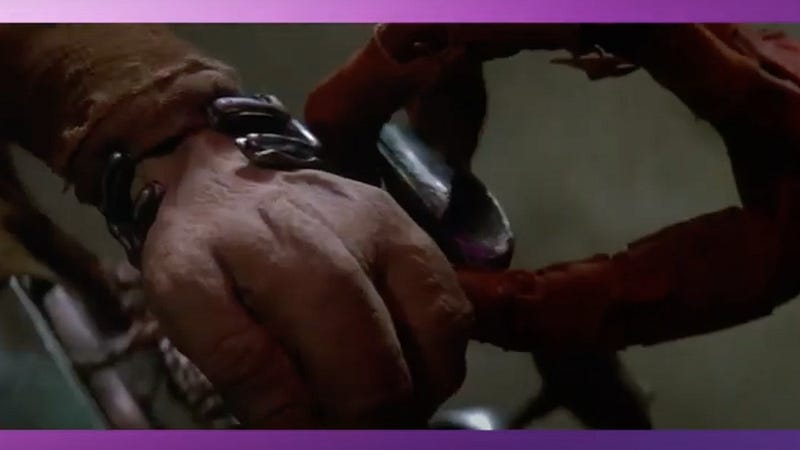
The Skeksis Drain the Podlings of Their ‘Vital Essence’
According to the film’s backstory, once upon a time, the Skeksis developed the custom of capturing members of a human-like race called Gelflings and draining them of their “vital essence,” which the Skeksis drank as a tonic to regain their youth and beauty. After the genocide, the Gelflings became nearly extinct. Only two survive.
The Skeksis still demand vital essence, but now they must acquire it from Podlings, a separate race or species whose vital essence the Skeksis consider to be an inferior product.
In this scene from the film, the scientist Skeksi pulls a Podling from a cage. The terrorized Podling whines incoherently. The Skeksi says: “You’re next, little Podling! This won’t hurt. We just want to drain your living essence. Then you can be the same as the other Podlings here, a slave.” The Skeksi buckles the Podling into a chair, splaying the Podling’s four limbs outward and restraining them. The Podling is forced to gaze into the crystal. The Skeksi gloats diabolically: “The beam will rid you of your fears… your thoughts… your vital essence.” The Podling’s eyes glaze over. The Podling’s flesh withers. The Podling’s vital essence flows from its veins into a vial. “You’re very lucky, slave! Only the Emperor can drink your essence!”
The vial is given to the Emperor, who immediately drinks it. “It will make you young again, sire!” the scientist Skeksi promises. The Emperor’s face immediately rejuvenates, but the tonic has the opposite effect on his hand. The scientist Skeksi blames the Podling essence as inferior: “Better when we used Gelflings.”
The zombified Podling will now join the rest of its kind, chained and whipped, doing whatever manual work the Skeksis require of it.
But What is ‘Vital Essence’?
My theory, here, is that it represents sex hormones. Testosterone would make the most sense, since it is the Emperor of the Skeksis who wants to drink it, although the Skeksis also attempt to extract the essence of the last surviving female Gelfling, Kira.
These are fictional creatures with fictional “essence,” so one can’t analyze the sexes too precisely. But I think the “vital essence” does, loosely, represent hormones. Long before hormones were discovered and understood, people often developed the superstition (or at least held out the hope) that if they ate part of another person or animal they could regain their youth and sexual potency.
In the film, the Skeksis seem to be masculine characters. Their dying leader is called “the Emperor,” and some Skeksis have deep or raspy voices. The simpering court chamberlain has a higher voice, but a chamberlain is, of course, a role that has often been traditionally filled by castrated men.
Nick van der Waard wrote in 2019:
At first glance, the Skeksis appear to be an all-male race, incapable of sexual reproduction. According to the official wiki, however, the 1982 novelization of The Dark Crystal by A.C.H. Smith describes the Skeksis as sexless, allowing them to express themselves however they want, gender-wise…It’s important to note how Smith’s emphasis of gender identity is never explored in The Dark Crystal [the film].
How Would Eunuch Podlings Fit Into ‘Dark Crystal’ Cosmology?
In the film’s backstory, a large purple Crystal cracked, and two new races appeared in the world: the wholly good, gentle, thoughtful Mystics, and the evil, violent, buffoonish Skeksis. Each individual of these races has a twin in the other race. If a Mystic’s hand is injured, the hand of the corresponding Skeksi will also suddenly begin to bleed, no matter how far away they are. If one twin sickens or is attacked, the other will similarly die. The binary here is about Good and Evil, not about gender, although some might interpret the nurturing Mystics as “feminine” and the hostile Skeksis as “masculine.”
The quest of the two surviving Gelflings — the only ones the Skeksis haven’t killed — is to scour the planet to find the small shard of the Crystal and plug into the broken place where it came from, thus healing the Crystal and restoring the world.
As long as the main Crystal has a hole — perhaps representing its own “castration,” though it is a rock — the Skeksis can leverage the Crystal’s power to drain Podlings and Gelflings of their vital essence. Presumably, when the Crystal’s brokenness is reversed, it will no longer have this deleterious effect.
Why Does It Matter?
The chemical castration of the Podlings turns them into zombies who are then unaware that they are enslaved, or who at least cannot outwardly object to their enslavement.
This fictional setup may appeal to a common real-world assumption that humans entirely lose their personalities when they are castrated. But this is not true. People’s hormone levels can change, and they are still people. Though their hormones may affect their emotions, their personalities and memories remain continuous, and they still feel pain and have preferences, just like everyone else.
This, in turn, is important because a belief in someone else’s lack of humanity — a belief that they have no “fears,” no “thoughts,” as the scientist Skeksi taunted the Podling during the torture—has often been used to rationalize their oppression and enslavement.
Where people have endorsed castration as a strategy to dehumanize someone else, claiming that castration actually somehow steals their soul or personality, they have also oppressed the people they castrate.
The Dark Crystal is a favorite movie of mine. I am not mad at the art. I am interested in what the art might help reveal to us about how we humans, collectively, have treated other humans throughout history.
I will be updating my book Painting Dragons: What Storytellers Need to Know About Writing Eunuch Villains. If you have an opinion on whether the enslaved, zombie Podlings in The Dark Crystal can be meaningfully interpreted as eunuchs, or if you have something to say about representations of eunuchs in film and literature more generally, please leave a comment!


