
Putting the Disco Back into Discourse
How my artwork blazes against the dying light!
The low slant of winter light coming through the western windows of my art studio, at just the right angle and at just the right time, sets my studio ablaze, turning it into a wonderland of iridescence and reflected light! Brighten your screen, turn up the volume, and watch the video above.
I have been a contemporary artist my entire adult life, starting as a performance artist in New York’s East Village in the early ’80s. I created some of the earliest gender-fuck performances at venues such as PS1 MoMA, The Kitchen, and St. Marks Church Danspace. By the ’90s, my work developed into a studio practice, though the performance DNA is still discernable. Below is today’s iteration of my ongoing written exploration of my formal, political, and conceptual ideas. For me, the dialogue between making and writing is essential to my progress and understanding.
The body of work I call DISCOurse is a non-medium-specific practice combining painting, drawing, collage, sculpture, and photographic digital imaging into larger works/installations. The work formally manipulates the glitz and glam aesthetic of early queer disco, reimagining its diverse site as a rehearsal for inclusion. In that era of the color-blind disco club, the veil of repression was lifted, if only for a few hours, to make otherness or queerness attractive and dazzling — even for the straight interloper. From Andy Warhol to movie stars, Drag Queens to S&M queens to Jersey teens with good haircuts, at the Disco you came home.
Before the eventual elitism of the velvet rope, or Disco’s arguable devolvement into sex, drugs, death, and exercise videos, the Disco was, for a time, a dreamland of marginal belonging. From this utopic perspective, 70’s Disco heralded progressive change by reveling in its flamboyant, radical aesthetic of shine.
With DISCOurse, I mean to celebrate and critique our pervasive shine obsession. I look soberly at the dangers of contemporary shine through a nostalgic filter of disco toward a re-queering and re-radicalizing of shine. This work elevates the imperfect, the perforated, the broken shine, to reveal the interstices of societies’ reflection, the spaces between our fragments, androgynous spaces filled with potential.
The site of DISCOurse, like cross-border economies, is where material goods, ideas, and definitions are hybridized and repurposed, are new and possible, where culture and the imagination anticipate a future diverse, optimistic, joyous and fun — it puts the disco back into critical discourse.
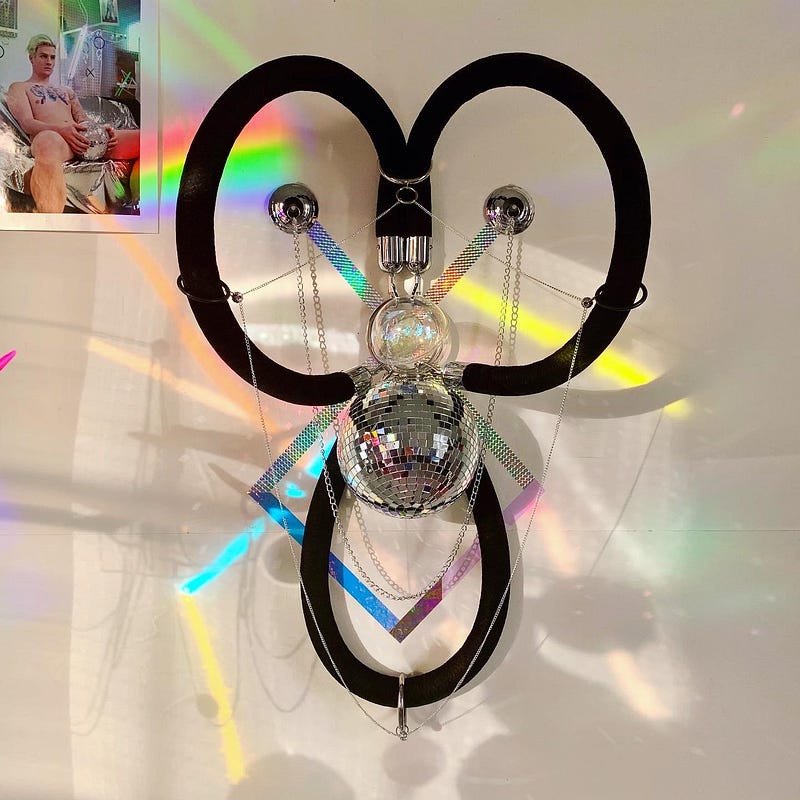
In a mirror queerness can hide. Not like skin color. What the regular ‘straight mirror’ reveals then is the surface of things, it reflects-confirms what we already know or think we know — the present. The spinning disco ball, or ‘queer mirror’, reflects what it sees in front, behind, up, down, even what we can’t see — dizzying, exotic, a pixelated globe. It makes of us a fractured, multiplicity of moving reflections in the round, scattered and recontoured onto chance surfaces. Here, even the straight reflection is made queer. It is in the spaces between our fragments, androgynous spaces, where potentiality lies — the future.
In the 3-D mixed media wall and floor pieces, I use custom pegboard either enameled black, brushed aluminum, coated with silver Mylar, or painted white. The pegboard acts as a conductive substrate for other materials and objects such as smaller paintings, disco balls, digital prints, found photos, holographic tape, Plexiglas, tube lights, pipe cleaners, leather and chain, to be attached and arranged. The evenly perforated panels are like large computer motherboards, each with a unique ‘form factor’ by which the connected components or ‘circuits’ communicate.
Often mirrored or shiny, the mother-pegboard makes all external reflections components too. These reflected images, including the viewer’s, appear to rasterize into a bitmap of 1’s and 0’s as the formal grid of pegboard holes act as a dot matrix inside the image. The reflections corrupt further as they are interpolated into the other layers of the work. One such layer on the surface of these panels can be images of digital glitches — failed images of pure pixilation, referring to both the pegboard and the mirrored disco ball as analog pixelating or image-failing device.
The shiny surfaced works can also be seen to perform like the mirror in a single-lens reflex camera, or a micro view of a silver gelatin print. In this way, I want to expand photography and re-imagine painting in an age of information and digital reproduction. Painting is liberated here not just from the static pictorial field of the canvas container, but also from ever having to complete itself. The work contains, and therefore is contingent on, whatever is in front of it — the viewer, other works nearby, the room itself. The total picture can only be formalized in live time, moving through space, only to change again, forever precarious.
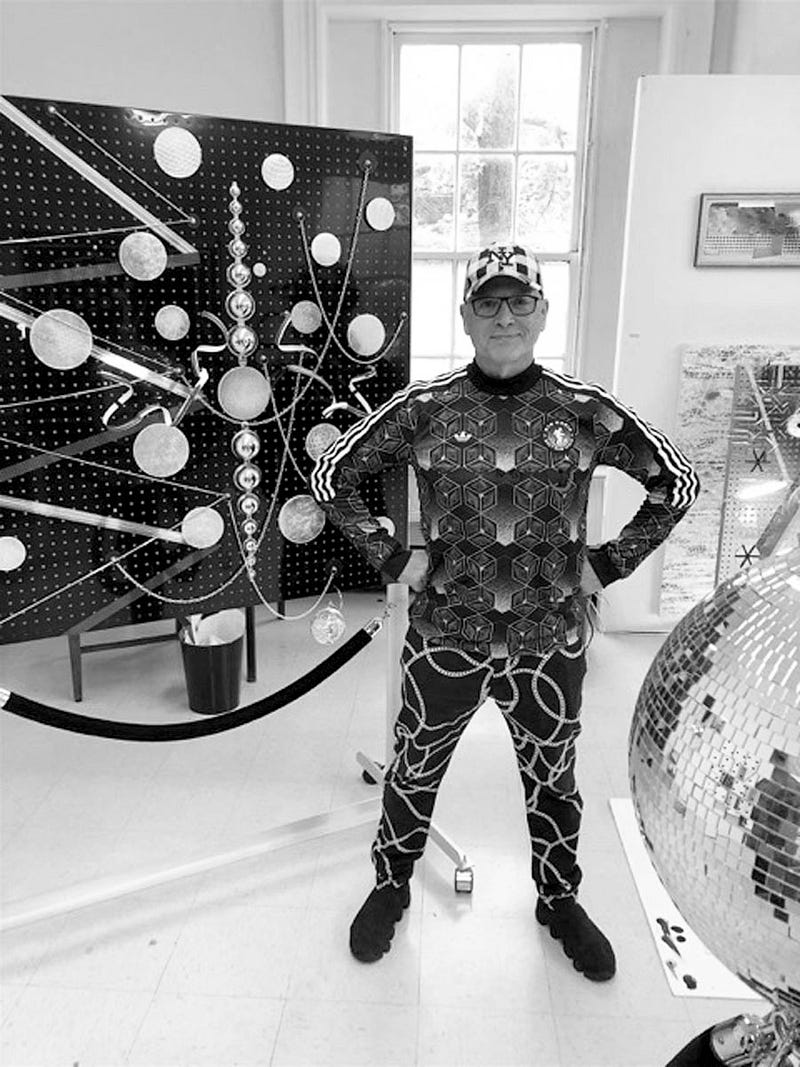
To view more of my work go here, or follow my Instagram account here.
If you liked this, check out more of my writing here on Medium. A few of the essays are chapters from my recently completed creative nonfiction LGBTQ memoir, Growing Up Under Water. My newly acquired literary agent is shopping it right now! Follow me to receive updates.



