
Public Property Is Still Property
Let’s talk about the commons
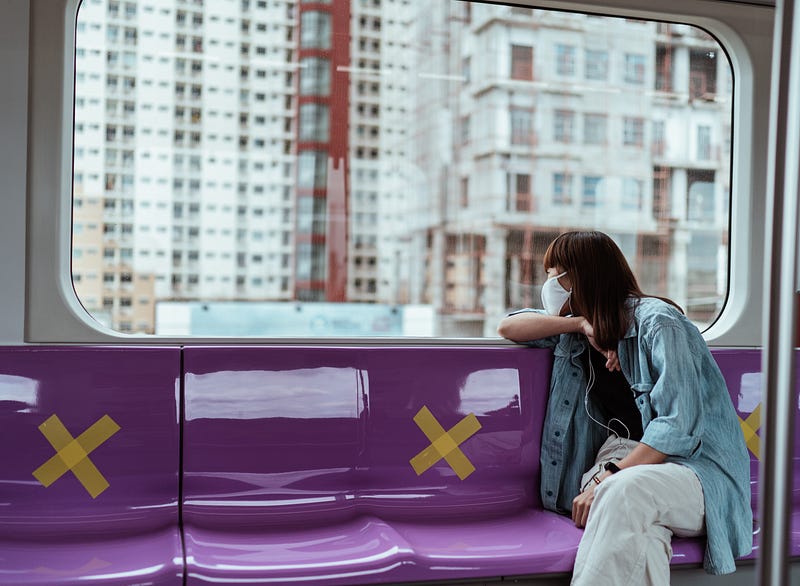
These reflections about private property began one morning when I stepped into a near empty Toronto TTC subway car. The car was occupied by only two people: a hooded young man (in his teens, by the look of it) sleeping on a row of seats curled up in a fetal position and a middle aged woman scowling at him from her seat across the room.
Intrigued by the scene, I spent the entire subway ride speculating about the story behind the woman’s seemingly hostile attitude toward the sleeping young man. What reasons could the woman have had for watching him so severely? What reasons could the young man have had for sleeping like that in the subway car?
Although I will never know exactly what happened that day, the encounter inspired me to think more deeply about our relation to public property and how we relate to one another in public spaces.
A thought experiment
Imagine that the reason the woman was scowling at this young man was because she believe that he was shamelessly violating the subway’s code of conduct (e.g. he was taking up more than one seat, treating the row of individual seats as a bench, using his commute as an opportunity to get some sleep, etc.). If a TTC officer saw him laying like that, they would surely reprimand him. They might even issue him a ticket.
This framing of the situation shows us that, similarly to private property, public property, too, is regulated by cultural, state, police, and legal apparatuses whose disapproval with one’s behavior within these spaces can result in expulsion and/or punishment (e.g. fines).
Ironic, isn’t it? Public spaces are by definition spaces that belong to all. Yet, access to these spaces is often conditional. One always runs the risk of being expelled from them (which raises important questions about how “public” public property and public spaces really are).
Another tension in our understanding of and relation to public property can be found in the way we think about these spaces in the absence of people. If public spaces such as this subway car belong to all, but there is no one there to claim their right to access said spaces, what kind of relationship must occupants have with these spaces? In other words, how must we relate to public spaces when those who, in theory, have access to them do not access them?
If you think that occupants of public spaces must engage with these spaces as if they were already occupied or about to be occupied by other people, then the woman’s attitude toward the young man in my thought experiment would be justified. His actions would violate the right that other people have to occupy the seats that he is — in a word — ‘hogging’. The fact that he is sleeping makes his actions all the more unacceptable as he would not only be taking up seats that belong to other people but also closing himself off to the possibility of ceding the seat to someone who might need it but would not feel comfortable asking for it.
This is a fairly common line of thought, one that I’m sure many of us have encountered, upheld, or entertained at one point or another. However, what often goes unnoticed is that these types of attitudes reveal to us something about how we think about public property and public spaces more generally: they show us that public property and public spaces are informed by the individualist logics and imaginaries that characterize private property relations.
More specifically, negative attitudes toward the actions of the young man in our thought experiment stem from a line of argumentation that goes something like this:
Individuals have access to the public space provide by the subway car. As a single individual, one has the right to occupy a single seat in the subway car. The rest of the seats belong to other individuals (present or not). Seats belonging to absent individuals will be policed and transgressions punished according to an established system of fines and/or result in expulsion from the “public” space in question. These measures apply at all times and regardless of individuals’ particular circumstances.
This shows how the spatial and relational logics that inform our use of public spaces are shaped by the exclusionary logics of private property. Like private property, these spaces are determined top-down according to a series of utilitarian and functionality principles that are incapable of or unwilling to meet people’s evolving needs but that are nonetheless secured through state, police, and legal apparatuses. As such, public spaces can enact the same forms of “neutrality-” and “equality-” based exclusions that characterize private property relations — relations that are backed up by policing and legal systems meant to protect the property rights of others (even when these others have no immediate need of these spaces).
But what would happen if we thought of our relation to these public spaces in more communal terms, rejecting their top-down determination and individualist logics of private property? Well, then, we would find ourselves treading the mental terrain of the commons.
In a nutshell, when we speak of the commons, we are referring to the idea of collectively owning and managing the resources and spaces that make our lives possible. At first sight, the public property label that we tend to attach to structures like our public subways appear to reflect this collective ownership vision of the commons. But, as my thought experiment tried to show, these spaces are governed by exclusionary private property logics that only appear to be guided by principles of collective ownership and collective responsibility. For instance, these property relations are handed down to us top to bottom in ways that are indifferent to people’s evolving needs and circumstances.
Thinking about public property along the logic of the commons would require us to uphold a radically different attitude toward these spaces and their occupants. We would have to think of these spaces not as belonging to all but as belonging to none, yet usable by all.
Such reimagining of public spaces would also entail a reconfiguration of our relations to those who presently occupy or are absent from those spaces. For one, the ways in which we relate and care for others and manage disagreements, conflicts, transgressions, etc. within these spaces would have to be transformed in ways that make these spaces more accommodating to people’s immediate needs and, thus, friendlier to human life.
Let’s rethink the subway scenario from the lens of the commons. If we reject the idea that public property and spaces must be designed, managed, and policed according to top-down rationalizations akin to those of private property, would the woman feel compelled to scowl at the sleeping young man in that manner? Would it matter to her how many spaces the young man takes up in the subway? Or the fact that he is taking this opportunity to get some sleep? The answer to these questions would probably be “no”.
Spaces like these would ultimately be seen as belonging to none, yet usable by all. As such, the spatial and interpersonal relations that characterize them would not be determined top-down by the restrictive and exclusionary logics of private property. Instead, these spaces would be open to spatial and interpersonal relations that better fit the needs and circumstances of their occupants (that is, of those with immediate need of these spaces). For instance, if the young man is exhausted and would like to lay down and get some rest, this space could embody an idea of care and attentiveness that is simply unavailable to us when we subscribe to the spatial and relational logics of private property.
In other words, reimagining public spaces along the lines of the commons can free up the possibilities of what these spaces can be and do for people in ways that enable rather than stultify the flourishing of human life.
The spatial and relational principles around which these spaces are organized would not be predetermined by external forces and interests but, rather, be informed and constantly reimagined according to the specific needs and circumstances of those who rely on them (without crystalizing into fixed relations to be policed and protected according to top-down utilitarian and functionality principles). Through the lens of the commons, such spaces would open to solidarities and to the proliferation of multiple life forms — to an abundance of possibilities that, in a sense, keep on giving precisely by virtue of escaping the external, alienating, and homogenizing forces that try to organize and police our lives and relations in indifferent, unequal, unjust, or undemocratic ways.
This is not to say that the commons is a magic or utopian solution to all our problems. However we decide to apply the logic of the commons to public and private property, we always run the risk of enacting forms of exclusions that we did not initially recognize or thought much of (needs change, social problems evolve). What matters is that we draw on the idea of the commons to rethink property (public and private) as unfinished and undetermined, as belonging to none rather than all. This would allow us to reimagine our relation to spaces and to other people in ways that can better respond to existing and emerging problems, and without the need for outside forces to police, exclude, or determine how spatial and interpersonal interactions are to unfold.
As my subway car analogy and thought experiment demonstrates,
public property, too, can fall into the traps of the individualist, restrictive, and exclusionary logics of private property — meaning that these spaces can neither meet the needs of all nor be all that they can be.
Reimagining our relations to property (private and public) can not only open possibilities for addressing people’s evolving needs and interests but also allows us to think more carefully about the conditions under which human and nonhuman life can flourish.
If this is a future we would like to secure for ourselves, we must start to think seriously about the commons.
Related Stories by MCQ


