
Psychedelics, Psychology and Mindfulness
How Magic Mushrooms Could’ve Given Us Consciousness
Stoned Ape theory
**Join Medium here if you aren’t already a member to get access to 1,000s more articles**
Terence McKenna was one of history’s famous psychonauts— someone who experiments with altered states of consciousness for personal exploration. So well-known, in fact, there’s a strain of mushroom named after him.
He came up ‘Stoned Ape Theory’, the idea that psychedelic mushrooms helped give humans consciousness. His ideas weren’t given much credence when he was alive, but in recent times the study of psychedelic substances have given his ideas fresh traction. Especially as evidence mounts of the efficacy of psychedelics in treating depression and PTSD.
What Magic Mushrooms Do in the Brain
McKenna spoke specifically of psilocybe cubensis, otherwise known as magic mushrooms, as what he thought helped humans develop consciousness.
The active ingredient is psilocybin, which is converted into psilocin after ingestion. Psilocin is an analog of DMT, another psychedelic substance, which just means psilocin is very similar in molecular structure (it’s DMT with an additional molecule). DMT is endogenous, meaning it’s produced naturally by the body, but science still doesn’t really know why.
It’s been seen that the brain on DMT looks very much like the brain in REM sleep, leading some to hypothesise DMT is what brings about those nightly hallucinations we call dreams.
Since psilocin is similar in structure it can also induce a dream-like state, but in a lighter way and all whilst staying awake. It brings about these effects in the brain in two main ways.
Firstly it activates a serotonin receptor known as 5HT2A, which is responsible for perception, mood, imagination and a few other things. These receptors are located mainly in the cortex; an area of the brain associated with reasoning and rational thought, which evolved larger in humans than in any other animal.
The 2A receptor is the one targeted by most psychedelic substances and is where the characteristic hallucinogenic ‘trip’ of a psychedelic experience comes from.
Secondly, psilocin temporarily blocks the Default Mode Network (DMN). The DMN is a network of connected brain regions which allow us to think into the past and look into the future. When not being deliberately used, it acts as an information-consolidation centre; integrating memories, thoughts, experiences and information. It’s also essentially where your sense of ‘self’ lies.
You can think of the DMN as your brain’s main ‘information highway’.
Psilocin disables one or more of its ‘connector hubs’ which connect the regions of the DMN, temporarily blocking its function. This forces the brain to connect in other ways because its main integration centre is shut, and brain regions which don’t normally ‘talk’ start talking.
Essentially magic mushrooms block off the brain’s main information highway, and in order for information to connect it has to take side roads it’s never taken and communicate with parts of itself it’s never spoken to.
This is what it looks like:
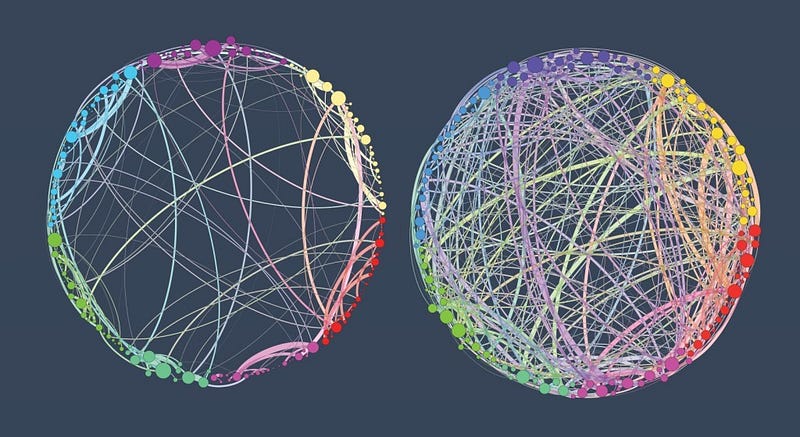
The different colours around the rim of each circle represent different areas of the brain, and the lines between them are the connections between the regions. The left side shows brain connection in normal function and the right shows brain connection under the influence of magic mushrooms.
The result of psilocin is an increase in brain connections between different regions which don’t normally communicate, and then brain cells formed during those connections stay in existence after the psilocin has worn off.
The Evolution of the Human Brain
We have big brains in terms of absolute size and ratio, especially compared to the majority of other animals. They consume a lot of energy too — about 25% of our total energy is used by our brains where they’re only about 2.5% the total mass of our bodies.
Somewhere between 500,000–100,000 years ago our brain’s doubled in size, which, from an evolutionary standpoint, is an almost unbelievable level of growth. Anthropologists don’t know how or why this happened, especially given such a massive size increase in a comparatively short time.
The Tripping Ape
This is where McKenna’s stoned ape hypothesis comes in, although I would call it the ‘tripping ape’ personally — stoned sounds too much like being vegged out on weed.
Psilocybe mushrooms can grow out of cow dung, and if our ancestors were friendly with our bovine kin like many cultures are today, it’s entirely possible they might’ve given those little mushrooms a try.
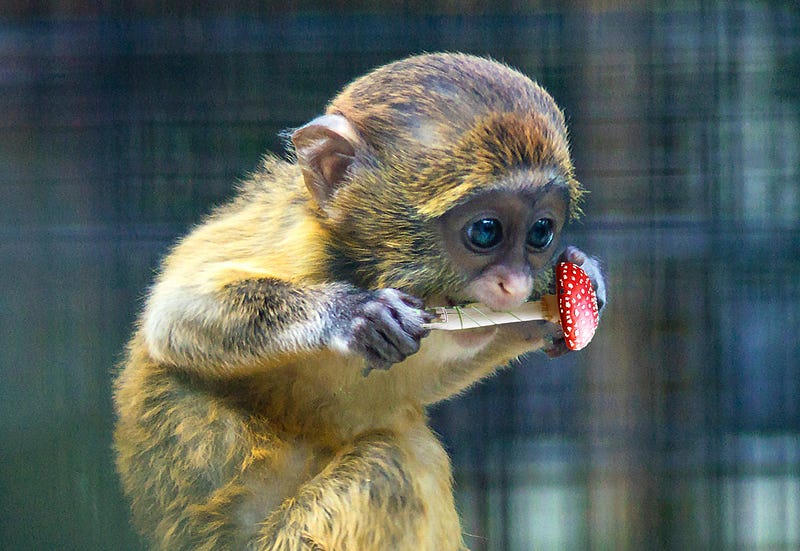
With psilocin’s effects of greatly increasing brain connectivity and stimulating serotonin receptors, especially in a part of the brain which we’ve evolved bigger than any other animal, it lends to reason this could have had a hand in developing consciousness.
Human Consciousness
The problem with theorising what may have caused consciousness is that we can’t say what consciousness actually is or where it exists in the brain.
Science hasn’t been able to find the seat of consciousness or even give it an exact definition, which is an issue when trying to figure out where something came from.
As far as I can see, consciousness seems to be a synergy of brain functions. Something which could come from multiple regions of our brains and seems to be a culmination of the connections and interactions between them. We could practically see consciousness as the quality of being self-aware, and the ability to choose whether or not to follow our base instincts, like most other animals seem to be forced to do, but the definition will vary person to person until (or if) science can define it.
It’s unlikely that one thing made us conscious, given how complex a thing it seems to be. It’s more likely the stoned ape hypothesis could provide a possible contributing factor to its development via increased cognitive connection, but there are likely many other factors that came into play.
Until we we get a better overall picture I’d say it’s worth studying psychedelics further. Since they may have helped grow and connect our brains, they could have potential to connect our neurons even further.
They warrant further research just from the simple fact they seem to be highly effective in treating depression — a condition on the rise globally.
Either way, Stoned Ape hypothesis is definitely the most fun evolutionary theory I’ve come across.
**If you enjoyed this article please consider Joining Medium to get access to all of Rajeet’s articles plus 1000’s more from other authors.**
Twitter: @rajeet_s