avatarKensei Sakamoto

Free AI web copilot to create summaries, insights and extended knowledge, download it at here

1845

Abstract

dium.com/v2/resize:fit:800/1*TQfArYw5lvEKpNa846mHng.png"><figcaption></figcaption></figure><p id="847e">Now, what we wish to show is the following:</p><figure id="667f"><img src="https://cdn-images-1.readmedium.com/v2/resize:fit:800/1*pgt9Jzkz8hucrntBEdukIQ.png"><figcaption></figcaption></figure><p id="4652">To do this, we can start with |<i>g</i>(<i>x</i>) - <i>L</i>| and observe that we can rewrite this in terms of |<i>f</i>(<i>x</i>) - <i>L</i>| and |<i>h</i>(<i>x</i>) - <i>L</i>| in the following way using the triangle inequality:</p><figure id="f405"><img src="https://cdn-images-1.readmedium.com/v2/resize:fit:800/1*-l8CyqFJ8_0pu_ozf_4osg.png"><figcaption></figcaption></figure><p id="ca34">Here the first and last inequality holds through the use of the triangle inequality (|<i>a </i>+ <i>b</i>| ≤ |<i>a</i>| + |<i>b</i>|) and the second inequality holds by using the fact that <i>f</i>(<i>x</i>) ≤ <i>g</i>(<i>x</i>) ≤ <i>h</i>(<i>x</i>). Now, notice that if we let ϵ₁ = ϵ₂ = ϵ/3 in our definition of the limits for <i>f</i>(<i>x</i>) and <i>h</i>(<i>x</i>), then the last line would add to ϵ. With the rough work done, we can now start our proof.</p><p id="f320">First let ϵ > 0 and choose <i>δ</i> = min{<i>δ</i>₁, <i>δ</i>₂} (min{} returns the minimum of these two numbers). Now, assume that |<i>x</i> - <i>c</i>| < <i>δ</i>. Since we chose <i>δ</i> to be the minimum of <i>δ</i>₁ and <i>δ</i>₂ this ensures that |<i>x - c</i>| < <i>δ</i>₁ and |<i>x - c</i>| < <i>δ</i>₂ are true which implies that |<i>f</i>(<i>x</i>) - <i>L</i>| < ϵ/3 and |<i>h</i>(<i>x</i>) - <i>L</i>| < ϵ/3. Now, since we already know that |<i>g</i>(<i>x</i>) - <i>L</i>| ≤ |<i>h</i>(<i>x</i>) - <i>L</i>| + 2|<i>f</i>(<i>x</i>) - <i>L</i>|, we can conclude that |<i>g</i>(<i>x</i>) - <i>L</i>| < ϵ/3 + 2ϵ/3 = ϵ as desired.</p><h1 id=

Options

"3814">Applications</h1><p id="66b3">Now that we have proved the squeeze theorem, we can now try to apply it and see how it can be used. For instance, consider the limit as <i>x</i>²sin(1/<i>x</i>) approaches 0. Notice how at exactly <i>x</i> = 0, this function is not defined and the sin(1/<i>x</i>) term causes the function to have an oscillatory behavior with an infinite frequency at <i>x</i> = 0. As a result, our traditional limit solving techniques will not work with this limit and we must resort to something else. However, notice that sinusoidal functions such as sin(1/<i>x</i>) are always bounded between 1 and -1, meaning that -<i>x</i>² ≤ <i>x</i>²sin(1/<i>x</i>) ≤ <i>x</i>². But since lim(x → 0) -<i>x</i>² = lim (x → 0) <i>x</i>² = 0, by the squeeze theorem we can conclude that lim(x → 0) <i>x</i>²sin(1/<i>x</i>) = 0. As such, without doing any complicated calculations, we were able to evaluate this limit through the use of the squeeze theorem.</p><p id="b396">As a visual aid to understand what’s going on here, we can graph the functions -<i>x</i>², <i>x</i>², and <i>x</i>²sin(1/<i>x</i>) on the same axes:</p><figure id="fc14"><img src="https://cdn-images-1.readmedium.com/v2/resize:fit:800/1*_z3gY1yX75SyJ96quuSPhg.png"><figcaption></figcaption></figure><p id="04d6">In the above graph, the red function is <i>x</i>²sin(1/<i>x</i>) and the blue curves are <i>x</i>² and -<i>x</i>². Notice how <i>x</i>²sin(1/<i>x</i>) is constantly being sandwiched by <i>x</i>²<i> </i>and -<i>x</i>² as we would expect from the -<i>x</i>² ≤ <i>x</i>²sin(1/<i>x</i>) ≤ <i>x</i>² inequality. But since both <i>x</i>² and <i>-x</i>² approach the same value as <i>x</i> approaches 0, the function in between gets ‘squeezed’ by the two functions, hence the name ‘squeeze theorem’.</p><p id="9e01">Thank you for reading.</p></article></body>

Proving the Squeeze Theorem using the Epsilon Delta Definition for the Limit

Out of the many techniques there are for solving limits, the squeeze theorem is a fairly famous theorem that has the ability to evaluate certain limits by comparing with other functions. For those who do not know the squeeze theorem, it states the following:

Let A be some domain containing the point c, and let f, g, and h be defined on this common domain (except possibly at c). Suppose that for every x in A, f(x) ≤ g(x) ≤ h(x). Then, if lim(xc) f(x) = lim(xc) h(x) = L, it follows that lim(xc) g(x) = L.

In this post, I will be going through a simple proof of this theorem using the epsilon delta definition for limits, and will finish with a simple application of this theorem.

Proving the Squeeze Theorem

To prove the squeeze theorem, I will be using the epsilon delta definition for limits which you can read more about in this post.

To begin, let f, g, and h be defined on A (except possibly at point c) and suppose that for every x in A, f(x) ≤ g(x) ≤ h(x). Additionally, suppose that lim(xc) f(x) = lim(xc) h(x) = L. Then, by the epsilon delta definition for the limit, we know the following statements are true:

Now, what we wish to show is the following:

To do this, we can start with |g(x) - L| and observe that we can rewrite this in terms of |f(x) - L| and |h(x) - L| in the following way using the triangle inequality:
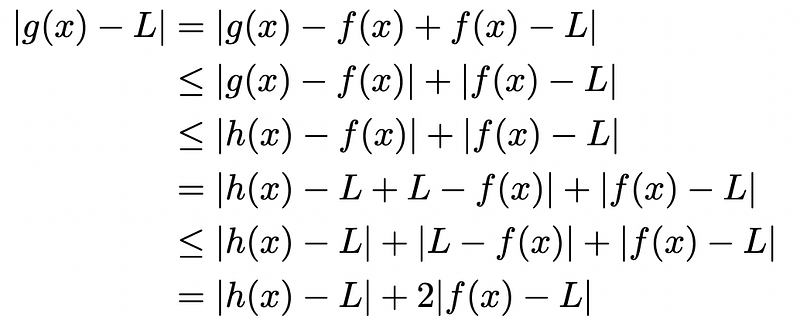
Here the first and last inequality holds through the use of the triangle inequality (|a + b| ≤ |a| + |b|) and the second inequality holds by using the fact that f(x) ≤ g(x) ≤ h(x). Now, notice that if we let ϵ₁ = ϵ₂ = ϵ/3 in our definition of the limits for f(x) and h(x), then the last line would add to ϵ. With the rough work done, we can now start our proof.

First let ϵ > 0 and choose δ = min{δ₁, δ₂} (min{} returns the minimum of these two numbers). Now, assume that |x - c| < δ. Since we chose δ to be the minimum of δ₁ and δ₂ this ensures that |x - c| < δ₁ and |x - c| < δ₂ are true which implies that |f(x) - L| < ϵ/3 and |h(x) - L| < ϵ/3. Now, since we already know that |g(x) - L| ≤ |h(x) - L| + 2|f(x) - L|, we can conclude that |g(x) - L| < ϵ/3 + 2ϵ/3 = ϵ as desired.

Applications

Now that we have proved the squeeze theorem, we can now try to apply it and see how it can be used. For instance, consider the limit as x²sin(1/x) approaches 0. Notice how at exactly x = 0, this function is not defined and the sin(1/x) term causes the function to have an oscillatory behavior with an infinite frequency at x = 0. As a result, our traditional limit solving techniques will not work with this limit and we must resort to something else. However, notice that sinusoidal functions such as sin(1/x) are always bounded between 1 and -1, meaning that -x² ≤ x²sin(1/x) ≤ x². But since lim(x → 0) -x² = lim (x → 0) x² = 0, by the squeeze theorem we can conclude that lim(x → 0) x²sin(1/x) = 0. As such, without doing any complicated calculations, we were able to evaluate this limit through the use of the squeeze theorem.

As a visual aid to understand what’s going on here, we can graph the functions -x², x², and x²sin(1/x) on the same axes:
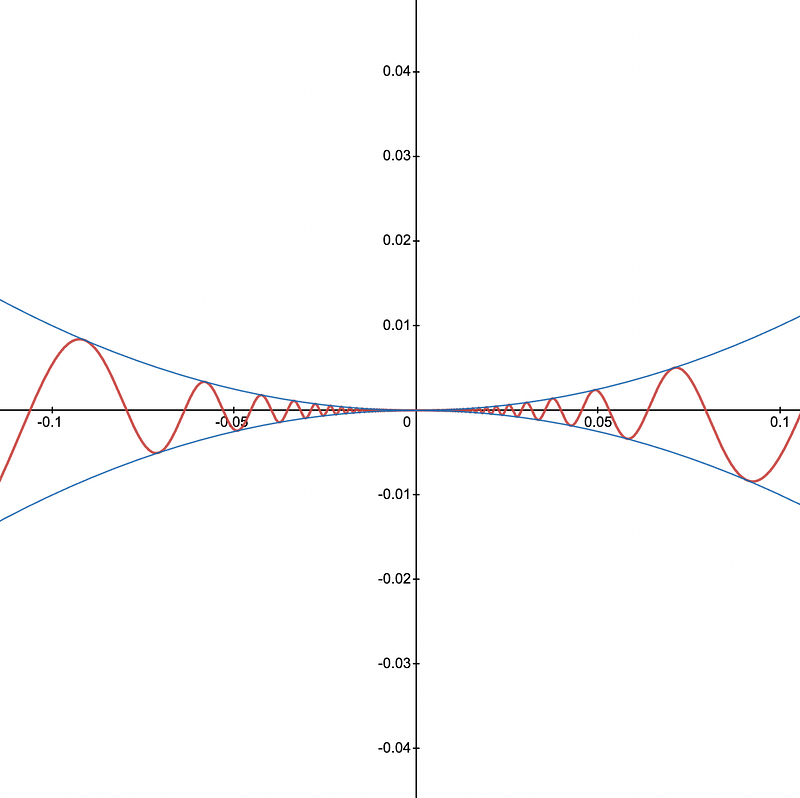
In the above graph, the red function is x²sin(1/x) and the blue curves are x² and -x². Notice how x²sin(1/x) is constantly being sandwiched by x² and -x² as we would expect from the -x² ≤ x²sin(1/x) ≤ x² inequality. But since both x² and -x² approach the same value as x approaches 0, the function in between gets ‘squeezed’ by the two functions, hence the name ‘squeeze theorem’.

Thank you for reading.

Mathematics
Math
Calculus
Real Analysis
Limits
Recommended from ReadMedium