
Rigorously Defining the Limit Using the Epsilon Delta Definition
Despite being the foundation for most concept in calculus, in most high school calculus courses, the limit is often presented as an ambiguous concept without a clear definition. However, there does actually exist a rigorous definition known as the ‘epsilon delta definition’ and is usually not taught until early university courses in calculus or analysis. Therefore, for this article, I would like to go through this definition and show how we can use it to prove certain limits.
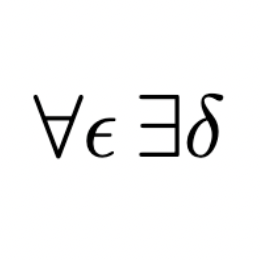
The Epsilon-Delta Definition
The main objective of the epsilon-delta definition is to give a proper meaning to the following statement:

For some function f : A → R. One intuitive explanation some may use is that ‘as x gets infinitesimally closer to c, f(x) gets infinitesimally closer to L’, but this definition is quite hand-wavy and unclear. Instead, a more accurate definition using the epsilon-delta definition would be the following:
Let f: A → R. lim(x → c) = L means that “∀ϵ > 0, ∃δ > 0 such that 0 < |x - c| < δ (where x ∈ A) ⟹ |f(x) - L| < ϵ”
If you do not understand the symbols, ∀ means ‘for all, ∃ means ‘there exists’, and ⟹ mean ‘implies’. So, to put this into words, the epsilon delta definition means that “for all ϵ > 0, there exists a δ > 0 such that 0 < |x - c| < δ (where x ∈ A) being true implies that |f(x) - L| < ϵ is also true”.
For now, it may actually help to understand the second half of the statement first. To do this, we can rewrite the 0 < |x - c| < δ inequality as c - δ < x < c + δ and the |f(x) - L| < ϵ inequality as L - ϵ < f(x) < L + ϵ. In these new forms, it should be more clear what we wish to achieve since c - δ < x < c + δ means that x is in the open interval, (c - δ, c + δ) and L - ϵ < f(x) < L + ϵ means that f(x) is in the open interval, (L - ϵ, L + ϵ). One common way of naming these intervals are as ‘neighborhoods’. For example, we can call (c - δ, c + δ) as the ‘δ-neighborhood of c’ and (L - ϵ, L + ϵ) as the ‘ϵ-neighborhood of L’. Therefore, the statement 0 < |x - c| < δ ⟹ |f(x) - L| < ϵ means that IF x is in the δ-neighborhood of c, then f(x) will be in the ϵ-neighborhood of L.
We can now connect this with first half of the epsilon-delta definition involving the ‘for all’ and ‘there exists’ statements. One way to think of this epsilon-delta definition is that we are given a challenge (the ϵ), and we need to react with some response (the δ). For example, if we are told that ϵ = 1, can we find a δ > 0 such that x being in the δ-neighborhood of c ensures that f(x) is within 1 unit away of L? If yes, then good, but notice that we want this to be true ‘for all ϵ > 0’. Therefore, for the limit to exist, this needs to be true for ϵ = 0.1, ϵ = 0.01, and so on. The question then becomes, ‘no matter how small we make ϵ, can we always find some δ that satisfies the implication?’ Therefore, in simpler terms, lim(x → c) f(x) = L essentially means that f(x) can be made as close to L as we want by requiring x to be close to c. This is precisely what the limit means.
Example Using a Simple Limit
Now that we understand what the epsilon-delta definition means, we can use it to prove certain limits. For example, consider the following limit:

While this should not be a difficult limit to confirm by just substituting in x = 2, we can still confirm it using the epsilon-delta definition. If we recall how the epsilon-delta definition works, we want to show that for any choice of ϵ we can always find a δ that satisfies 0 < |x - c| < δ ⟹ |f(x) - L| < ϵ. Substituting in f(x) = 3x - 1 and the specific values for c and L, this means that we want to show that 0 < |x - 2| < δ ⟹ |3x - 6| < ϵ. However, if we notice the inequality in the second half, we can actually rewrite this as 3|x-2| < ϵ which looks very familiar to the |x - 2| < δ inequality in the first half of our implication. In fact, if we choose δ = ϵ/3, then the implication will be true for all ϵ > 0. With the rough work done, we can begin the proof:
Let ϵ > 0 and choose δ = ϵ/3. Given that x ∈ R, assume 0 < |x - 2| < δ. This assumption then implies that |f(x) - L| = 3|x-2| < 3(ϵ/3) = ϵ. Therefore, by the epsilon-delta definition of the limit, lim(x → 2) 3x - 1 = 5.
While it is easy to get lost with all the symbols, it is important to notice that we have found an explicit formula for δ that can respond to any value of ϵ. For example, if ϵ = 1, then δ = 1/3 satisfies the implication. If ϵ = 1/10, then δ = 1/30 also works and so on. Therefore, we have proved that for any given value of ϵ, we can always find a δ that satisfies the implication, which is what is necessary for the limit to exist. While this was a very basic example, the epsilon-delta definition is still a very powerful tool that can be used to prove or disprove many limits.
Infinite Limits
Finally, I would like to finish off by briefly discussing how we can adjust the epsilon-delta definition for infinite limits. For example consider the following limit:

The simplest example of such a limit would be the limit of 1/x as x → 0. Notice that if we mindlessly try to use our epsilon-delta definition and substitute L = ∞, this would not work since ∞ is not an actual number. The idea of an ϵ-neighborhood around ∞ just does not make any sense. Therefore, we must adjust our definition. Instead of having f(x) be infinitesimally close to some value L, what we instead want to achieve is that f(x) can get infinitesimally large. Or in other words, it can’t be bounded by any real number, M. Therefore, lim(x → c) f(x) = ∞ would mean:
∀M > 0, ∃δ > 0 such that 0 < |x - c| < δ ⟹ f(x) > M
Similarly, we can also adjust the definition for when x approaches infinity instead. For this, we will use the letter N (the choice letters is arbitrary and may differ from different sources). Therefore, lim (x → ∞) f(x) = L means the following:
∀ϵ > 0, ∃N > 0 such that x > N ⟹ |f(x) - L| < ϵ
Finally, in the case of both x and f(x) approaching infinity, we can combine these two definitions. Hence, lim (x →∞) f(x) = ∞ would mean:
∀M > 0, ∃N > 0 such that x > N ⟹ f(x) > M
As such, we can make these relatively simple adjustments to the epsilon- delta definition in special limits involving infinity.
Thank you for reading.
References
Abbott, S. (2016). Understanding analysis. Springer.
Stewart, J. (2016). Calculus (8th ed.). Cengage Learning.