
Procrastination, Briefly Explained
And the reasons we have a natural tendency to procrastinate.

What is procastination?
Procrastination is one of the main barriers blocking you from getting up, making the right decisions and living the dream life you’ve thought of.
Have you ever tried to avoid important tasks (from work, school, college, writing… any of them!) and find yourself staring at the ceiling instead… like, you know, literally wasting your time — like tossing it away?
If so… you know what I am talking about then!
You are a professional Procastinator — so Welcome aboard ;)
Let’s start with the etymology of the word:
Pro-crastinus: (lat.) belonging to tomorrow.
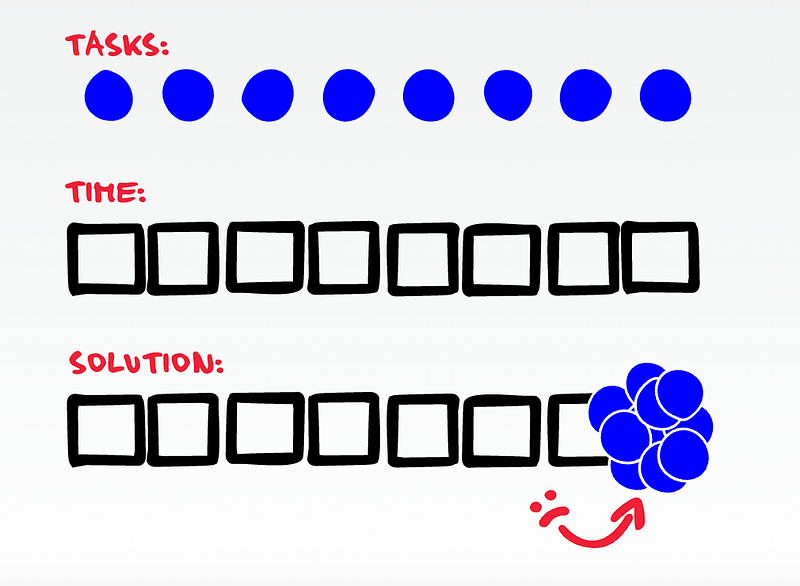
Procrastination: putting things off intentionally or habitually.
Suffering More, Performing Worse
One of the first studies to document the pernicious nature of procrastination was published in Psychological Science back in 1997 by Dianne Tice and Roy Baumeister. The research was focused on Procrastination among students — they rated college students on an established scale of procrastination, then tracked their academic performance, stress, and general health throughout the semester.
Procrastinators reported lower stress and less illness than non-procrastinators early in the semester, presumably as a result of putting off their work to pursue more pleasurable activities, but they reported higher stress and more illness late in the term. Procrastinators also received lower grades on all assignments. Procrastination thus appears to be a self-defeating behavior pattern marked by short-term benefits and long-term costs.
As Tice and Baumeister stated, “Thus, despite its apologists and its short-term benefits, procrastination cannot be regarded as either adaptive or innocuous. Procrastinators end up suffering more and performing worse than other people.”
Recent studies have shown that people regret more the things they haven’t done than the things they have done. In addition, feelings of regret and guilt resulting from missed opportunities tend to stay with people much longer — as sometimes all our opportunities seem to be at our fingertips, but we can’t seem to reach them.
When you are procrastinating, you waste precious time that could be investing in something meaningful. However, the world today is conducive to procrastinating and learning how to overcome it is, consequently, one of the most important skills you must learn. So, the golden question here is…
Why do people procrastinate?
Willpower is often perceived to be the key leading cause of procrastination, however, our intrinsic motivation is the one that helps us to overcome the habit of putting things off on daily basis. Some of the most common reasons why people tend to procrastinate nowadays are:
- Decision paralysis: The number of opportunities that today’s world offers is staggering. Modern society idolizes individual liberty in the belief that the freer people are, the happier they will be. Yet, with more freedom to make our own decisions and to perform our actions, we have become easily confused about what is a priority and therefore we have become demotivated to do anything at all.
- Ignoring The Value of Time: We were all born and unfortunately at some point will all die too. The time we spend on Earth is both limited and finite. Even though time is the most valuable commodity you have, people tend to omit this — and behave as if their time is infinite. We all should be more aware that every single second you waste is gone forever. The mere realization that life is finite leads people to begin managing their time more carefully.
- Lack of self-discipline: You can imagine self-discipline or self-control as a moment when you give yourself orders, but you are having a hard time following them. It is not the primary cause of procrastination, but an important compound. To be disciplined, you need to have the true motivation and learn to maintain and work on positive habits.
Now that everyone is aware of why we are procrastinators, the next natural question would be…
What can I do to stop procrastinating?
This is one of the most extremely personal and subjective questions — ever. We, as individuals, work completely different, which means not every solution works for every individual. Yet, you can find many tricks and tips related to this topic. How to overcome procrastination is one of the most intensively discussed topics. For instance, Denis Waitley stated the following steps to overcome procrastination at Success.com:
- Take five minutes to list the things “you were going to do tomorrow.”
- Look at your list — and do one thing on it right now.
- Pick a time (today) to work on the list.
- Quit trying to be perfect.
- If what you’re putting off involves other people, talk to them.
- Ask yourself, What’s the worst thing that could happen if I did this today?
- Imagine how you’ll feel once you do whatever it is you’ve been postponing.
You do not like his solution? No worries, you can find plenty of them out there. Here I summarize some of the ones I found more interesting:
There are other people that instead of trying to overcome Procrastination, just want to make it a good ally. Check them out if that is your preferred solution:
Fun fact! Procrastination has its own webpage. You can check it out below :D
Feel free to share your thoughts and experiences in the comments! ✨
You can suscribe to my Medium Newsletter to stay tuned and receive my content. I promise it will be unique!
If you are not a full Medium member yet, just check it out here to support me and many other writers. It really helps :D
Some other nice medium related articles you should go check out! :D


