avatarAvi Kotzer

Free AI web copilot to create summaries, insights and extended knowledge, download it at here

3429

Abstract

path, the one recommended by the Buddha and embodied by the patriarch Jacob.)</p><p id="47b3">Proteins begin life as a string of amino acids, their basic building blocks. These amino acids interact with each other to create the three-dimensional shapes that are more stable and essential for protein functionality.</p><figure id="0ea9"><img src="https://cdn-images-1.readmedium.com/v2/resize:fit:800/0*HVZZOBYjsP6JP4XD.png"><figcaption>Credit: wikipedia.com</figcaption></figure><p id="578b">Cooking meat causes the <b>denaturation</b> of proteins; the go back to the unfolded state. So reverse the white arrow when you’re grilling a slab of beef next Memorial Day weekend.</p><p id="068d">Now, the protein that prions are made of, called <b>PrP</b>, is found in healthy humans and other animals. That’s not the issue. In fact, PrP seems to play key roles in the nervous system that are still being studied and discovered. Some of them are repairing myelin — the sheath that surrounds some nerves — in mice and regulating long-term memory in humans.</p><p id="ed02">PrP comes in two main varieties: PrPC and PrPSc. The latter is actually the prion, <b>Sc</b> standing for “scrapie”, the original brain disease first discovered in sheep. PrPSc always causes prion infections, and it does so by changing the shape of the normal PrPCs.</p><p id="9684">Prions cause nerve disease by getting together in amyloids, or plaques in the central nervous system. This turns the normal tissue into a Swiss cheese version of it, which gives it a “sponge-like” appearance. Hence the use of the word <b>spongiform</b> in the technical name of the disease.</p><p id="9337">How do humans get prions? From eating animals who have them: sheep, goats, cows. The more interesting question is: how the heck did sheep and goats and cows get the prions? Well, modern science has found out that prions may be transmitted through manure, or that the remains of dead animals and their bodily fluids can deposit prions in the environment. There is even talk about airborne transmission.</p><p id="7355">But the epidemics I mentioned before, in the 1990s and the early 2000s, happened mostly because cows were fed… other cows.</p><p id="7543">Okay, not glaringly and directly, but still pretty horrible. This had been going on for a while with something called “meat and bone meal”, which contains about 50% protein and is added to animal feed to improve the quantity and quality of its amino acids.</p><p id="1fb4">Because of the prions and their ghastly consequences, meat and bone meal was banned from the feeds given to ruminants (cows, sheep, goats, etc.), although it’s still allowed for other animals.</p><p id="9592">Here is a chart showing the rise in mad cow disease in the United Kingdom. Note that the title of the graph says “reported”. There were probably a lot more.</p><figure id="4911"><img src="https://cdn-images-1.readmedium.com/v2/resize:fit:800/0*4HYqid6FHlEzPP6X.png"><figcaption>Image by SuperManu</figcaption></figure><p id="af69">Now, unlike certain bacteria or parasites, prions are not destroyed by cooking the meat. So people started getting prions, which in humans causes variant Creutzfeldt–Jakob disease. Most people don’t live much longer than a year after they start showing symptoms, although the prions can remain “dormant” for a long time before the disease starts.</p><p id="7f7f">There is no known treatment or cure for

Options

this dreadful disease, although a possible vaccine has been in the works.</p><p id="a922">In his 2018 book <i>The End of Epidemics</i>, Dr. Jonathan Quick and Bronwyn Fryer argued that mad cow disease was the first “Frankenstein” disease, or <b>man-made epidemic</b>, because “a human decision to feed meat and bone meal to previously herbivorous cattle… caused… an animal pathogen to enter into the human food chain, and from there to begin causing humans to contract Creutzfeldt–Jakob disease.”</p><h2 id="a830">PRY-on</h2><p id="305f">That is the official pronunciation of the petrel also known as the whalebird. Ironically, the whalebird is relatively small. The name prion, in this case, comes from the Greek <i>priōn</i>, meaning “saw”, in reference to the serrated edges of the birds’ bill.</p><figure id="2b63"><img src="https://cdn-images-1.readmedium.com/v2/resize:fit:800/0*SkGLOqFT9wKKo4eC.jpg"><figcaption>Photo by Christopher Watson</figcaption></figure><p id="fded">That’s a much prettier thing to look at than an unfolded protein. Or a cow dying from bovine spongiform encephalopathy.</p><p id="8617">Prions are found in the Southern Ocean and spend a substantial portion of their life around the islands just north of Antarctica. Due to bad marketing, however, they never became as popular as penguins. Maybe if that photo of a prion walking on water had become viral, we’d have witnessed a miracle of popularity.</p><p id="c843">So, okay, maybe the New York Times had forgotten about the prion bird. No fowl play there. After all, they never got to star in a documentary narrated by <a href="https://www.imdb.com/title/tt0428803/">Morgan Freeman</a>.</p><p id="72b1">But the deadly unfolding protein? That was something the entire world was both talking and crapping its pants about for a good number of years.</p><p id="05f2">Maybe the editors of the Spelling Bee puzzle got a case of “mad word disease” when they determined that <i>prion</i> is a <a href="https://www.merriam-webster.com/words-at-play/dord-a-ghost-word"><b>dord</b></a><b>.</b></p><p id="f8a2">You can check out my previous entry on another <b>dord </b>here:</p><div id="4f85" class="link-block"> <a href="https://readmedium.com/lido-5bd3cfbefafd"> <div> <div> <h2>Lido</h2> <div><h3>An outdoor swimming pool… and an indoor movie theater</h3></div> <div><p>medium.com</p></div> </div> <div> <div style="background-image: url(https://miro.readmedium.com/v2/resize:fit:320/0*50mNB3u9rHtV-x4X)"></div> </div> </div> </a> </div><p id="7446">*What the heck is a <b>dord, </b>you ask? Here’s the answer:</p><div id="ea7f" class="link-block"> <a href="https://www.merriam-webster.com/words-at-play/dord-a-ghost-word"> <div> <div> <h2>'Dord': A Ghost Word</h2> <div><h3>One of the questions people like to ask lexicographers is this: Can you sneak something into the dictionary? Can you…</h3></div> <div><p>www.merriam-webster.com</p></div> </div> <div> <div style="background-image: url(https://miro.readmedium.com/v2/resize:fit:320/0*QA5G6FzaeWOd6G23)"></div> </div> </div> </a> </div></article></body>

Prion

A tiny thing too huge to be ignored by the New York Times

Image by By Ismaïl Jarmouni

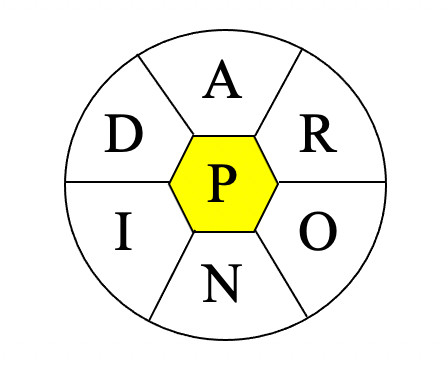
Today’s New York Times Spelling Bee letters:
Art: Iva Reztok

A, D, I, N, O, R, and center P (all words must include P).

Merriam-Webster says…
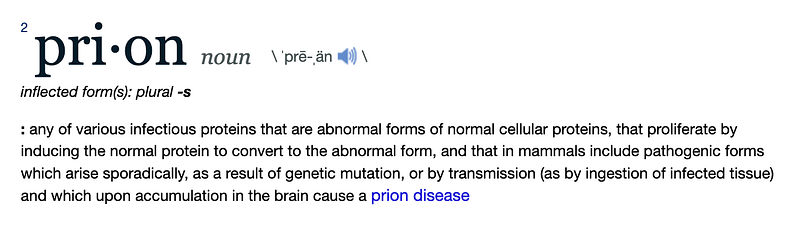
Credit: merriam-webster.com

Silly little dictionary! Don’t you know prion can’t possibly be a word if the New York Times says it ain’t?

For further fascinating facts, check out the Spelling Bee Master.

What’s your favorite dord* from today’s puzzle?

My Two Cents

A cursory search within the New York Times archives reveals plenty of articles over the years that mention prions. The oldest is from 1994 and the most recent is barely three months old.

Which brings up the question: how could the editors of the Spelling Bee reject this word for today’s puzzle? How, I ask again!? And I’m not even talking about the other, completely different definition of prion, a bird which is much nicer and less deadly than the killer proteins.

Perhaps the even older Times articles listed in the “prion” search are about the small seabirds, because I doubt the medical prions were known back then.

PREE-on

That’s supposed to be the correct pronunciation of the medical prion, although the other pronunciation is also in usage. However, the man who coined the word in 1982, Stanley B. Prusiner, specifically mentioned the pronunciation as PREE-on. In this case, prion stands for protein and infection.

What is a prion, anyway?

Have you heard of Creutzfeldt–Jakob disease, also known as CJD? Surely you’ve heard of mad cow disease and the huge scare that the world went through in the mid-1990s and again in the early 2000s.

Mad cow disease is technically known as Bovine spongiform encephalopathy, which is why most of us insist on calling it “mad cow disease”. Plus, that sounds scarier, even though it’s more pronounceable. The condition brings about the loss of neural function — and eventually death — in cows.

This horrible disease is caused by prions, which are misfolded proteins that are able to get other proteins to fold incorrectly, too. Sort of like how humans get convinced to do stupid things by other stupid people, especially stupid leaders. (I’m sure both sides of the political spectrum are convinced that the leaders of the other side are the stupid ones. That’s why I pick the middle path, the one recommended by the Buddha and embodied by the patriarch Jacob.)

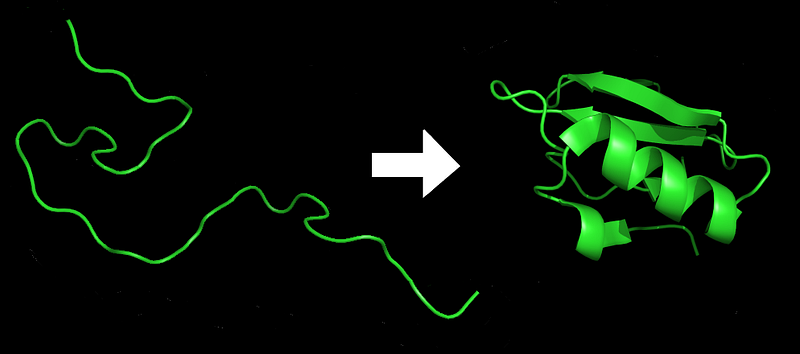
Proteins begin life as a string of amino acids, their basic building blocks. These amino acids interact with each other to create the three-dimensional shapes that are more stable and essential for protein functionality.
Credit: wikipedia.com

Cooking meat causes the denaturation of proteins; the go back to the unfolded state. So reverse the white arrow when you’re grilling a slab of beef next Memorial Day weekend.

Now, the protein that prions are made of, called PrP, is found in healthy humans and other animals. That’s not the issue. In fact, PrP seems to play key roles in the nervous system that are still being studied and discovered. Some of them are repairing myelin — the sheath that surrounds some nerves — in mice and regulating long-term memory in humans.

PrP comes in two main varieties: PrPC and PrPSc. The latter is actually the prion, Sc standing for “scrapie”, the original brain disease first discovered in sheep. PrPSc always causes prion infections, and it does so by changing the shape of the normal PrPCs.

Prions cause nerve disease by getting together in amyloids, or plaques in the central nervous system. This turns the normal tissue into a Swiss cheese version of it, which gives it a “sponge-like” appearance. Hence the use of the word spongiform in the technical name of the disease.

How do humans get prions? From eating animals who have them: sheep, goats, cows. The more interesting question is: how the heck did sheep and goats and cows get the prions? Well, modern science has found out that prions may be transmitted through manure, or that the remains of dead animals and their bodily fluids can deposit prions in the environment. There is even talk about airborne transmission.

But the epidemics I mentioned before, in the 1990s and the early 2000s, happened mostly because cows were fed… other cows.

Okay, not glaringly and directly, but still pretty horrible. This had been going on for a while with something called “meat and bone meal”, which contains about 50% protein and is added to animal feed to improve the quantity and quality of its amino acids.

Because of the prions and their ghastly consequences, meat and bone meal was banned from the feeds given to ruminants (cows, sheep, goats, etc.), although it’s still allowed for other animals.

Here is a chart showing the rise in mad cow disease in the United Kingdom. Note that the title of the graph says “reported”. There were probably a lot more.
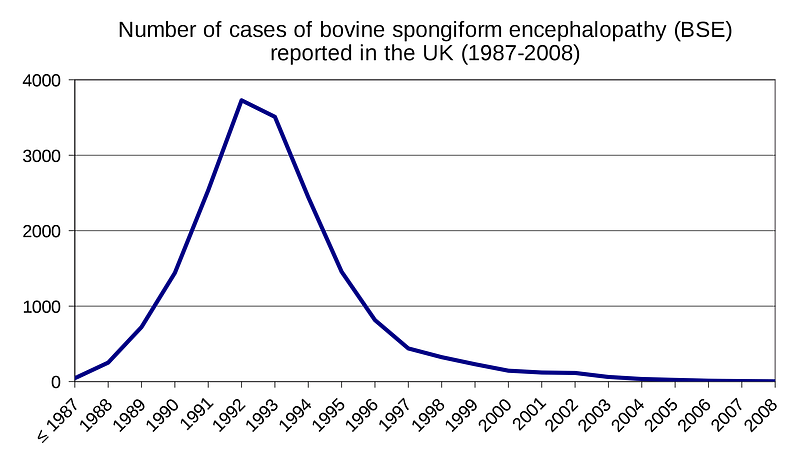
Image by SuperManu

Now, unlike certain bacteria or parasites, prions are not destroyed by cooking the meat. So people started getting prions, which in humans causes variant Creutzfeldt–Jakob disease. Most people don’t live much longer than a year after they start showing symptoms, although the prions can remain “dormant” for a long time before the disease starts.

There is no known treatment or cure for this dreadful disease, although a possible vaccine has been in the works.

In his 2018 book The End of Epidemics, Dr. Jonathan Quick and Bronwyn Fryer argued that mad cow disease was the first “Frankenstein” disease, or man-made epidemic, because “a human decision to feed meat and bone meal to previously herbivorous cattle… caused… an animal pathogen to enter into the human food chain, and from there to begin causing humans to contract Creutzfeldt–Jakob disease.”

PRY-on

That is the official pronunciation of the petrel also known as the whalebird. Ironically, the whalebird is relatively small. The name prion, in this case, comes from the Greek priōn, meaning “saw”, in reference to the serrated edges of the birds’ bill.
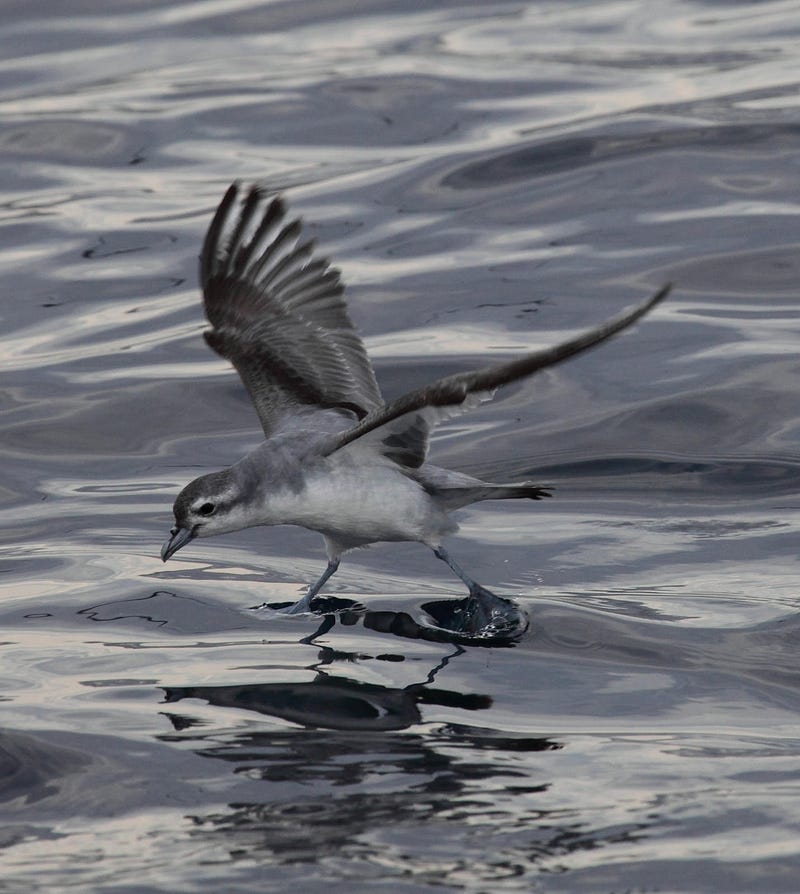
Photo by Christopher Watson

That’s a much prettier thing to look at than an unfolded protein. Or a cow dying from bovine spongiform encephalopathy.

Prions are found in the Southern Ocean and spend a substantial portion of their life around the islands just north of Antarctica. Due to bad marketing, however, they never became as popular as penguins. Maybe if that photo of a prion walking on water had become viral, we’d have witnessed a miracle of popularity.

So, okay, maybe the New York Times had forgotten about the prion bird. No fowl play there. After all, they never got to star in a documentary narrated by Morgan Freeman.

But the deadly unfolding protein? That was something the entire world was both talking and crapping its pants about for a good number of years.

Maybe the editors of the Spelling Bee puzzle got a case of “mad word disease” when they determined that prion is a dord.*

You can check out my previous entry on another dord* here:

*What the heck is a dord, you ask? Here’s the answer:

Spelling Bee
Language
Science
Food
Animals
Recommended from ReadMedium
avatarAnthony (Tony/Pcunix) Lawrence 👀
I Have Decided I Cannot Vote For Camila

I just cannot

2 min read