
Lido
An outdoor swimming pool… and an indoor movie theater
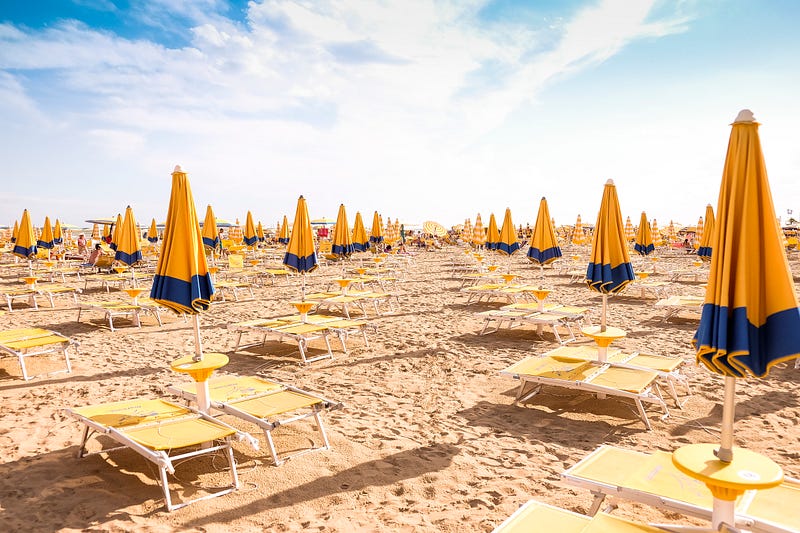
Today’s New York Times Spelling Bee letters:

H, I, L, N, O, W, and center D (all words must include D).
Merriam-Webster says…
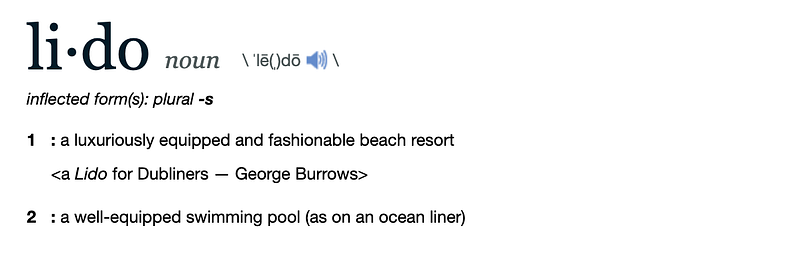
Silly little dictionary! Don’t you know lido can’t possibly be a word if the New York Times says it ain’t?
For further fascinating facts, check out the Spelling Bee Master.
What’s your favorite dord* from today’s puzzle?
My Two Cents
The word dhoni was an interesting choice for today, but I went with lido because it brings to mind pleasant recollections of another life I lived long ago.
The word lido comes from the Latin litus, meaning “beach”. But lido in Italian means “waterfront” or “beachfront resort”. It became associated in Italy with the Lido di Venezia, a barrier island in the Venetian Lagoon, where the city’s film festival is held in late summer. Lido first referred to beach resorts in Europe, but later the word became a synonym for outdoor pools… at least, in Britain.
Pooling your resources
Outdoor swimming became popular in the 1930s in the United Kingdom, and likely other countries, too. Why? Perhaps American swimmer and Tarzan actor Johnny Weissmuller had something to do with it. He won 5 gold medals for swimming in the 1924 (Paris) and 1928 (Amsterdam) Summer Olympics. Plus, he was, well… Tarzan the Ape Man.
Interesting fact: Weissmuller’s famous Tarzan yell was so distinctive because Douglas Shearer, the sound recorder, played it in reverse.
Anyway, as I was saying… although some lidos had been built in the 1920s, the boom in the UK came in the 30s. Here are some photos of the Grange Lido, which officially opened on August 18, 1932.
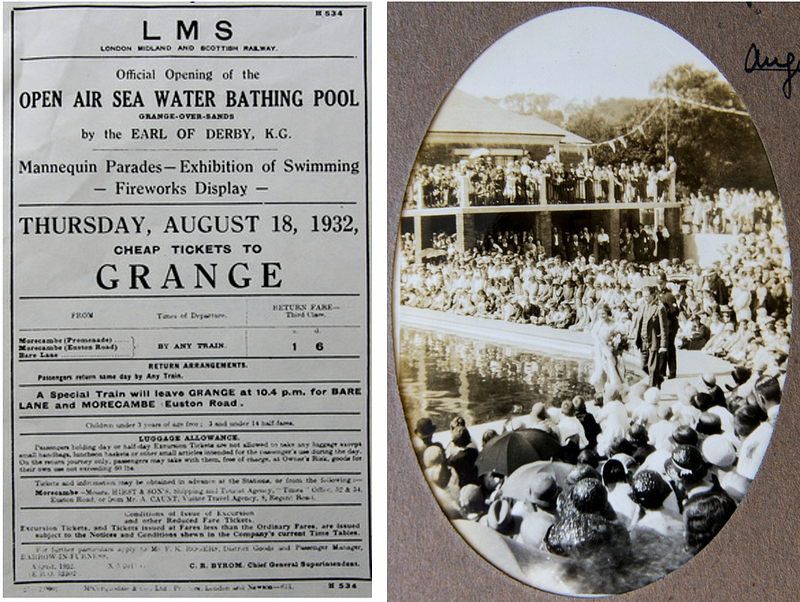
You can clearly tell it was a resounding success. For some strange reason, however, people chose to wear drab, sepia-colored swimsuits instead of more colorful ones.
As you see from the advert, the Grange was not officially called a lido back then. Supposedly the first one to be officially called that was the “Edmonton Lido”, in the north-London town by the same name. By the end of the 1930s, there were dozens of lidos around London and further out, in England, Scotland, and Wales.
The Jubilee Pool, an Art Deco lido in Penzance (where the Pirates play?), is notable for having seawater in it.
Lidos stayed popular for the next few decades; some had up to 6,000 visitors per day during the summer, and more than 50,000 over the year. Things also became more colorful.
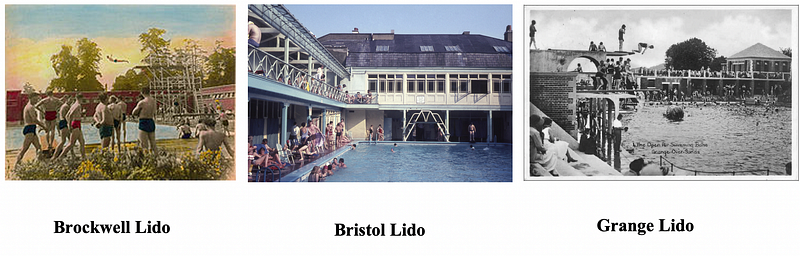
Well, except for the Grange. That stayed in grayscale. Or greyscale, because we’re talking about the UK.
Many of the lidos closed in the 1980s and 90s, but a couple of decades later they started being reclaimed and refurbished, many of them through fundraising efforts. This was partly helped by the fact that government historical agencies had declared them “listed buildings”, which is similar to being declared a “landmark” in the U.S.
Listed buildings are protected and cannot be demolished or altered without special permission.
So, over the last ten years or so, lidos have become very popular across the United Kingdom again. Maybe after the pandemic is finally over you’ll be able to head over to one and see what it’s like to bathe in a pool with thousands of other people at the same time.
I’ll venture a guess: very warm.
In Spain, where I now live, there are also a few lidos, although they are not called that. They are particularly popular in places that are not by the seaside. For example, Madrid. Here is a photo of the Puerta de Hierro pool:
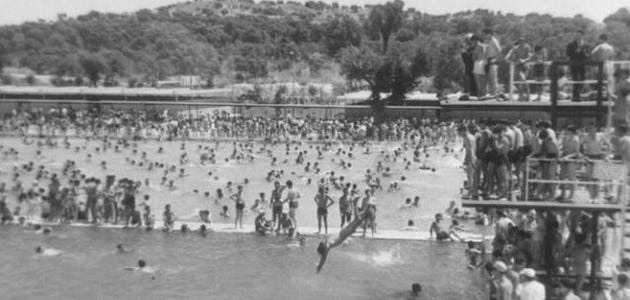
Hmmm… looks like it was built by the same contractors who worked on the Grange Lido.
An old cinema in Caracas
In the capital of Venezuela, (where I grew up), the Lido was a popular movie theater in the first half of the 20th century. To be honest, I do not remember it at all, having been born in the second half of the 1900s. Here is a photo that, shockingly… is also in black and white.
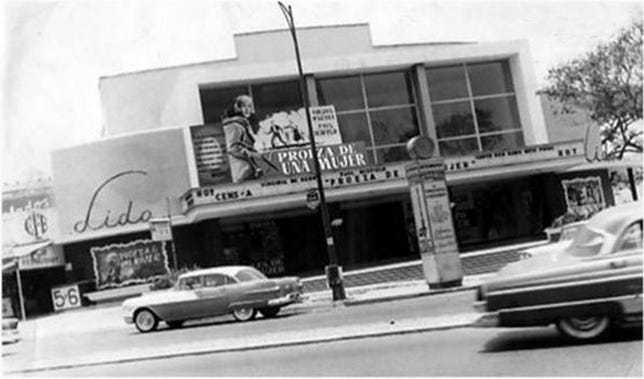
Plus, it seems there was a very strong wind that day.
In the 1990s a whole new shopping mall was built where the old theater used to stand.
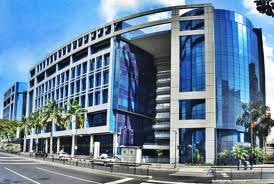
As you can see, it’s much smaller… but at least it has some color to it and it’s not tilting. The movie theater is inside, by the way.
When that theater opened, it was the most expensive one in Caracas. That’s because it had stadium seating and all the other trimmings that the company uses as an excuse to charge outrageous prices, which suckers gladly pay for some silly reason.
When the movie The Mask came out, I was one of those suckers who had some silly reason to pay an outrageous price to see it at the new Lido theater. A few days later I was with some friends; the father of one of them was around, too. Now, I’m telling this story for the benefit of any Spanish-speaking readers out there, because it’s not that funny in English.
“Mask” translates to máscara in Spanish, so the movie was called La máscara. When I told my friend’s dad that we had gone to see it at the recently-opened Lido and had paid through the nose for the novelty of doing so, he deadpanned in Spanish: “Entonces no es la máscara, sino la más cara.”
La más cara translates as “the most expensive”. Yeah, he made a dad joke in 1994 before they were all the rage in 2020.
You’ll have to trust me on this: it was hilarious when it happened.
That’s it. That’s my big lido-related pleasant recollection I mentioned at the beginning. Sorry to disappoint you so heavily. To make up for it, here is another black and white photo:
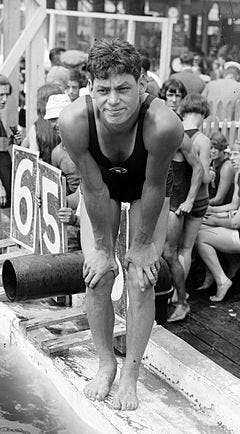
That’s Johnny Weissmuller in 1924. No, not at the Grange Lido. Probably about to kick ass in a swim meet.
So remember: if you are curious about lidos, go check them out in England. I wouldn’t recommend going to Caracas to check out the Lido movie theater because, well, (1) it’s just a movie theater and (2) Caracas is still a very, very dangerous city.
However, if you do go to the UK, just ask for the “humongous outdoor pool”. You can’t use the word lido because the editors of the Spelling Bee puzzle decided that it’s a dord.*
You can check out my previous entry on another dord* here:
*What the heck is a dord, you ask? Here’s the answer: