
Posture One: The Three Streams of a Cloud Security Posture
Article 3 of 9 in Building Your Cybersecurity Posture on Medium

Enterprises need transparency into their cloud security posture in order to remain compliant with risk, security standards, and industry best practices. First step is to build a cloud security governance policies that sets the security standards for your cloud assets. After you know your policies, you need to continuously monitor your cloud assets for configuration changes, misconfigurations, and vulnerabilities. Finally, just knowing that you have issues doesn’t provide security, you need to begin the processes of remediating existing issues through automation and preventing future issues by scanning deployments into your could estate.
Building out a cloud security posture is task the requires agreement and participation from security, operations, and engineering. Agreement is required because security rules without engineering agreement does not provide security, it creates hidden IT and the overuse of risk exemptions.
The Three Streams
Going deeper into cloud security you need to think about what and how to properly monitor your cloud security posture. I find it useful to separate the work into three streams.
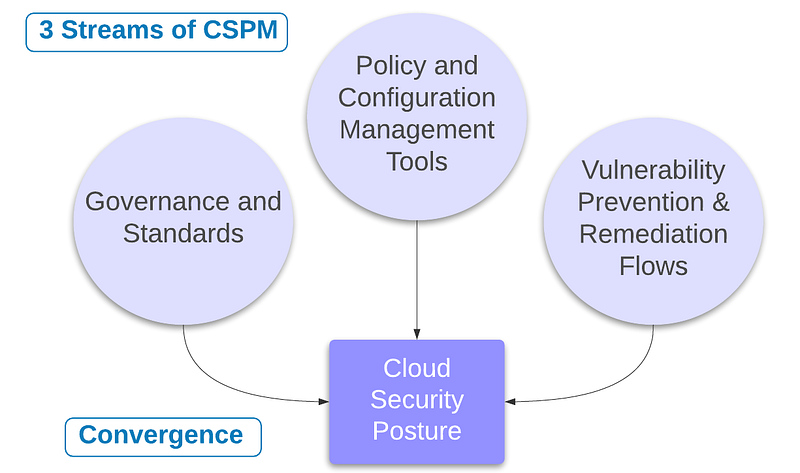
Once the work is divided up, each stream can be pursued independently to expedite building a safe and secure cloud security posture.
Stream 1: Governance and Standards
Governance is the framework of policies and process’s that provide oversight of how security is implemented and how risk is measured for your organization. Governance steers the policies derived from enterprise values. A policy is a high level description of how security should be implement. From policies, security standards are created that are detailed rules and measures that enforce the policy.
Governance can be both centralized and decentralized at the same time. I feel that a good cloud governance framework has centralized policies and standards. At the same time a good cloud governance framework has a decentralized risk review and interpretation process.
Building a governance model of policies and standards for your enterprise is no easy feat. Often in the case of cloud governance and policies, there are existing standards throughout other policies such as your network, application, infrastructure policies. To precisely govern cloud security, I believe it is necessary to provide a single policy representing your cloud. Clouds are continuously evolving, adding new virtual asset types, and even launching new asset categories. It seems to me that cloud security is important enough to spend the time and build out its own governance model.
Stream 2: Policy and Configuration Management Tools
Software is a security and compliance tool that identifies drift, misconfigurations, vulnerabilities, and risks to our cloud assets. When securing your cloud assets,
There are 5 major cloud security capabilities that need to be measured as part of your cloud security posture:
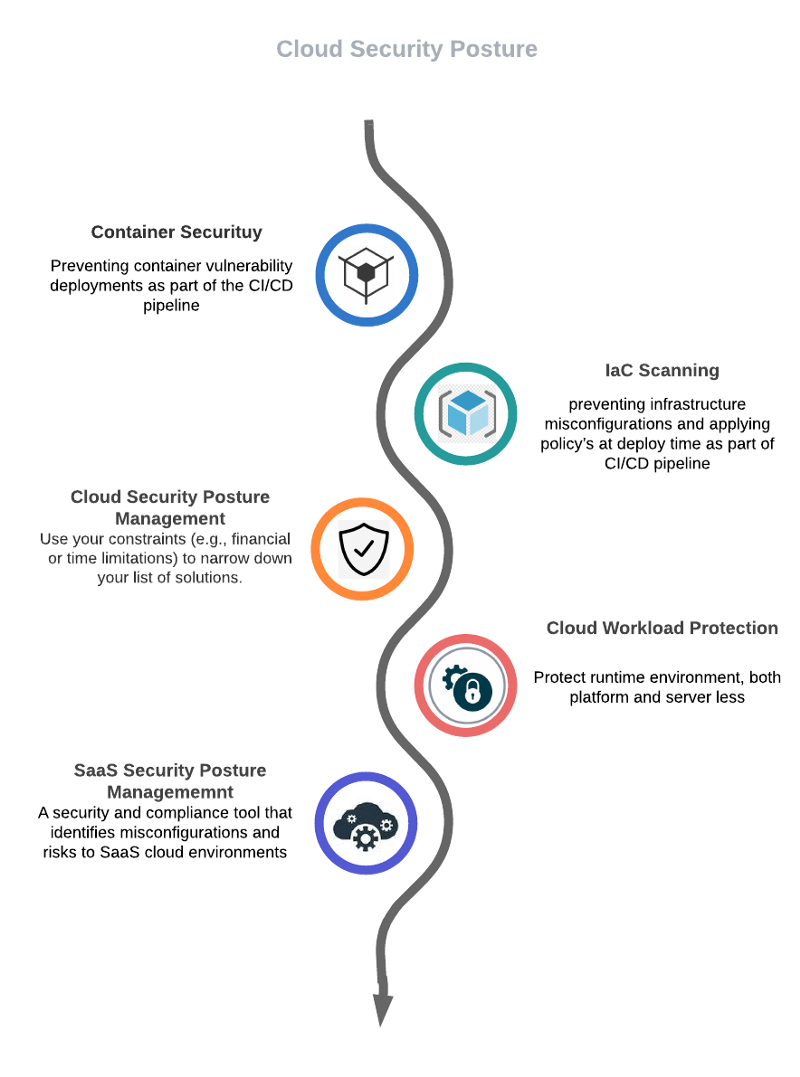
- Container Security — prevents deployments of containers with security vulnerabilities as part of the CI/CD pipeline.
- Infrastructure as Code(IaC) scanning — prevents infrastructure vulnerabilities by checking for policy misconfigurations at
- Cloud Workload Protection — actively scans runtime environments, both platform and server less, for security vulnerabilities
- Cloud Security Posture Management — a security and compliance tool that identifies misconfigurations and risks to our cloud assets in our IaaS and PaaS cloud environments
- SaaS Security Posture Management — a security and compliance tool that identifies misconfigurations and risks to SaaS cloud environments
Stream 3: Vulnerability Prevention & Remediation Flows
In addition to having a governance model and monitoring our cloud estate, we need to take action to both prevent issues from occurring and remediating any issues that manifest.
Using Infrastructure as Code Scanning to Prevent Misconfigurations
Once we have a controlled cloud configuration, it makes sense to evolve and decentralize the security to the developer. This is a classic “Shift Left” example where we provide the centralized policies to be used in the DevSecOps pipeline so that developers can get real time feedback of their configurations. Developers cannot wait for feedback on a misconfiguration or policy violation until after deployment into a production environment. By integrating IaC scanning in the DevSecOps pipeline and using the centralized governance model, we make the experience for developers to do the safe and secure thing frictionless and useful by moving the feedback cycle into their CICD process.
Using Cloud Workload Protection to Detect Configuration Drift and Runtime Vulnerabilities
Of course not all configurations stay static in our prod environments. Matter of fact, configurations can be altered for both malicious and non-malicious reasons, but in either case it’s important to detect the change and remediate the issue. Often this is done by first detecting the deviation, and then issuing an issue ticket in your project management tool of choice to fix the problem. More mature organizations even automate this process.
Convergence of the Steams into Cloud Security Posture
Once you have built out the three stream, they become your cloud security posture. Your cloud security posture gives you the ability to monitor a defined set of policies & standard across multiple cloud platforms, measure risk of your entire cloud asset portfolio, and instrument fixes to identified misconfigurations and vulnerabilities.
Articles in my Medium series “Building Your Cybersecurity Posture”
Article 1 — “13 Asset types to Build Your Cybersecurity Around”
Article 2 — “The 6 Categories of Cybersecurity Posture”
Article 3 — “Posture One: The Three Streams of a Cloud Security Posture”
Article 4 — “Posture Two: Application Security Posture”
Article 5 — “Posture Three: Data Security Posture”
Article 6 — “Posture Four: The Three Focuses Enterprises Need for an Identity Access Management Posture”
Coming soon…
Article 7 — “Posture Five: Network Security Posture”
Article 8 — “Posture Six: Device Security Posture”
Article 9 — “The Future of Securing Your Assets in a Decentralized Cloud”
As my daughter says, if you are interested in “what-ever-this-is,” then please consider following me on Medium.


