
Post-Millenials vs. Infinite Jest
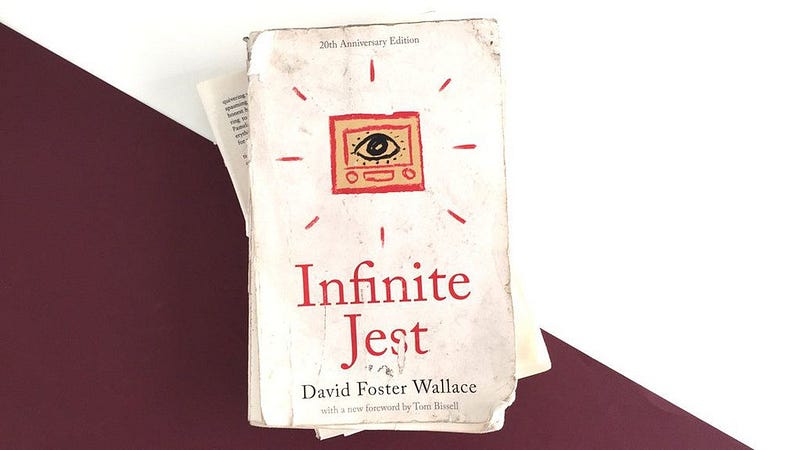
My memories of the 90s are sparse, because that was when I was born. Like me, David Foster Wallace’s novel Infinite Jest came into the world in 1996 and grew up in the eruptive age of smartphones, social media, and personal computers.
This bland and self-centered observation makes the following point — the times in which the work was written are radically different from when I finished the novel, which was no more than a month ago. Yet, as Tom Bissell writes in the forward to the 20th Anniversary edition of Infinite Jest, Wallace’s ideas about addiction, worship, and entertainment have only expanded in importance with the ever-totalizing reach of technology and leisure.
Millenials had box televisions, cassettes, and cartridges. I, a borderline member of Generation Z (or a “post-millenial”), have YouTube, console video games, and music streaming. Whereas the TV generation was subject to the content that companies chose to display on their screens, the post-Millenials have been given near-infinite control over what we consume. In fact, what companies of the 21st century have started to monetize is consumer choice in and of itself. Constantly competing for our frenetically thin attention, companies offer us order in the digital sea of chaos via this choice, and therefore personal identity.
Despite these changes, we now have the worst opioid crisis in American history. The prevalence of mental illness is rising. We elected Donald Trump.
And speaking of Trump (I would not be the first to make the comparison to Infinite Jest’s slime-spewing President Johnny Gentle), let’s talk about cartoons. I would argue that TV shows have changed quite a bit in purpose. The cartoons that Millenials watched, not just the literal Saturday morning cartoons but also goofy sitcoms and sickly sincere melodramas, served as purely entertainment and thus as a harmless escape from life.
Video content now, whether it’s Netflix TV shows or YouTube vlogs or 30-sec Twitter clips, or at least the way we interact with that content, has largely moved away from the raison d’être, that is, to amuse.
Even the silliest content seems to always have an underlying seriousness. Look at shows like Bojack Horseman or Rick and Morty, in which cartoons are our modes for speaking about depression and loneliness. Look at internet memes, which give young people an unexpected but importantly comfortable medium for expressing their anxieties. Content has become strikingly self-conscious.
Consumption has itself become intensely personal. Human knowledge has always seemed infinite, but now access to that knowledge seems infinite too. The result is, at least concerning the Internet (although I see this extending to education and politics), is that individuals can own and cultivate spaces for a strange but intense narcissism.
This narcissism is not inherently a bad thing. In many ways, it satisfies a longstanding cultural yearning for authenticity and self-knowledge. However, the realization that Infinite Jest’s narrator stumbles on is that narcissism and technology and a lot of free time are ingredients for self-worship.
And this is not just people worshipping their own images and personas, but also people worshipping the very idea of Self and the preservation of the ego. The characters of Infinite Jest are deprived of this sense of an “I” and try to compensate for this lack with various addictions, which they are literally lost to.
The character who comes closest to the self is James Incandenza (literally referred to as “Himself” by his family), father of protagonist Hal and creator of the Entertainment. Unlike the other characters, who only consume addictive substances, James actually creates his own. This ability to create, and thus to manipulate, is what allows him to achieve the most endlessly addictive, and therefore fatal, entertainment of all: a genuine expression of the Self.
The gift that James gives to his son, since he never gives Hal any sort of verbal advice (much like what James Joyce does for Wallace), is this ability to “jest.” Yet, the narrator realizes that James’ act of creation is not enough to transcend the pull of addiction, in his case of alcohol. This, as is the issue in our modern times, is because James “jests” purely for himself. Or at least, he imagines the Entertainment as the distillation of a perfect “Himself.”
This is at least my interpretation of Infinite Jest and it’s continuing relevance. We have become jesters of our own courts, moving the chess pieces in our digital environments to nourish and to play out our sense of Self. This is the ultimate, and most pernicious form of worship because the Self, like everything in human life, is never enough.
I think it’s easy to misunderstand Infinite Jest as saying that the solution, or at least the better alternative to addiction is a leap of faith into trite prayer and sincere clichés. If this was the case, I don’t think we’d still be reading the novel in 2018.
Rather, we should be conscious of the basic human feelings and intentions underneath the clichés or rather, underneath the Internet memes, the YouTube vlogs, and perhaps the voters on the other side of the aisle. Understand that everyone is, in this era in which the act of creation is increasingly democratized, a little desperate for some connection. This, I would argue, is a step towards a balance between narcissism and empathy in the present age, and to begin answering some of the bigger questions in Infinite Jest. Where am I in this mess? What does it mean to be apart of a community? What does it mean to live an honest, decent life?
If you enjoyed my writing, please consider supporting me on Patreon: https://www.patreon.com/xichen