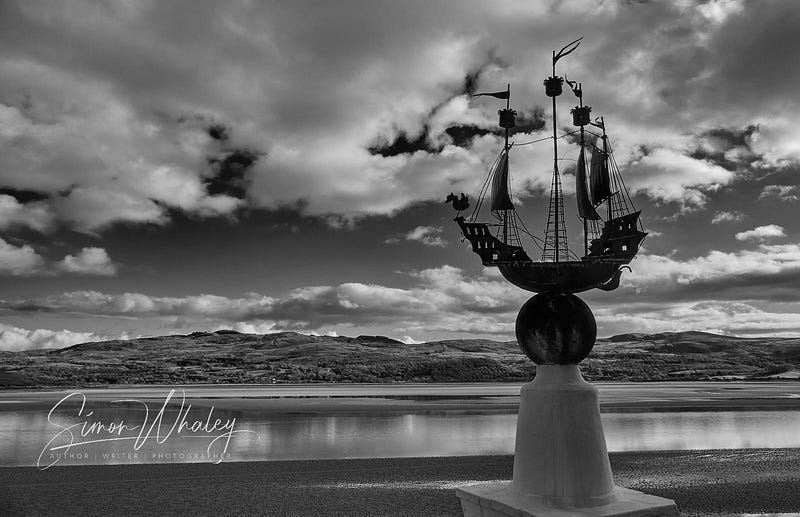
Portmeirion — The Colourful Italianate Village in North Wales
How an architect created a visual masterpiece and taught the world the beauty of recycling
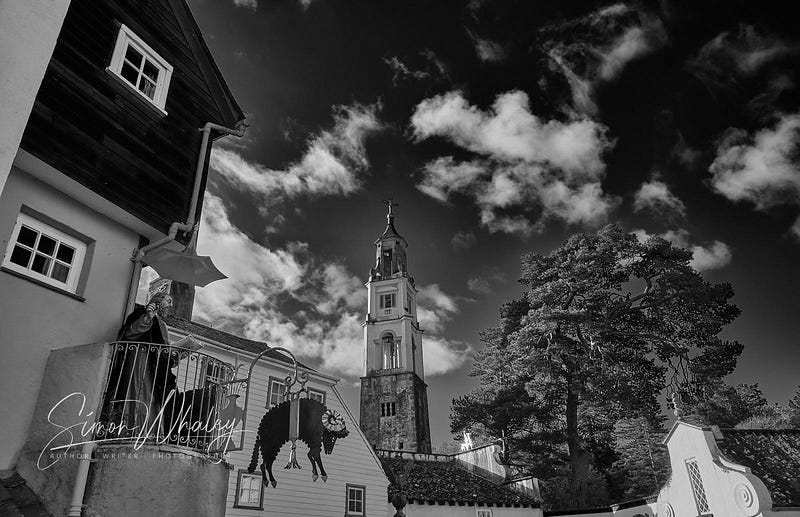
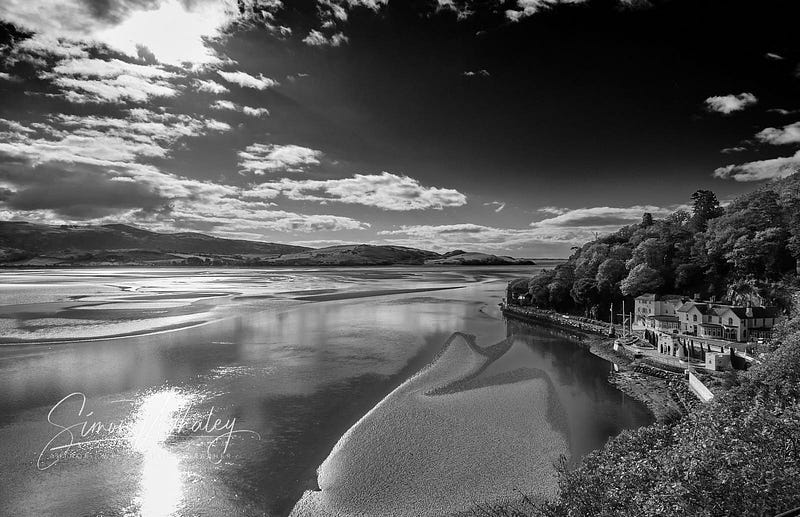
Nestling on the side of an estuary in North Wales is the most amazing architectural masterpiece to be found anywhere in the UK. While many UK seaside towns and villages have colourful properties that create a rainbow of brightness whatever the British weather can throw at it, Portmeirion produces a kaleidoscope of hues and shades.
But on my last visit, a couple of weeks ago, I was mindful of Globetrotter’s Monthly Challenge — celebrating gray, and it struck me how ironic it would be to write about such a colourful place with a gray slant.
In some ways, shooting in monochrome revealed a whole new aspect of Portmeirion I hadn’t seen before. The colour camouflaged it.
Portmeirion is one of those places you can visit time and time again and you see something new each time you go. Not because there are new developments — there aren’t. In fact, the last major works to be completed in the village were over fifty years ago.
There is so much detail on every building that it is not possible to take it all in on one visit. But viewing Portmeirion through the glasses of greyness illuminated many of those finer details.
The idea of looking at the details of a place came to me after reading Brad Yonaka’s fascinating piece about manhole covers:
And a shout out goes to Mario López-Goicoechea for it was his architectural images that made me think about looking at Portmeirion in a different shade of light.
Portmeirion exists thanks to the architect, Clough Williams-Ellis, who in 1925 spent less than £5,000 buying a parcel of land, which he described as, “a neglected wilderness.”
He’d always dreamed of creating a coastal village and the land he acquired in 1925 gave him the opportunity to do so. It was originally called Aber Iâ, which means ice estuary.
Clough changed this to Portmeirion, acknowledging its estuary location that gave it a port-like feel, and merged it with the old county name of Merioneth (which disappeared during the 1974 local government re-organisation).
Clough’s personal motto was, “Cherish the past, adorn the present, construct for the future.” Portmeirion completely encapsulates that.
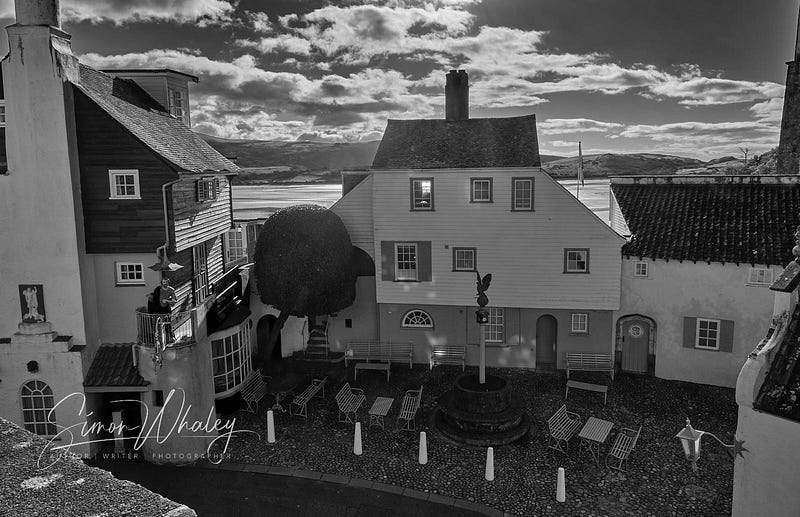
Clough saw his village as his “home for fallen buildings,” because much of what we see today originated elsewhere. He was forever recycling bits of buildings, and upcycling salvaged pieces to show that discarded architecture had beauty that could be cherished again and enhance his village.
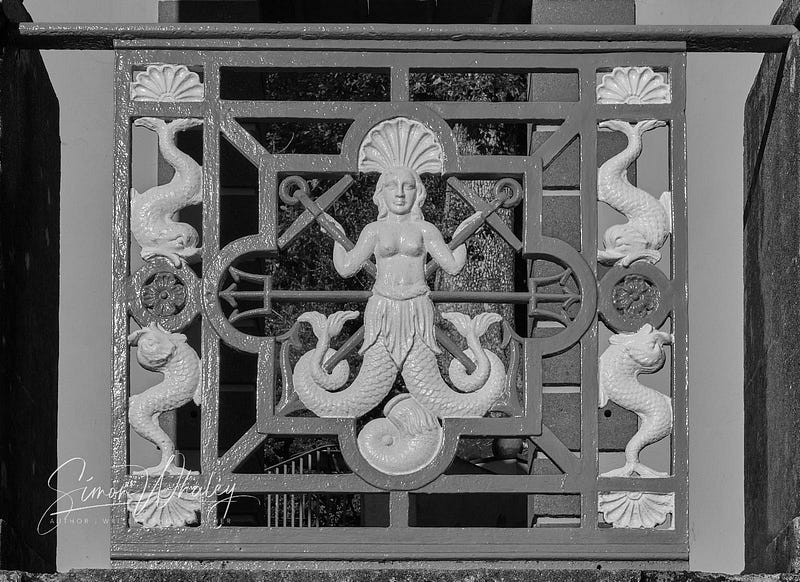
Look at the Mermaid panel above. These adorn various buildings and fences around Portmeirion. Having a coastal design suggests they were made for the village, but they were actually salvaged from a seaman’s home in Liverpool that was destined for demolition. I love the detail of the scales on the fish, and mermaid’s tails, something the monochrome images have accentuated. (And the children love them, because they’re slightly rude!)
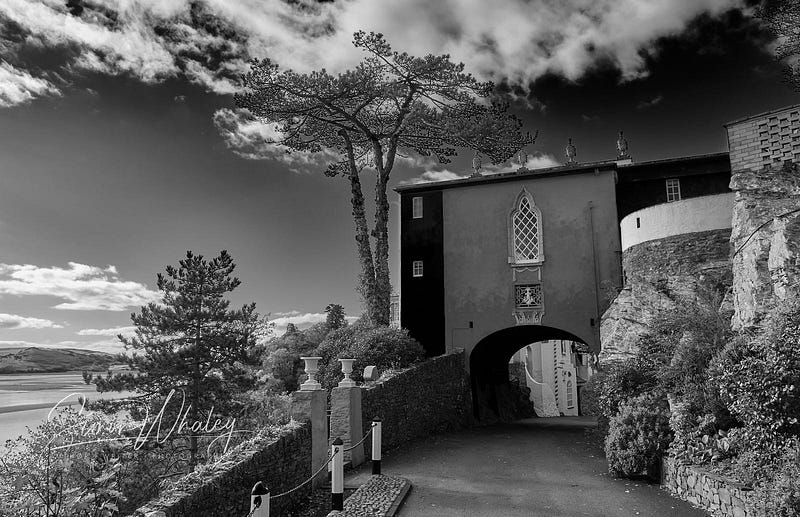
These panels can be found on The Gothic Pavilion. “This was a generous gift to me from Nerquis Hall,” Clough wrote, where it was a porte cochère — a covered entrance which is wide enough for vehicles to pass through. During the dismantling process it was badly damaged, but this didn’t deter Clough, who insisted on making use of the material.
“In the end,” he added, “we built up, not the original portico, but an amended version which, with its more attenuated proportions and slender pinnacles, is generally held to have gained in elegance whatever it may have lost in authenticity.”
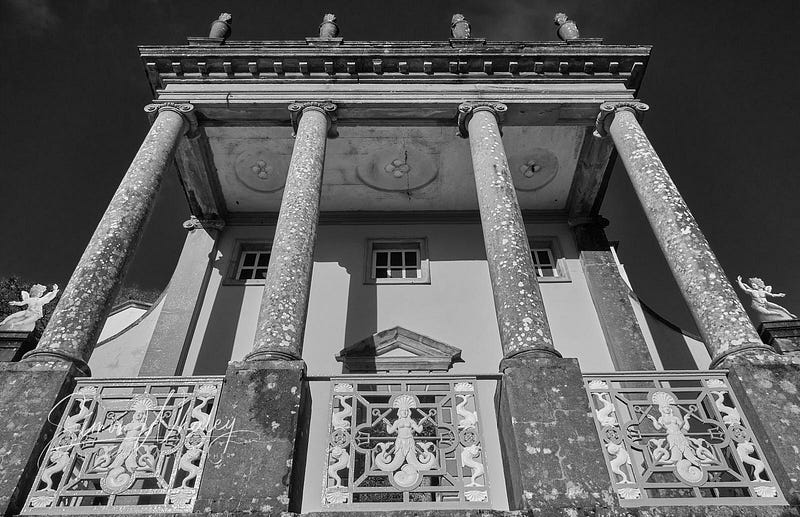
One of Portmeirion’s many fascinations is that there are sculptures and statues everywhere, once you start looking. Here’s one I found underneath The Gothic Pavilion …
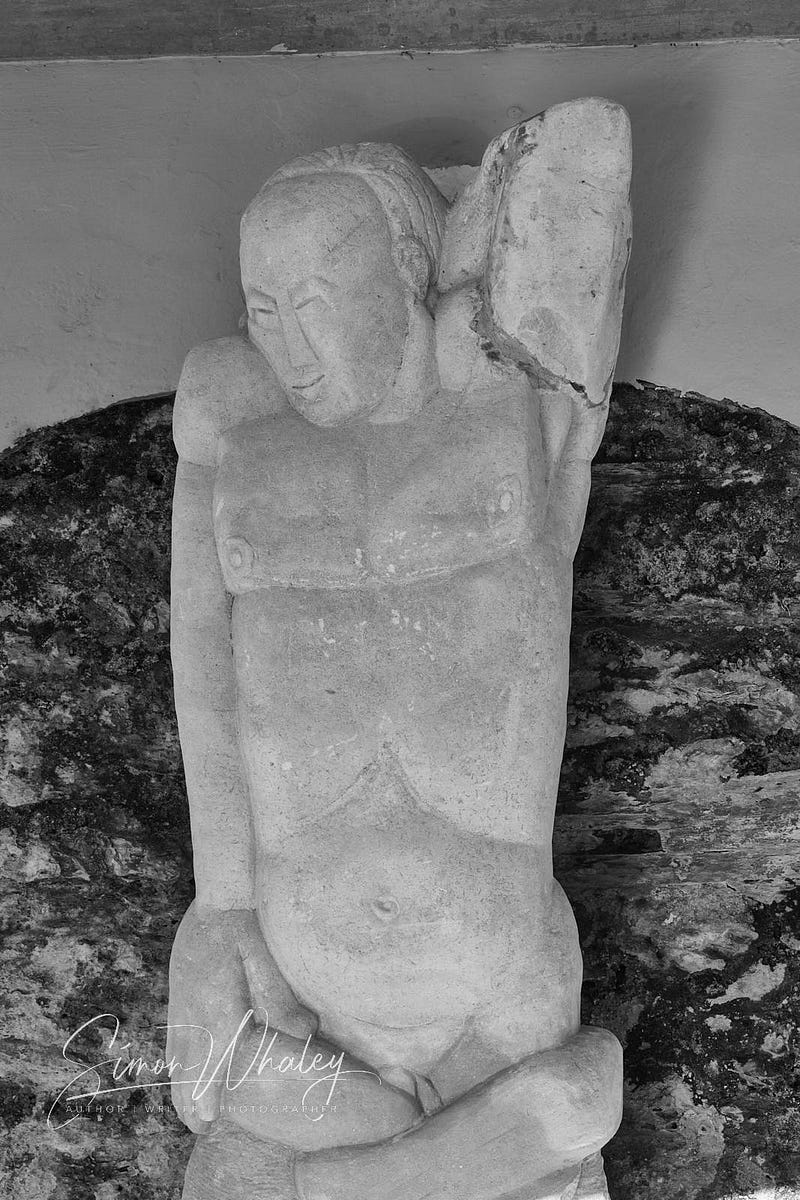
I love the way the texture of the stone is enhanced in this monochrome image. (It does make that crack under his armpit look more painful — I think he needs to change his deodorant 🤣.)
Portmeirion was built in two stages: between 1925 and 1939, and then from 1954 to 1976. Some buildings already existed on the site when Clough bought it in 1925.
The Hotel beside the estuary, for example, was the original mansion of the Aber Iâ estate, although it was derelict and overgrown. Realising he needed cash to build his village, he quickly renovated it, opening to paying guests in Easter 1926, less than a year after acquiring the site.
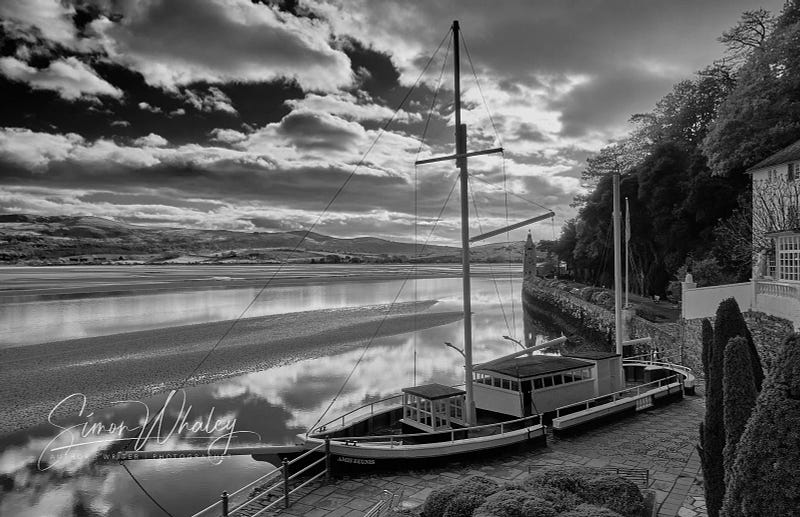
But Clough took things further, by incorporating a sailing boat into the quayside. The Amis Reunis looks as though it is docked at the quayside, when in actual fact, it is part of the quayside.
Whenever I visit during the school holidays, the Amis Reunis is packed with budding child sailors all shouting nautical terms.
“Raise the anchor”
Release the mainsail!”
“Eye, eye, captain!”
Coming in November (when it’s also cheaper to get in) means it’s much quieter. You can hear the birds chirruping in the foliage, and various chimes of Portmeirion’s numerous clocks.
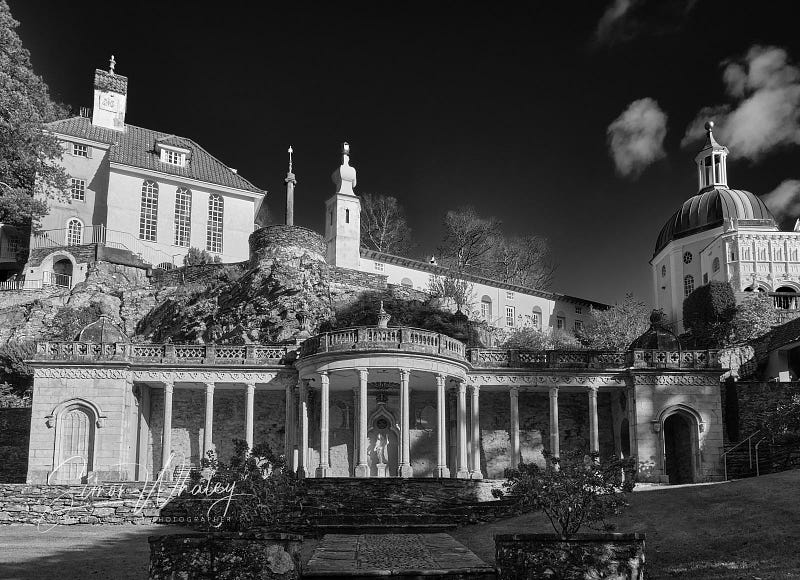
The Bristol Colonade, which overlooks the central Piazza, was originally built around 1760 and stood in Bristol, over 170 miles away. It suffered from bomb damage and the associated Bath House had deteriorated so badly it couldn’t be saved. In 1959 the Ministry of Works gave Clough permission to dismantle it, and rebuild it at Portmeirion.
Just off from the Piazza is The Town Hall, built between 1937 and 1938. Originally, Clough planned to build a theatre here, but when flicking through the pages of Country Life magazine he spotted an article announcing the demolition and sale of the assets of Emral Hall, in Flintshire.
He dashed across Wales arriving just in time for the start of the sale, where he bought the ballroom ceiling for £13, and then went on to buy the rest of the room, including the mullioned windows, oak cornices, and fire grate. To make use of these purchases, he dropped his theatre plans and built the Town Hall instead.
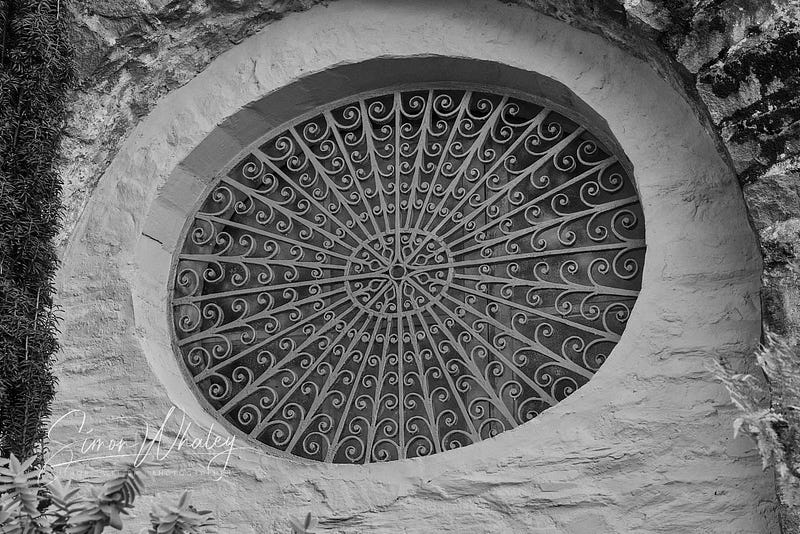
Emral Hall is not the only building to help form part of this amazing building. To the left of the Hall’s main doors is an oval grille in the wall, which used to be part of the old Bank of England building in Walbrook, in the City of London. (I assume he found it in a reclamation yard, rather than stole it from the building!)
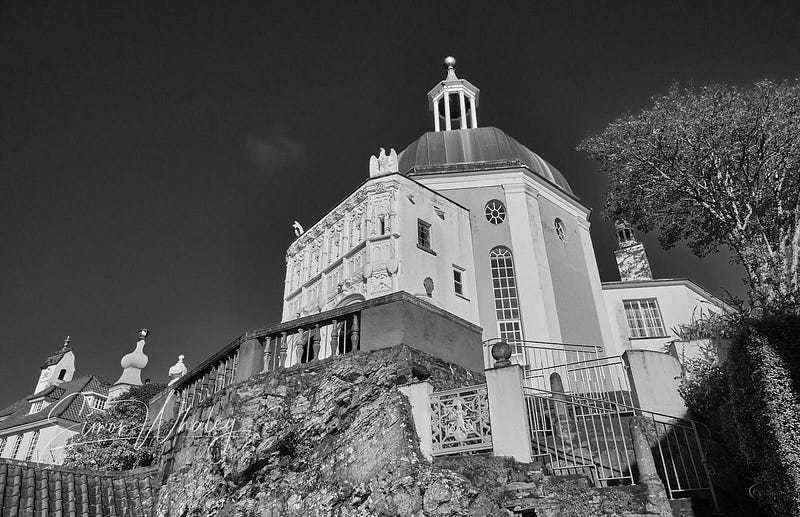
Pieces were often acquired on spec in the hope they might come in useful one day. When he built The Pantheon in 1960, Clough added the ornate Gothic porch, which he’d picked up 20 years earlier, from Dawpool, a Cheshire property. Although used as a porch for The Pantheon, at Dawpool, such was the scale of the building, it was originally an interior fireplace. But at least Clough used all those bits he pieces he acquired just in case they came in handy. (Most of my just in case stuff gets shoved in a kitchen drawer!)
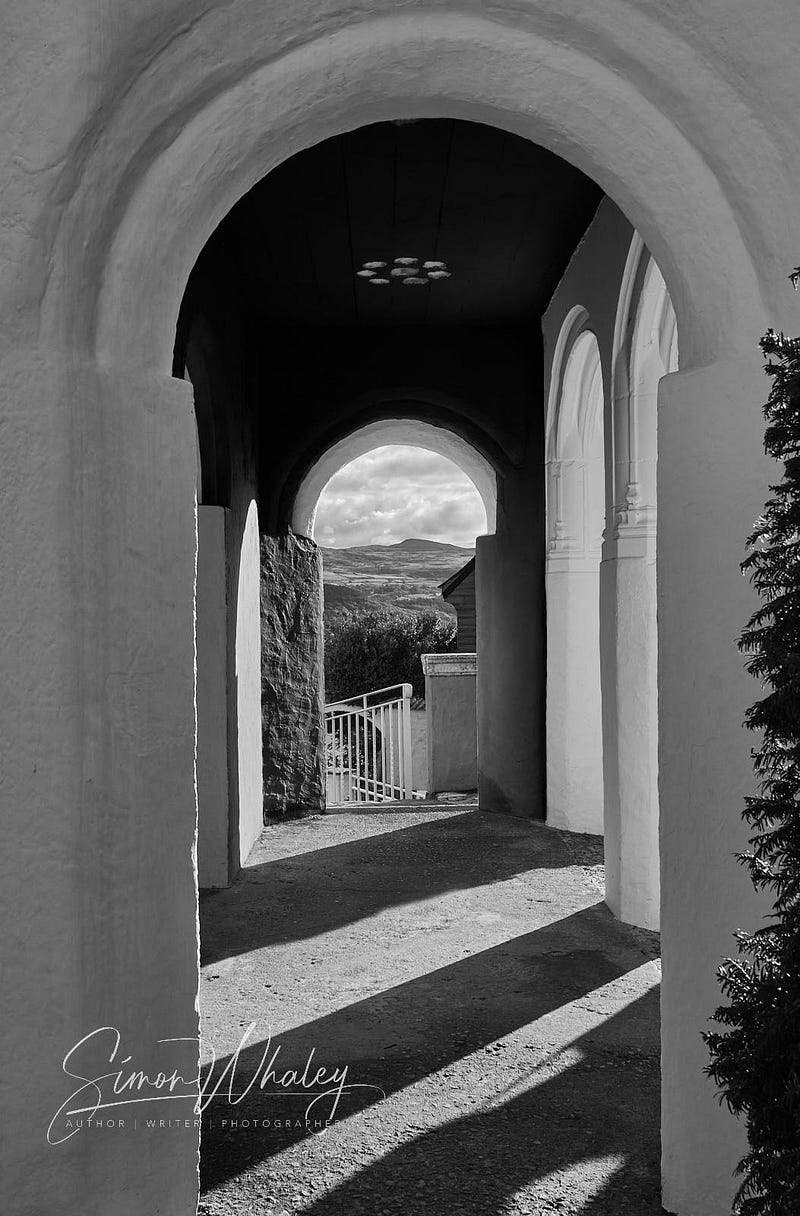
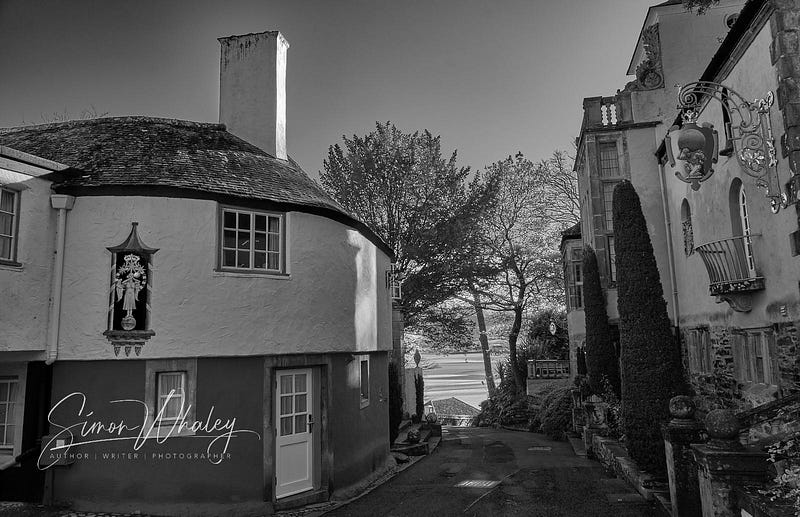
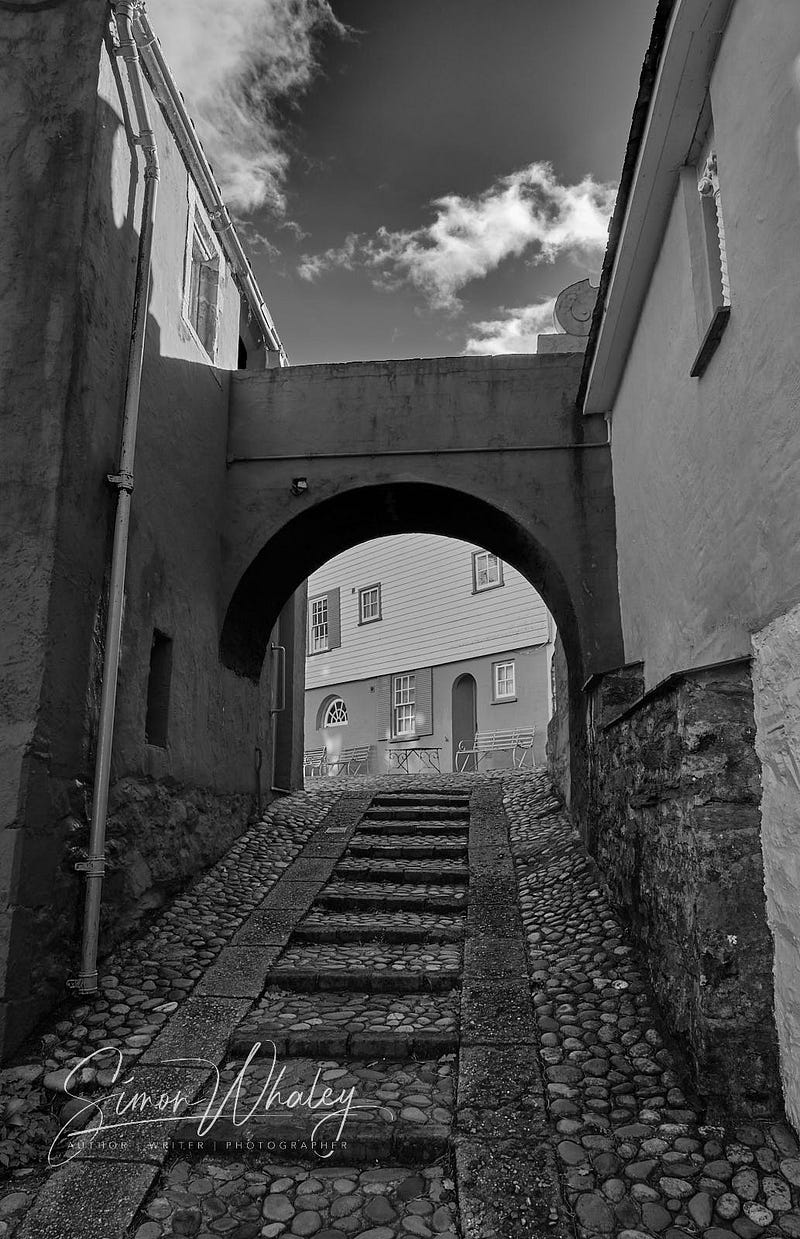
While the image above is reminiscent of a Greek island building, there are nooks, crannies, and passageways everywhere, that feel as though they could be part of a village anywhere in the Mediterranean. The cobbles really pop in greyscale.
But stop and look at this passageway. Steps have been created in the gap between the concrete slopes where a vehicles tyres can run. So there are steps for pedestrians, if they prefer, or they can walk along the slopes, and it’s still accessible by vehicles. Multi-functional perfection.
To really appreciate Portmeirion, you have to slow down. In fact, it’s best to stop walking, and just stare. Take everything in. Because only then will you spot things …
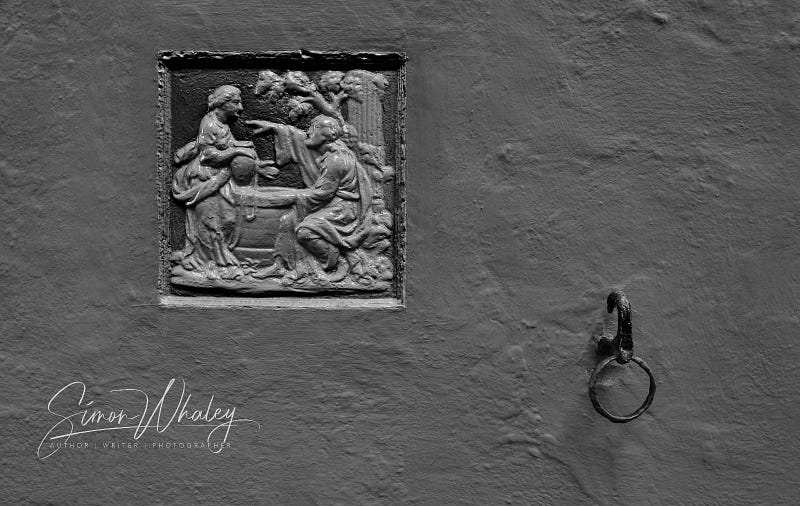
… like this ornate tile and hoop on the wall of a building. It’s such a little detail, but it adds so much. While the hoop was probably used for tying up your horse, when you popped into the shop, the tile is just exquisite.
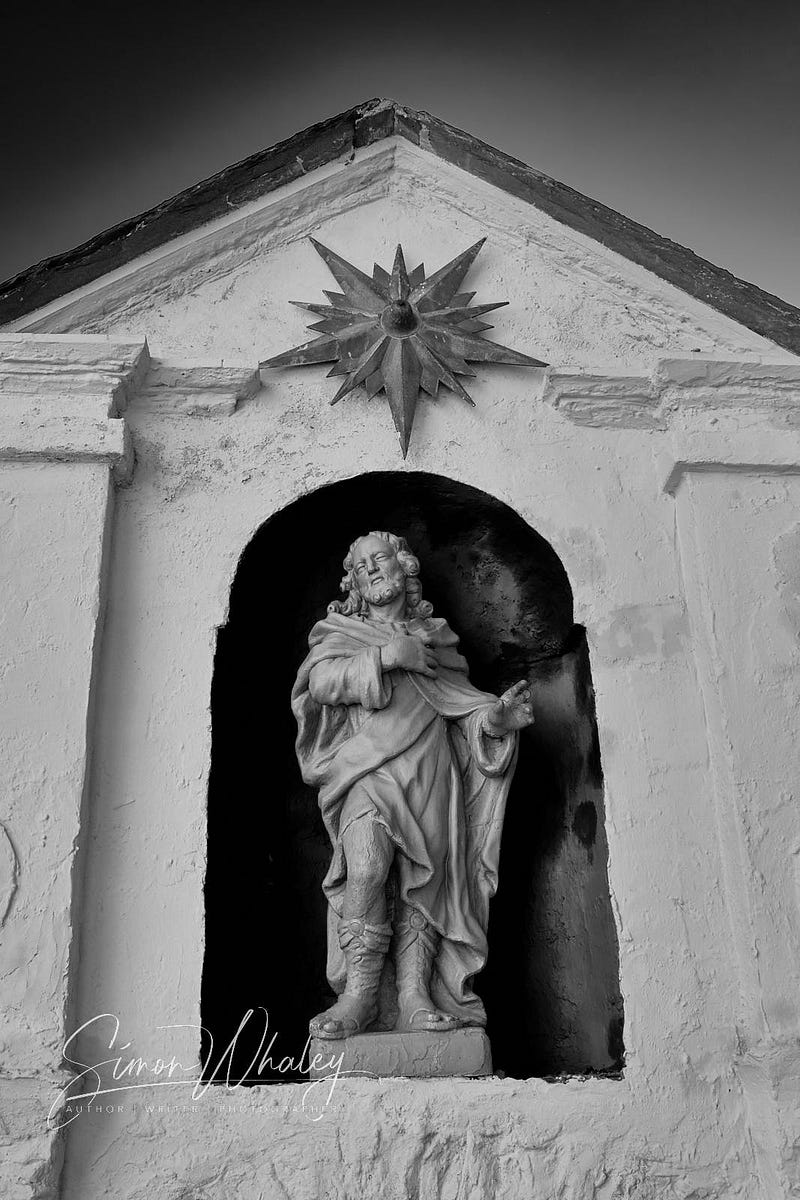
And don’t forget to look up, too, for Clough put statues everywhere, including building gables. I envy Clough his design skill. He knew what to put where. If I’d done it, it would look a complete mess!
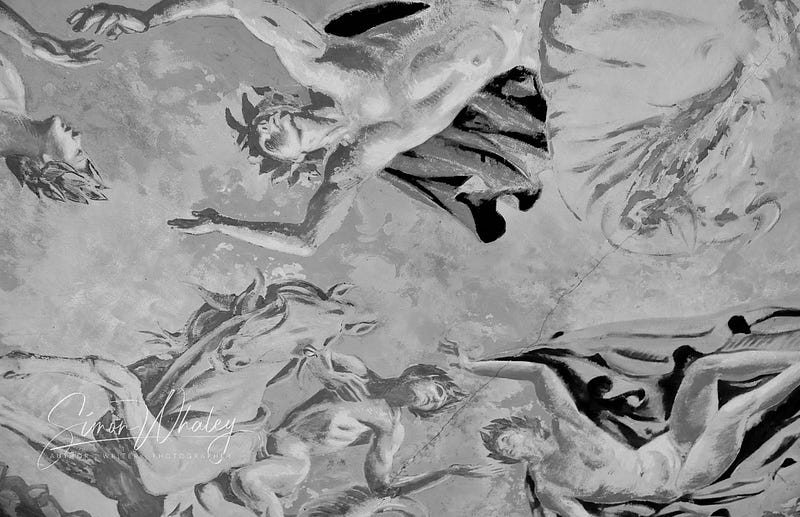
While you’re looking up, don’t forget to look up when you pass under a property on stilts. Clough believed that even a ceiling space was worthy of beautifying. (I’d be proud to have this on a wall, let alone a ceiling!)
Clough’s home for fallen buildings has certainly stood the test of time. In the 98 years since he acquired the site, Portmeirion proves that if you cherish the past, adorn the present and construct for the future, it is possible to create something stunningly beautiful.
I’m always in awe of this man. He was ahead of his time, recycling and reusing, not just ornaments and interior structures, but entire buildings. Sometimes, Portmeirion makes me mad. If we can make places look like this, why can’t we build more like this everywhere?
Even on a grey November day, Portmeirion is stunningly beautiful.
And the beauty is everywhere. Just look at the detail and design in the central column below.
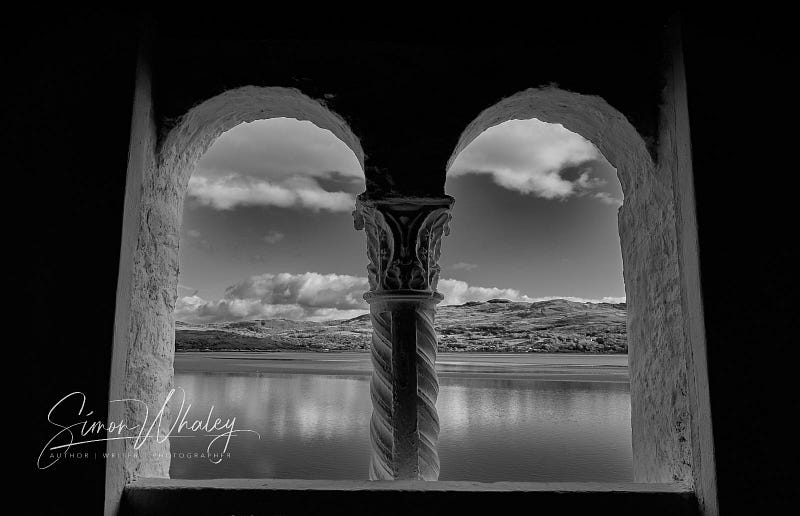
In a 1976 article in Country Life magazine, the phrase “Cloughing-up” was used to denote something that had been lifted from dullness. You can’t get more Cloughed up than Portmeirion!
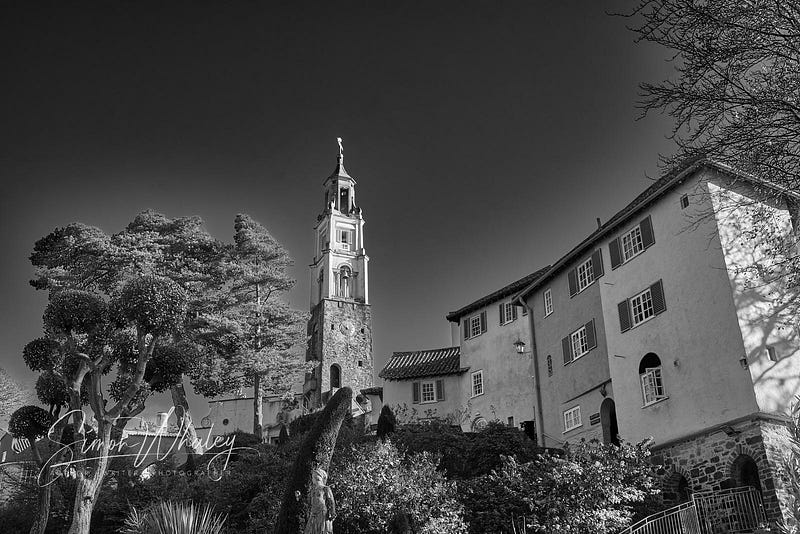
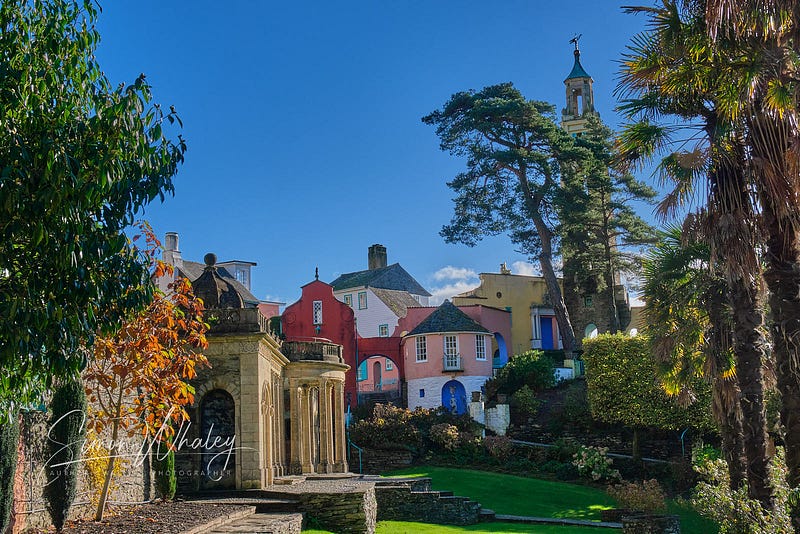
I’m sure you’ll agree, even as grey images, Portmeirion is still colourful. But if you’ve never been, and you’re intrigued as to what the village looks like in colour, here’s a taster …
(Okay, I admit it — Portmeirion doesn’t always have this good weather in November!)
And if you’re looking for something more magical, what would you say if I told you that many of these buildings are rented out as self-catering accommodation? Why visit Portmeirion, when you can stay? (That is so on my wish-list. I can only imagine having the whole village to myself after it has closed to the public at the end of the day.)
For more information visit: http://www.portmeirion-village.com