
FOODIES, BEWARE!
Pop-Tart Fan Bugged by Filling
“You may have been eating insects your whole life”
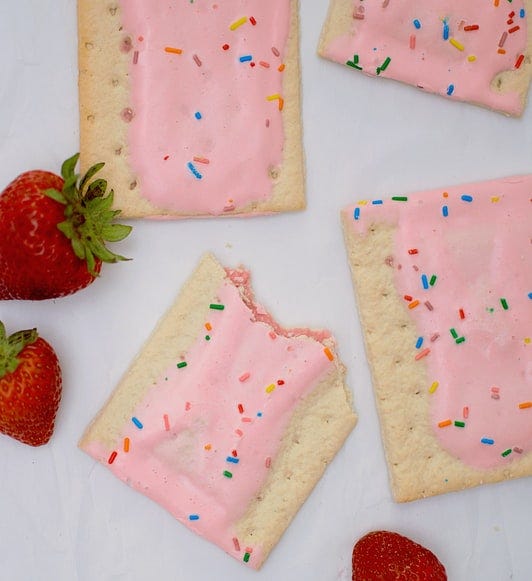
The thing I always loved about my strawberry yogurt was the authentic color and crunchiness of it all.
Same with those devoted to Pop-Tarts. My friends would often bring them to school to munch on, straight out of the box, during the first class of the day. They’d pull those space-age looking foil packets out of a pocket in their backpacks and chow down. Can you say “Ewwwww…Gross”?
Yes, we teens took our delectable selections seriously back in the day. But one New York State woman is reaching beyond a whole new level on the estimable food pyramid when it comes to what’s on America’s breakfast menu.
A strawberry is not a strawberry if it’s an apple or a pear.
You’ve probably heard about the case. A gal by the name of Elizabeth Russett is suing the Kellogg Company on the grounds of false advertising.
Ms. Russett contends that the faux pastry she has come to know and love since it broached grocery store shelves in 1964 does not contain enough strawberries.
Yes, 735,000 of her fellow Americans have died from an insidious virus allowed to run rampant during the last presidential administration, but this woman is concerned that her daily sugar intake of Pop-Tarts is possibly polluted with a medley of other genuine fruits instead of 100 percent of the aforementioned strawberries.
“The Product’s name, ‘Whole Grain Frosted Strawberry Toaster Pastries,’ is misleading because it includes ‘Strawberry,’ but does not include pears and apples, even though the fine print of the ingredient list reveals the presence of more of these fruits than strawberries,” according to the lawsuit, as reported across the InterWebs.
Ms. Russett is asking for more than $5 million in damages because her strawberries might not really be strawberries.
I guess she has the means to hire an attorney to pursue the issue of dietary purity. My question, though, as a long-time English teacher in good standing: Did Ms. Russett ever read Fast Food Nation, by Eric Schlosser? She should. And you, Dear Reader, should, too.
This exposé reveals more than a few tasty nuggets about what goes into the food we Americans enjoy with such gusto, including — perhaps — those overly beloved Pop-Tarts.
She’s bugged about the dang berries, and I’m guessing she really doesn’t even know the reason why.
In doing her research, I hope Ms. Russett came across the tidbit in Federal law that says manufacturers aren’t required to report all of the ingredients she’s consuming. You know, the so-called “Natural Flavors”, which are far, far from anything resembling wholesome and good-for-you, too. And that includes those of a non-fruity nature.
Any fruit coloring, crunchiness or whatnot in the food we all eat could originate from the most unlikely of sources — a teeny, tiny beetle.
Cochineal extract, according to Schlosser, comes from the “dessicated bodies of female Dactylopius coccus Costa, a small insect harvested mainly in Peru and the Canary Islands”.
The bugs are pulverized, mixed up and turned into a lot of that yummy “strawberry”-like flavoring we’ve come to know and to love over the years — in grapefruit products, yogurt, and — quite possibly, but I couldn’t prove it at press time — Strawberry Pop-Tarts. Better do some more research, Elizabeth, stat!
Yeah, so if your yogurt, popsicles, frappuccinos, ice cream, fruit pies, cupcakes and sodas taste especially delish today, you can thank that tiny little red bug. Oh, and its larvae, too. Because life — of tiny little red bugs, at least — is not so sacred to those who want to use it to further their financial interests.
Or, as the BBC put it in an article three years ago, “You may have been eating insects your whole life”.
Someone, quick — tell Elizabeth Russett! She might have to change her lawsuit. Again, I have no proof that the Dactylopius coccus Costa is part-and-parcel of any Pop-Tart on the market today. But it could be the lack of strawberries in her breakfast pastries that’s bugging her — and the legitimate ants in her pants might be from an insect of another variety.