
Pollex
This word is thumbing its nose at us

Today’s New York Times Spelling Bee letters:
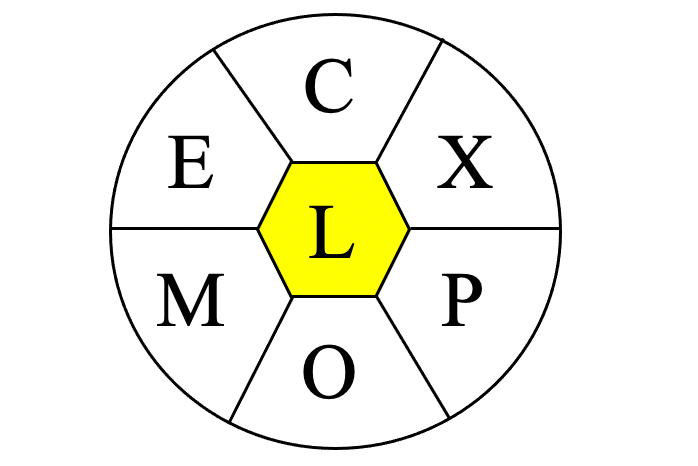
C, E, M, O, P, X, and center L (all words must include L)
Merriam-Webster says…
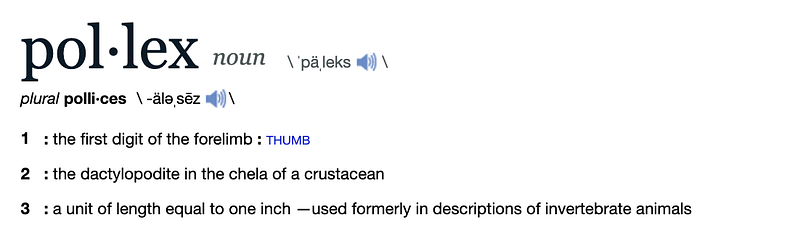
Silly little dictionary! Don’t you know that pollex can’t possibly be a word if the New York Times says it ain’t?
For further fascinating facts, check out the Spelling Bee Master.
What’s your favorite dord* from today’s puzzle?
My Two Cents
That thumbs up in the photo at the top of today’s column is probably what a lot of Real Madrid fans are doing right now, even at this late hour. There’s a lot of celebrating going on in Madrid, Spain, today… and in France for that matter. A few hours ago Real Madrid won the UEFA Champions League for the 14th time, beating Liverpool 1–0 in Paris. This tense and exciting match served to cap one of the unlikeliest journeys a club ever took to crown itself as the best in the world.
(Note to Americans: when I say football I mean “soccer”, not handegg.)
Yes, football’s World Cup — which will be played this coming fall in Qatar–– is the biggest and most widely viewed tournament, but that event is played by national teams. The Champions League features the top football clubs from European countries (plus a few that aren’t in Europe). These clubs have some of the best players from all over the world. If you’re not familiar with European football but are familiar with American sports like baseball or basketball, you can think of the Champions League as the equivalent of MLB or the NBA, with today’s game being sort of like a Game 7 of the finals. The difference is, of course, the first six games did not happen. The format is very different from playoffs in American sports. But the result is about the same.
In any case, forgive me if I’m a bit distracted today. Adrenaline is still coursing through my body from the incredible underdog win today. And what’s even more amazing is that I’m not a Real Madrid fan!
Pollex the thumb
The thumb is the first digit of the hand, right there next to your index finger. Our friends at Merriam-Webster define it as either “the short and thick first or most preaxial digit of the human hand differing from the other fingers in having but two phalanges and in having greater freedom of movement and being opposable to the other fingers” or “the corresponding digit in any of various animals”.
Real Madrid isn’t usually an underdog in any type of match or competition. But in this season’s edition of the Champions League tournament, there were a number of teams greatly favored over the Spaniards to win it all. Among them were three from the Premiere League in England: Chelsea (last year’s winner), Manchester City (last year’s runner-up), and Liverpool. And then there was Paris St-Germain, or PSG as they are know, runners-up in 2020 and home to Kylian Mbappé ––the highest paid player in the world, and of the best forwards today–– and Lionel Messi, who for many years was considered the best in the world.
The etymology of thumb is interesting. In Middle English it was called thoume, thoumbe, thombe, from Old English thüma; akin to Old Saxon & Old High German thūmo (thumb), Old Norse thumall (thumb of a glove). But here things take a turn. The original Latin word was tumēre, meaning “to swell”. So perhaps the ancients saw the thumb simply as a swollen finger.
Real Madrid faced every single one of those four favorite teams in the elimination rounds en route to becoming the champion. In this system, teams play each other twice (one game at home, one game away), with the aggregate score counting to advance. If the aggregate score is tied at the end of regulation in the second game, the teams play an extra 30 minutes. If they are still tied, they go to penalty kicks.
There are a few differences between the thumb and the rest of the fingers on a human hand:
- The thumb opposable to the other four fingers.
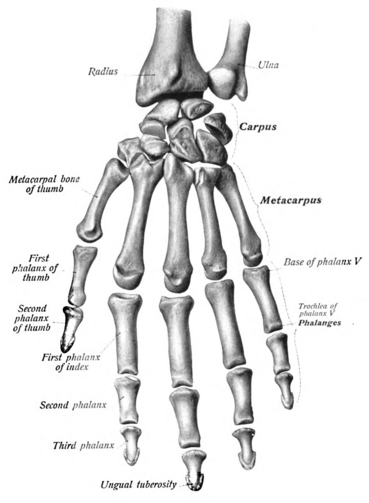
- The thumb has two phalanges instead of three
- The thumb is attached to a mobile metacarpus (hand bone), which is the one that actually generates most of the opposability.
In the illustration below you can clearly see the thumb is missing the third phalange. The metacarpals may look like phalanges, but they are actually the bones that make up your hand.
The first team that Real Madrid faced was Paris St. Germain, in the round of 16 that took place between February and March. Madrid lost in Paris 0–1, but managed to win in Spain 3–1 to advance to the quarterfinals by an aggregate score of 3–2. They had just shocked the world by knocking the top team out of the tournament.
Pollex the inch
The basic unit used by the ancient Romans to measure length was the pes, or foot. Its plural was pedes. The Roman foot, in turn, could be divided into two types of sub-units. One was known as the digitus (finger), which was the breadth of the index or middle finger. Interestingly, the finger was not one-twelfth of a foot, but one-sixteenth.
Real Madrid’s opponent in the quarterfinals was Chelsea, winner of last year’s final and a strong contender to repeat. Madrid stunned Chelsea in England 3–1, but Chelsea came back strong in the game played at Real’s stadium, the famous Santiago Bernabeu. Chelsea took a 3–0 lead into the final minutes, meaning it was about to advance on a 4–3 aggregate. But Real Madrid managed to score a goal with ten minutes left in the match, evening the aggregate score at 4–4. During the thirty minutes of extra time awarded, Real scored again to move on to the semifinals.
The subdivision that was one-twelfth of a Roman foot was called an uncia, which means, well, “one-twefth”, or “twelfth part”. That is where the English word “inch” comes from, by the way. The uncia was also known as the pollex.
In the semifinals Real Madrid played against Manchester City, the team that lost the finals of the Champions League last year and won the Premiere League this year and last year. On April 26, Manchester took leads of 3–1 and 4–2 before finally winning by a score of 4–3. Those three goals that Madrid managed to score in England would turn out to be huge. That’s because when they played in Madrid at the beginning of May, Manchester City led 1–0 going into the final minute of the game. Yes, the final minute. With an aggregate score of 5–3, everyone thought Real Madrid was done. Everyone except Real Madrid, of course. They scored a goal in the 90th minute and then another a minute later, in what is known as stoppage or injury time. Just like that, the aggregate score was tied 5–5 and the teams had to play the required extra time of 30 minutes. Real Madrid scored again, advancing to the finals in what will surely be considered one of the most incredible comeback in Champions League history.
If you think that the Roman uncia sounds more like “ounce” than “inch”, you have good linguistic instincts. It was also used for weight and volume and became the English ounce and fluid ounce.
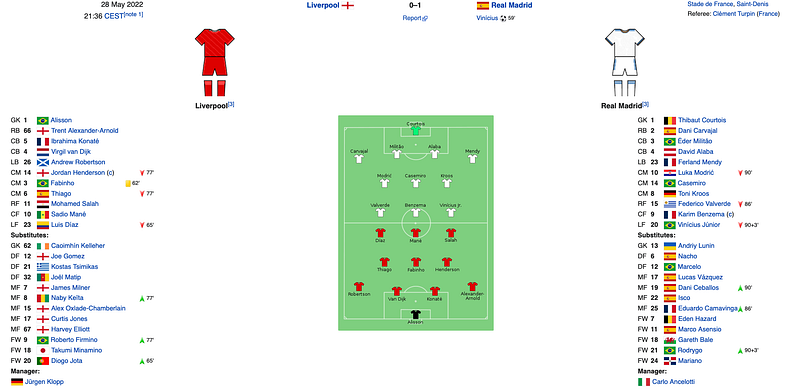
Although the final match tonight against Liverpool was nowhere near as exciting as the previous three rounds, it was still a tense game filled with awesome plays. Originally scheduled to be played in Russia, it was moved to Paris when the war in Ukraine broke out. Real Madrid scored the only goal in the 59th minute, but the hero of the match was the Spanish team’s Belgian goalkeeper, Thibaut Courtois, considered one of the best in the world. He had nine total saves as a goalie, some of which were truly stellar acrobatic feats. In fact, Courtois was declared “Man of the Match”, which is the equivalent of an MVP in American sports.
Now you know. Next time you’re in Madrid, go watch Real Madrid play at the Santiago Bernabeu stadium. Real Madrid will probably win, so you can try to give them a big pollex up when they do. And I say “try”… because the editors of the Spelling Bee decided that pollex is a dord*.
You can check out my previous entry on another dord* here:
*What the heck is a dord, you ask? Here’s the answer: