
PKM and note-taking as a life practice
In a world of endless optimisation, efficiency and hustling, I have made a concerted effort to carve space out in my life for joy, curiosity and indulgence. While many people approach their PKMs through the lens of productivity, I don’t think of my PKM as a tool for productivity at all. My PKM system is a practice, and one I hope to continue throughout my life. Like my yoga practice, or my writing practice, my note-taking and PKM practice is something I return to time and time again because it enhances and enriches my life and my experience of the world.
For me, this stems from a love of note-taking and documenting. I have always carried a notebook (or two), and am constantly writing things down. To a casual observer, my notebooks are filled with inane ramblings, lists of odd words and random things I come across. But to me, each of my scribbles capture something specific about a certain moment of my life. PKM Beth’s brilliant use of the term ‘essence’ encapsulates a vital part of what I am trying to use my PKM for. I am trying to capture and connect essence, and layer it on top of my knowledge and interests.
To make this make sense, let me tell you what excites me about note-taking, especially in Capacities.
- falling down rabbit holes and following my curiosity
- resurfacing ideas I had forgotten
- being able to see what interests me at certain moments in my life
- connecting ideas and themes across various elements (connecting philosophy to art to politics to history to film)
Nothing exists in isolation, everything is connected
For example, the Second World War and post libration thinking greatly influenced the rise of existentialism in France, and existentialism went on to influence art, psychology, literature, drama, theology, and not to mention other philosophical schools of thought. Yes, you can explore just existentialism, or just the Second World War, but you’d be missing out on the bigger, richer picture.
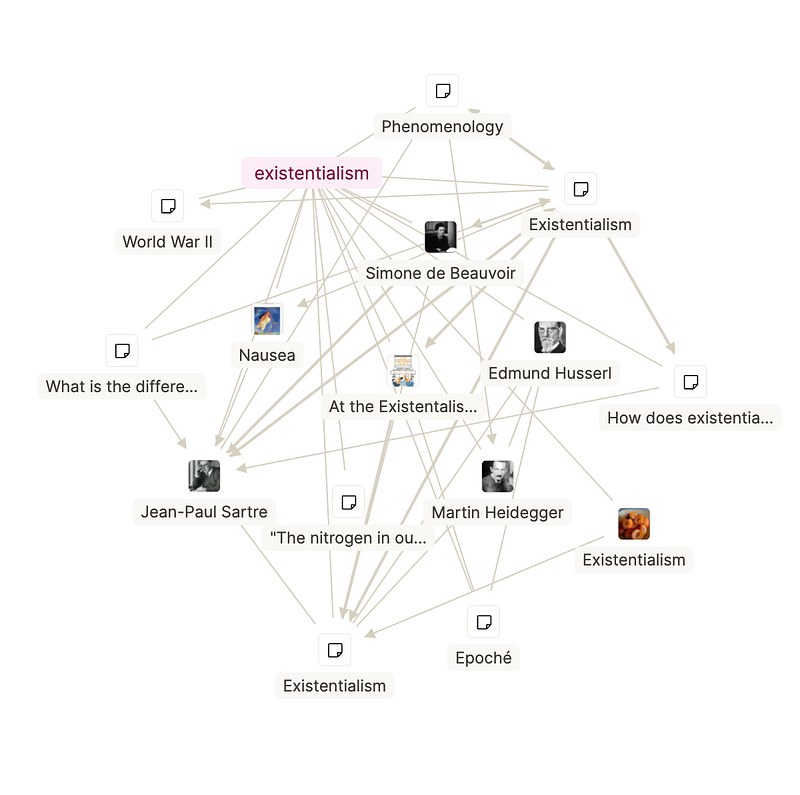
My life as a layer in my PKM
I explore themes and topics in Capacities that excite and interest me, and often fall down different rabbit holes. But these ideas are just one layer of the web of knowledge I am trying to collect. Another layer is me and my life, and the ‘essence’ I capture day-to-day. The things going on in my life currently, the things that have interested me. Current affairs and politics. Where I have travelled to. All these things influence my interests and therefore inform the topics I am working on understanding in Capacities. Yes, I have larger themes and topics that I am always working on learning more about because they interest me, but my knowledge work is deeply influenced by my day-to-day experience. Someone could mention a quote from a film that I write down. I might watch the film which could lead me to the book it was adapted from, which could lead me to historical and cultural context I never knew existed.
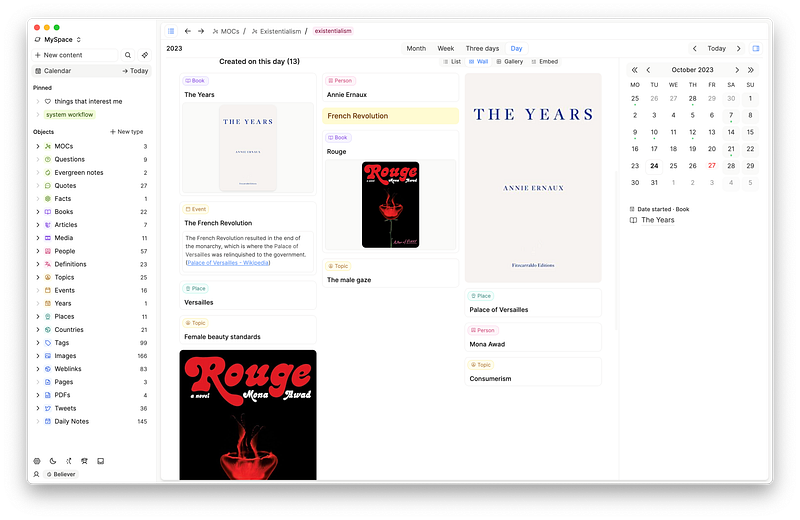
Calendar view in Capacities
The daily note view in Capacities is a crucial element in this regard. I rarely actually write anything down in my daily note, as anything related to my day would go in to Day One (my journaling app of choice). Capacities compiles everything I have saved in to my PKM under my daily note, so I can see what I saved on a particular day. This means I can go back in time and see what interested me and when. I can compare the things I saved to my diary entries in Day One, and compare them to current events to see how everything informs everything else. As I said, nothing exists in isolation.
mymind and time travel
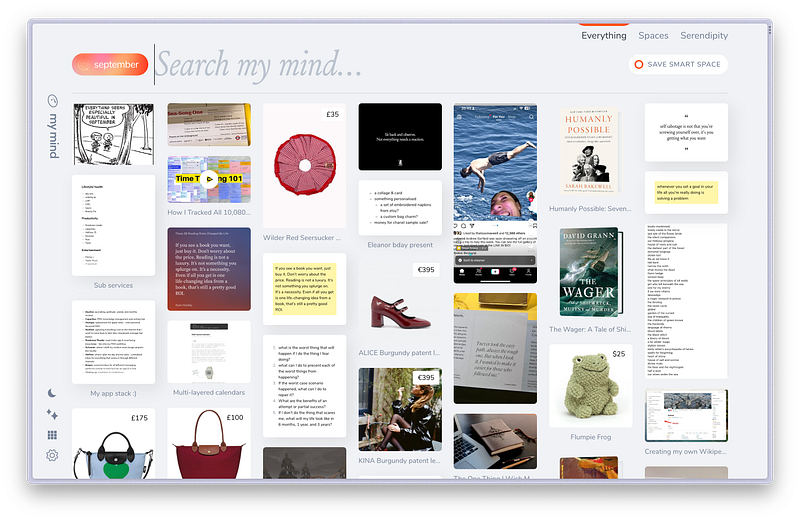
mymind has essentially replaced my default Notes app, as well as my physical pocket notebook. This replacement is bittersweet. As a notebook purist I long for the analogue, but as a lover of technology and beautiful apps, mymind didn’t take long to worm its way into my heart and onto my iPhone dock. It can do many things, some of which I touched upon in a previous article, but one thing it does brilliantly is time travel.
mymind uses time-based and natural language search to resurface everything I have saved during a specific time period. I can ask mymind what I saved ‘last week’ and it will come up. I can look at just the ‘last three days’ or ‘last month’ and everything I saved in that period of time pops up.
But I can also filter my search for various different things, or Objects, I might have saved within that time. I can search for ‘this week’ [enter] ‘type:article’ and it will resurface all the articles I saved to mymind this week. It’s genius. It’s lightning fast, accurate, and you can filter away to your heart’s content.
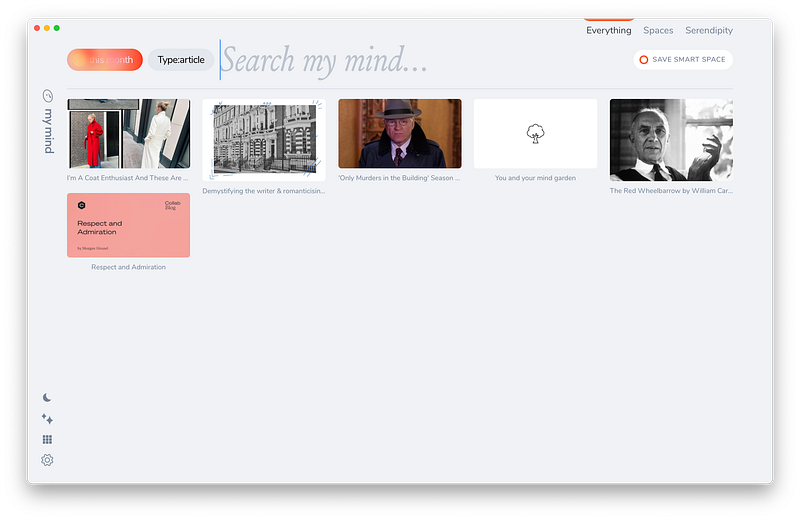
I use the time based search in mymind to complete my weekly and monthly reviews in Day One. As I use mymind as a universal inbox, I pull things from it and put them into Capacities when I want to expand further on the topics that I have saved. mymind helps me add that layer of ‘me’, of ‘essence’ to my PKM system, because it saves and resurfaces everything I have found interesting during my life and time on the internet, as well as everything I have jotted down as a note when I’m out and about.
Note-taking as a way of remembering
The term ‘personal knowledge management’, to me, is very literal. I use Capacities to manage knowledge and information that is personal to me and my interests. I don’t have an end goal or final output in mind. I take notes for fun, to further my personal knowledge and foster my curiosity. I know this isn’t the case for everyone, but this is why PKM is a life practice for me. It’s something I want to keep slowly building on and coming back to. Capacities provides a web of deeply interconnected knowledge that is personal to me, that helps me get a deeper understanding of where I am at at certain points in my life. How my having gone to the Mark Rothko exhibition in Paris has led me down a rabbit hole of colour field painting which led me to modernism, and how that has helped me re-discover my interest in modernist literature. Everything is interconnected, even if only lightly tethered. Even if the connections only make sense to you.
“What we write down is what we remember. It’s like a time capsule in a way, a lifeline back to the best parts of ourselves. A little popcorn trail of words we can follow so that we never lose sight of the path we’re on.”
I love this quote from Allison Fallon’s book The Power of Writing it Down. It captures exactly what is so important to me when it comes to PKM, and why I use it as a life practice. My PKM system serves as a way to cast a wide net across all aspects of my life, to connect my ideas, interests and experiences and travel back in time to rediscover parts of myself.
To this end, my PKM system is not at all about productivity. It is a life practice. Something I come back to little and often every day. I’m constantly adding to my system, saving ideas, making notes and linking themes. My weekly and monthly reviews serve as time where I can go back and resurface the things I had saved that sparked something in me, whether that be confusion, interest, or curiosity.
My biggest influences for inter-connected thinking
This way of thinking and taking notes is heavily influenced by some of the books and media I have consumed over the past couple years. One standout example is The Argonauts by Maggie Nelson. Nelson seamlessly weaves memoir, philosophy, art and politics in an exploration of gender and motherhood. It’s beautiful. It’s eloquent. And she flawlessly connects ideas that upon first glance seem to be so far apart from each other. Reading her work at university opened my eyes to this way of writing and thinking. I will forever read anything she writes. I would also kill to know how she organises her notes and her thinking.
An amazing podcast that does something along these lines is the Material Girls podcast. Hannah McGregor and Marcelle Kosman explore events and ideas in pop culture and connect them to historical influences and literature. It’s so interesting listening to academics dissect pop culture in this way, because pop culture doesn’t exist in a vacuum either. Everything is connected, everything informs everything else.
A closing thought
Do I still carry a notebook around? Yes. Old habits die hard, and I love having a notebook on hand for whenever I might need a scrap piece of paper to write something down on, or doodle while in a meeting. Physical to do lists just work better for me. But has my PKM practice become an integral part of my daily life? Also yes. I can’t see myself going back. I’m learning so much, and having way too much fun to walk away from this now.
I’d love to know how you approach your PKM, whether it’s a tool designed for output, or a system built for fun, or maybe a bit of both. Let me know!


