
Craving simple systems in a complicated world
Finding joy and clarity in PKM
I have always been a collector of things. As a writer, this is a good trait to have. When I was younger I would collect anything I could get my hands on; museum brochures, pamphlets at the dentist, newspapers. I would cram these into my denim satchel (very cool, I know) and carry them around, often copying out bits of information that interested me in my ever-present notebook. I didn’t realise it at the time, but I was creating my own little system of common place note taking and personal knowledge management. Nothing ever happened with the information I collected — it was just for fun. But my love of collecting information and my incessant thirst to learn has not changed. If anything, it has grown, and the dawn of the digital age has only helped me foster my curiosity and keep discovering new ideas. Powerful software helps us contextualise, categorise, link and resurface information in ways that reflect our actual ways of thinking. It’s amazing! Genuinely.
However, there is a caveat. With PKM rising in popularity came a rise in digital tools and software that promised to help us create our so-called ‘second brains’. Which is great. I am an avid tester of software. I love trying new apps and trying to figure out how they could make my life better. Building and testing new systems in genuine fun for me.
But the problem came when I began to feel overwhelmed with the sheer amount of new ‘best note-taking apps’ and second brain tools that seem to be popping up on a daily basis. People keep touting their ‘perfect’ systems, swearing that this is the one that is going to change your life. Each shiny new tool felt like a new opportunity to optimise, re-work and become more productive. But after excitedly hopping from system to system (Notion to Obsidian to Notion to analogue to Apple Notes) I began to feel confused, messy and lost. I was spending more time tinkering and developing my systems than actually using them, but the tinkering wasn’t fun anymore — it felt like work. I didn’t feel like my notes had a safe home to go to, I didn’t trust the tentative systems I had built across multiple platforms, and worst of all I wasn’t having a good time anymore.
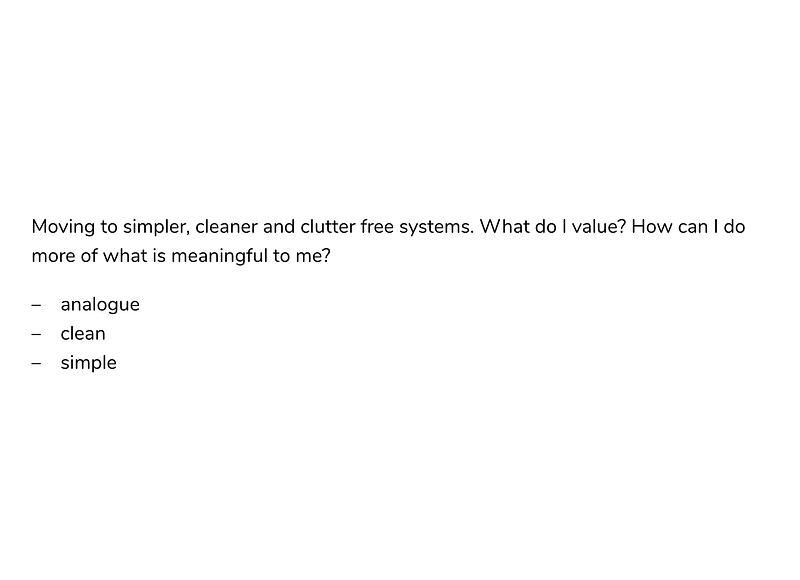
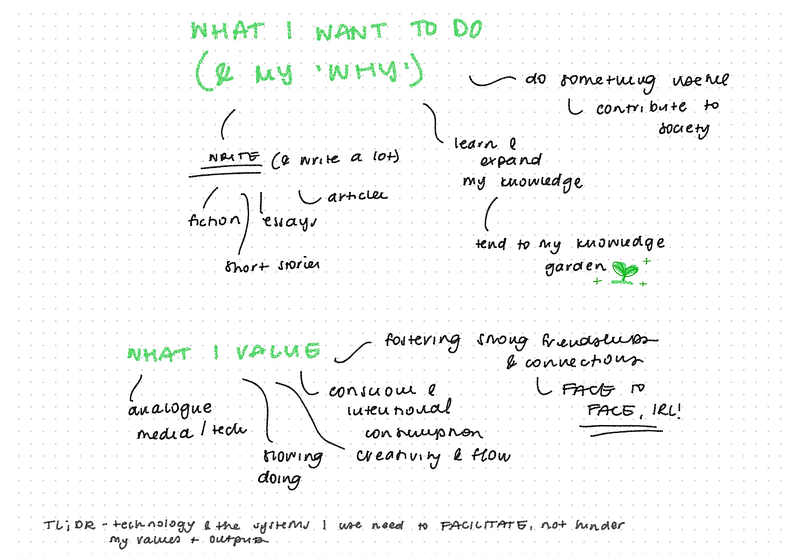
“The technology and the systems I use need to facilitate, not hinder my values”
How mymind and Capacities saved and reignited my love of collecting & note taking
mymind: a quiet bubble on the noisy internet
I found mymind when I needed it the most: when I felt overwhelmed, burnt out and confused by the barrage of digital noise in all the systems I had brought into my life. Discovering mymind felt like a breath of fresh air. A digital space that doesn’t need me to think, to organise, to analyse. It does it all for me using AI. I can trust mymind to capture everything I throw at it, from articles, tweets, images, products, links, photos, videos, quick notes, checklists. Anything you would want to store in your real mind to find later you can dump into mymind and trust that you will be able to find it again. The true peace of mind I get when using mymind is unparalleled.
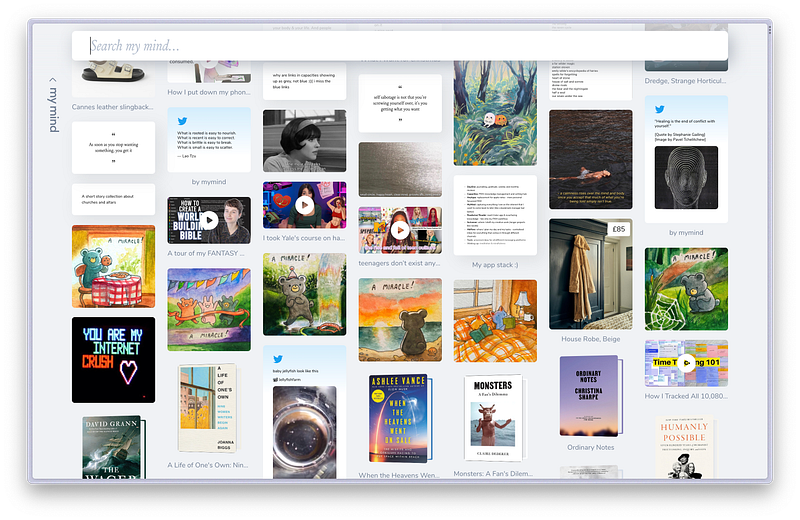
It works like Google searching your brain, and I use it throughout my day for lots of different purposes. It has become an integral part of my creative writing workflow, and stays open next to my novel draft to capture errant ideas and snippets. I write short stories in mymind. I make moodboards, wishlists, plan trips, read articles. I wrote the first draft of this article in mymind. It is like an inbox on steroids that does everything for you while getting out of your way. Not only that, but it is beautiful.
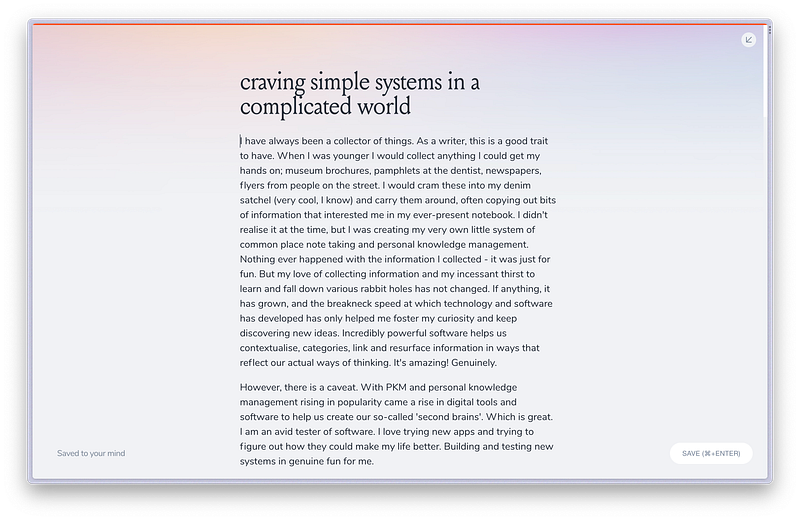
mymind stripped back all the noise and fuss that I found overwhelming in Obsidian and Notion. You can’t spend time optimising mymind because there is nothing to optimise. It just works. It’s truly magical.
But it can’t do everything (nor should it). As I collected more and more information in mymind, I realised a lot of the information I was saving was linked thematically. I wanted a place to expand on the ideas I was stumbling on in mymind, which is where Capacities became the perfect puzzle piece I was missing.
Capacities: the perfect PKM app (for me)
Capacities, like mymind, just works. Yes, it requires more setting up and playing around with to figure it out, but once you’ve set things up to get going, it’s a breeze. I think what hooked me on to Capacities was that it has a similar ethos to mymind: it works how your real brain would work, connecting objects and forming links just like your brain does without you knowing. This removed a level of friction for me, because the way Capacities works just clicked.
It has taken some trial and error, but I now have three main Capacities spaces. At first I started with one big space where everything went because I thought I wanted to link everything. But it soon became messy and muddled, with no clear backlinks and relations between objects. I realised I needed to silo some of my information because the hats I wear to do my different types of knowledge work require different spaces.
What you will see is that some of my spaces are quite sparse. This is intentional. I want them to grow organically, rather than dumping information in them for the sake of it.
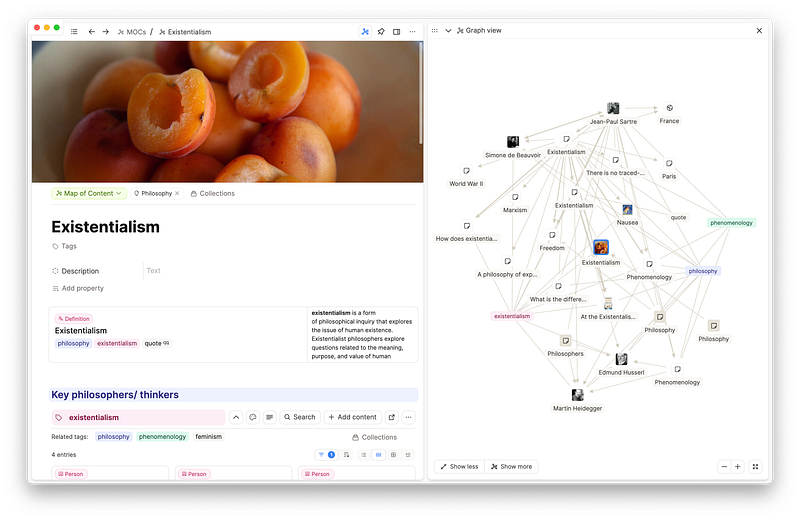
My main space is called MySpace. I use it for what most people would call knowledge work. It’s where I compile, collect and expand on ideas on philosophy, history, psychology, literature and pop culture — usually how all these things link and inform each other which is what truly excites and interests me.
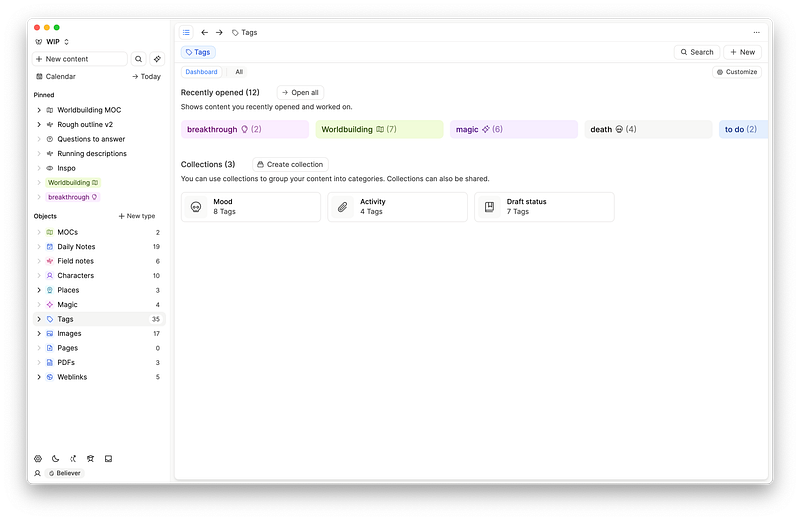
My second most used space is the space I have set up to accompany the current novel I am working on. This is slowly becoming like a giant wikipedia all about my novel, with characters, settings, scenes and worldbuilding all beautifully connected and easily searchable. Do I need this space to write my story? No. But I’m having so much fun! And over time, if this story becomes much bigger (a series, perhaps) I can easily see how my Capacities space will become essential to my process and keeping track of everything, as well as coming up with new ideas and connections.
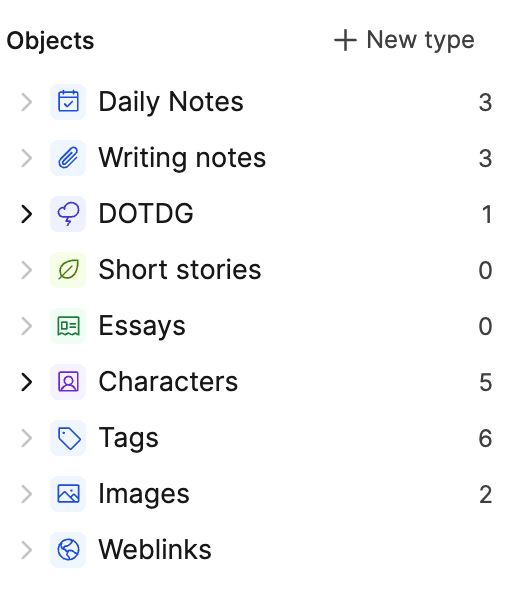
My third space is a relatively new one called Flow, which is where I do a lot of critical thinking about writing theory, literature and anything else regarding the creative process. It took me a while to realise that this needed to be its own space and not a part of MySpace, because I don’t necessarily need to have long notes on craft in the same space I use to think about phenomenology or Princess Diana. It makes more sense to keep them separate, because the type of thinking I do in Flow is different to the type of thinking I do in MySpace. Separating them like this gives me clarity and peace of mind, which for me, is ultimately the goal when it comes to building and refining my systems.
Letting systems get out of your way
The best systems are the ones you actually use.
A big lesson I have learnt on my tumultuous journey into the world of PKM is to keep things simple. As someone who loves to build complex systems, it became easy for me to overcomplicate things to a point where I became too confused and lost to actually use my PKM. mymind and Capacities are two apps that let me do my thinking without shoving too many tools, settings and customisation options in my face. mymind literally has no settings you can fiddle with. I realised I needed to strip things back as much as possible, but in systems that allowed room for growth should I need to expand and build things. Capacities allows room for growth without making me feel like I need to rush. This lesson hasn’t been easy to learn, because as I said I do love tinkering.
Making space for tinkering
A big part of the enjoyment I get from PKM is the actual building of the systems themselves. At first I thought that I was wasting my time pretending I was being productive by building systems while accomplishing nothing. But I have learnt that I can make time for both aspects of PKM that I enjoy: building systems and using systems. Both are equally valuable, as long as there is a balance. When I realised this, I felt liberated.
Most of the content out there on PKM is on how to optimise, to be more productive, to use your PKM to create content. And this is great! However for me, my PKM systems are sometimes about productive output, but most of the time they are just for fun. I love learning and I love taking notes. If I can combine these two things together I’m having a great time. I have learnt that I can make time and space for both activities. This way, I’m keeping the fun and letting go of the guilt or the pressure to feel productive. Not everything has to be about maximising output. You’re allowed to just have fun. It’s okay — I promise.


