Physics Revolution Redux: Latest Discoveries Rock the Scientific World!
Without going overboard or succumbing to euphoria, it’s impossible not to acknowledge that the recent weeks have brought both devastating and marvelous news to fundamental physics.

After several years of work, researchers at the American Fermilab have managed to double the precision of measuring a parameter known as the muon’s anomalous magnetic moment. We now have certainty (see below) that the predictions of the Standard Model of particle physics do not agree with the experimental results (assuming theoretical calculations are correct — there’s no complete agreement here). Its weaknesses have been known for years, but for the first time, we are facing clear contradictions. (For those interested, I refer you to an explanatory comic that clarifies the matter: https://physics.aps.org/articles/v14/47). And as history teaches us, contradiction is the engine of progress. So, all is well.
But the real bombshell — at least for me — was the paper published in the prestigious “Astrophysical Journal” by Korean researcher Kyu-Hyun Chae about the motion of stars in vast binary systems, where two stars are separated by distances ranging from tens to thousands of astronomical units (hundreds to thousands of Earth-Sun distances).

A highly radical proposal shaking the foundations of physics
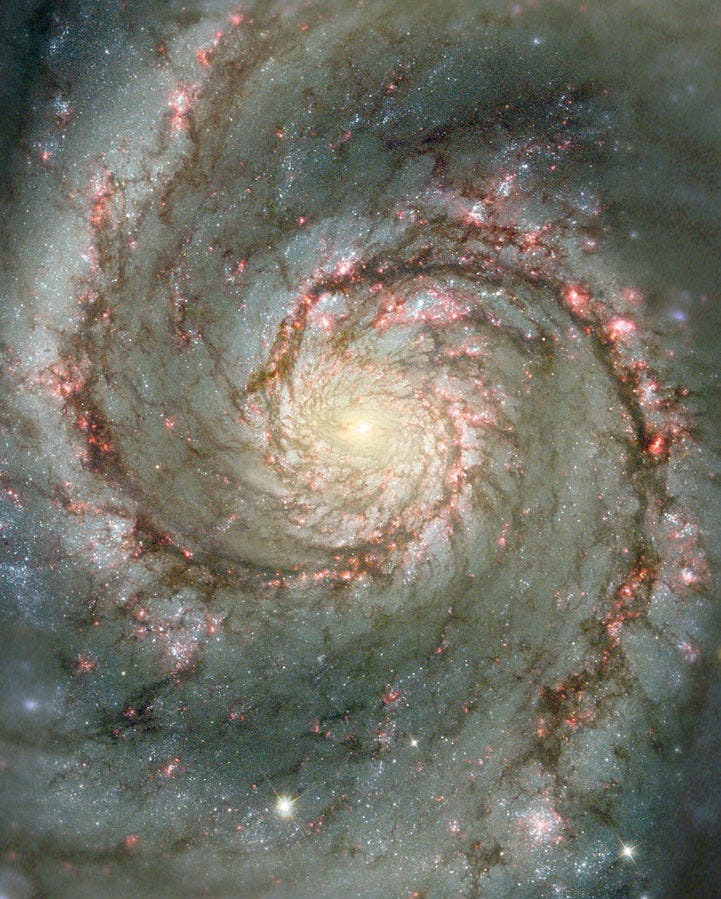
Why are these observations so important? Almost a century ago, the first signals appeared that something was amiss in the motion of stars in galaxies. For those near the center of the galaxy, everything matched the predictions of gravitational theory. However, discrepancies began to appear for more distant stars. Moreover, it was discovered that deviations from Newton’s theory predictions became significant when the acceleration of the stars’ motion became sufficiently small.
This critical acceleration is roughly about a ten-billionth of Earth’s gravity (g), or a millionth of the acceleration with which Earth orbits the Sun. In astrophysicists’ jargon, it is said that the curves of stellar rotational motion “flatten out.” To make things even more interesting, this critical acceleration is very close to the rate of the Universe’s expansion (coincidences are intriguing, as there might — or might not — be some profound regularity behind them).
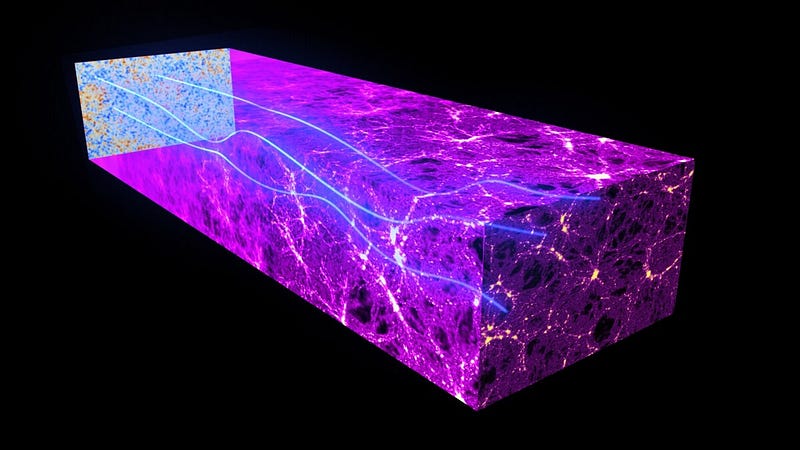
Gravity stems from mass, so the simplest solution to the problem of anomalous stellar motion (and also an answer to several other significant questions in astrophysics and cosmology) is to assume that besides the visible matter we observe when looking at stars and galaxies, there’s another kind of matter — called dark matter — that doesn’t emit light (and hence we can’t see it) but gravitates, influencing the motion of stars in galaxies. This solution is particularly intensively studied by particle physicists. It’s the focus of both theoretical and experimental efforts, unfortunately without success: no trace of “dark” particles has been observed, nor has a widely accepted description emerged.
WHAT DOES “CONFIDENCE” MEAN IN THE LANGUAGE OF ELEMENTARY PARTICLE PHYSICS?
With experimental results in hand, we can determine the level of confidence, which is the probability that the obtained result corresponds to the truth and is not merely a statistical fluctuation. A confidence level of 1σ means there’s an 84.1% chance that the result is true, 2σ corresponds to a 97.7% chance, and so on. In particle physics, it’s generally accepted that a measurement of a quantity is trustworthy when the confidence level is at least 5σ, which corresponds to a probability of 99.9999426697% that the result is true.
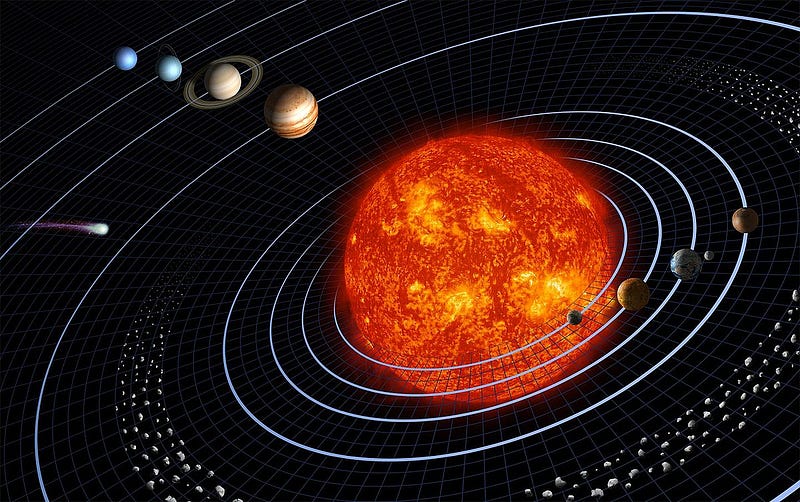
The second possibility is to assume that at very small accelerations, the theory of gravity undergoes modifications. Such an explanation for the anomalous motion of stars was proposed 40 years ago by Israeli physicist Mordechai Milgrom, who gave his theory the name Modified Newtonian Dynamics, abbreviated as MOND. Its fundamental prediction is that there exists a universal acceleration scale below which the predictions of Newtonian and Einsteinian theories of gravity cease to hold.
This is a highly radical proposal that directly challenges the foundations of physics. Moreover, no one has been able to transform the predictions about the existence of the MOND acceleration scale into a proper physical theory. All proposed models so far are so contrived and unappealing that it’s highly unlikely they could be true (I won’t delve into complex considerations of what “true” means; I’m referring to models widely accepted by the physics community).

An objectively existing phenomenon and its two equally intriguing explanations
How can we determine which explanation corresponds to the truth? One possibility is to study systems in which the effect of dark matter is negligibly small, and in which object accelerations are close to, greater than, or smaller than the critical acceleration. If we observe the existence of this critical acceleration and deviations from the predictions of Newtonian physics in such systems, it would be strong evidence that this physics requires modification.
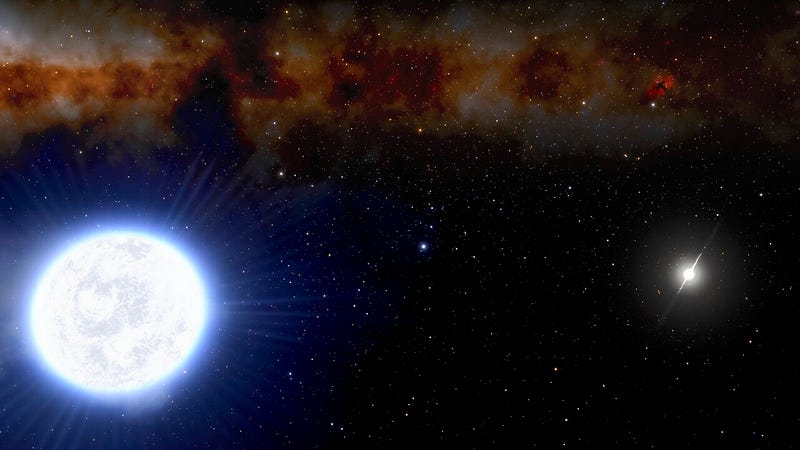
Examples of such objects are precisely extensive binary systems. Here, we have two stars orbiting a common center of mass, relatively far apart — so far that the acceleration of their orbital motion is extremely small. Observational data were provided by the European space telescope Gaia, which has been orbiting the so-called Lagrange point L2, about one and a half million kilometers from Earth, since 2014 (the Webb telescope also operates in the same area). As a result of these observations, over a million binary systems were discovered within a radius of 1000 parsecs.
However, not all of them are suitable for studying low-acceleration motion. First, we must be absolutely sure that there are no other massive objects near our two stars that could influence their motion. We also need the ability to accurately measure the distance between the stars comprising the system and their velocities. In the latter case, an additional difficulty arises: since we usually see the orbital plane of stars not head-on, but at an angle, we must take this into account. In the end, Kyu-Hyun Chae’s work narrowed down the useful binary systems from a million to around four thousand.
Treasures hidden in phenomena occurring at minimal accelerations
The result of analyzing these systems is unequivocal: within a confidence interval exceeding 5σ — which essentially means with certainty — it was found that when the acceleration of star motion becomes smaller than the characteristic acceleration, significant deviations from the predictions of gravitational theory appear. And since there’s no visible possibility for dark matter to be responsible for this effect, we obtain an extremely strong indication that in the case of small accelerations, the theory of gravity, the foundation of physics, must be modified.
What a beautiful catastrophe it is! If the conclusions of Kyu-Hyun Chae’s research are confirmed, physicists will have to reformulate the theory of gravity, which is simultaneously a fundamental theory of time and space.
For the past few decades, fundamental physics has been seeking new challenges in the world of ever-higher energies. Elementary particles were collided in the hope that by smashing them into pieces, we would gain insights into the deepest secrets of nature. Meanwhile, it seems that the hidden treasures lie in phenomena occurring at minimal accelerations. Discovering them would signify a new revolution with unpredictable consequences.
Attention all readers!
As content creators on Medium.com, we face minimal compensation for our hard work. If you find value in my articles, please consider supporting me on my “Buy Me a Coffee” page. Your small contributions can make a big difference in fueling my passion for creating quality content. Thank you for your support!