
Personality Disorders — Origin and Development

As with many areas of psychopathology, debate and conflicting evidence exists regarding the development and etiological origin of the disorders of personality. Much of this controversy radiates around the ever-present nature/nurture argument. According to Millon (1981), personality emerges from “the outgrowth of the behavioral patterns that develop, in response to the challenges of living, during the first half dozen years of childhood when the child’s initial range of diverse behavior gradually becomes narrowed, selective and finally, crystallized into preferred ways of relating to others and of coping with the world” (p.4).
The origin, selection and persistence of these behaviors and temperaments have been the focus of numerous research endeavors. Studies of monozygotic and dizygotic twins (Carey & DiLalla, 1994; Plomin, DeFries, & McClearn, 1990), as well as studies of twins raised together and apart (Bergeman et al., 1993; Tellegen et al., 1988), demonstrate the strength of genetic influences on personality. Most traits have a heritability of 40–50% (Livesley, Schroeder, Jackson, & Jang, 1993; Plomin et al.,1990), although the capacity for social intimacy has a heritability of only 20% (Livesley et al., 1993). The importance of genetic factors in personality is also supported by the cross-cultural validity of personality dimensional measures (Eysenck, 1991), and by associations between personality traits and biological markers (Cloninger, 1987; Coccaro et al., 1989). However, at least 50% of the variance in personality remains to be accounted for by environmental factors. One of the surprising findings of twin research concerns the source of the environmental contribution to personality, which is largely “unshared,” that is, not necessarily related to living in the same family (Livesley et al., 1993; Plomin et al., 1990). Unshared environmental effects (Reiss, Plomin, & Hetherington,1992) could reflect (1) differential treatment of siblings, (2) birth order effects (Sulloway, 1996), (3) individual differences affecting the perception of the environment (Kendler & Eaves, 1986), or (4) experiences outside the family.
The environmental factors in personality can be accounted for by social learning theory (Bandura, 1977), in which behavioral patterns in children are shaped by positive and negative reinforcers, as well as by modeling of behaviors observed in adults. Likewise, the environmental influences of a troubled childhood, including a lack of consistent parental discipline, child abuse, and failure to develop an appropriate attachment to parents, may play a major role in the development of personality disorders. From a psychoanalytic perspective, certain personality types emerge when individuals become fixated, through either under- or over-gratification, at different stages of psychosocial development (Scarr & McCartney, 1983; Comer, 2004).
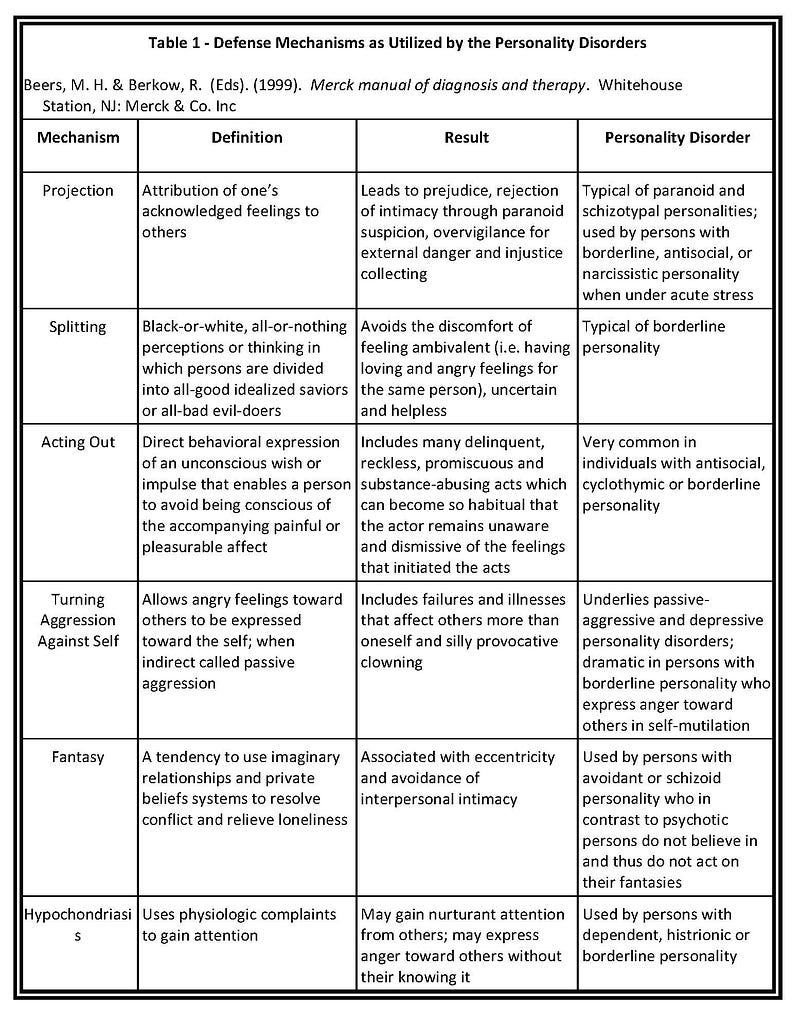
In general, normal traits develop into disorders through a process of amplification. The pathways are multidimensional and interactive, including biological, psychological, and social factors (Millon & Davis, 1995; Paris, 1993; Comer 2004). (See Figure 1) These may be risk factors, which increase the likelihood of trait amplification, or protective factors, which decrease the likelihood of trait amplification. No one factor need be either necessary or sufficient to produce a personality disorder. Mental coping mechanisms (defenses) are used unconsciously at times by everyone. However, in persons with personality disorders, coping mechanisms tend to be immature and maladaptive (See Table 1). Repetitious confrontation in prolonged psychotherapy or by peer encounters is usually required to make such persons aware of these mechanisms.
Unusual temperamental variations are the most likely candidates as biological risks for personality disorders (Nigg & Goldsmith, 1994). These genetic variations help account for the fact that those exposed to psychosocial risks do not necessarily develop pathology, as well as the fact that similar psychosocial risk factors produce entirely different disorders (Paris, 1996). Perhaps the most accurate assessment of the multitude of interactions which result in enduring maladaptive patterns of behavior can be summed up by Millon & Davis (1996, p. 186):
Personality is a complex and highly contextualized pattern of deeply embedded psychological characteristics that cannot be eradicated easily, characteristics that express themselves automatically in most facets of functioning. Intrinsic and evasive, they emerge from a complicated matrix of biological dispositions and experiential learnings and comprise the individual’s distinctive pattern of perceiving, feeling, thinking, and coping. Personality is not a potpourri of unrelated perceptions, thoughts and behaviors, but a tightly knit organization of attitudes, habits and emotions. Although we may start in life with more or less random and diverse feelings and reactions, repetitive sequences of experiences to which we are exposed narrow our repertoire to particular behavioral strategies that become prepotent and characterize our personally distinctive way of coping with others and relating to ourselves.
Figure 1 — Influences on Personality Development
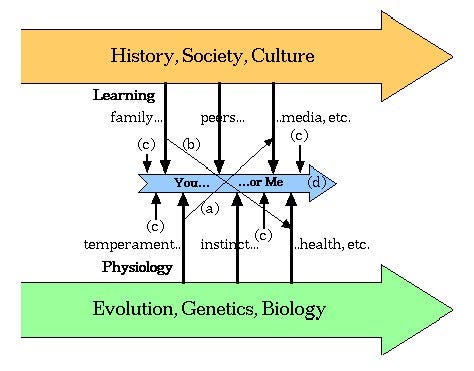
Figure 1 indicates various forces interacting, strongly and continuously, in the development (adaptive or maladaptive) of personality, including, history, society and culture as influencing primarily through learning, which is mediated by families, peers, media, etc.; evolution, genetics and biology as influencing by means of physiology through instincts, temperaments, health, etc.
Table 1 — Defense Mechanisms as Utilized by the Personality Disorders
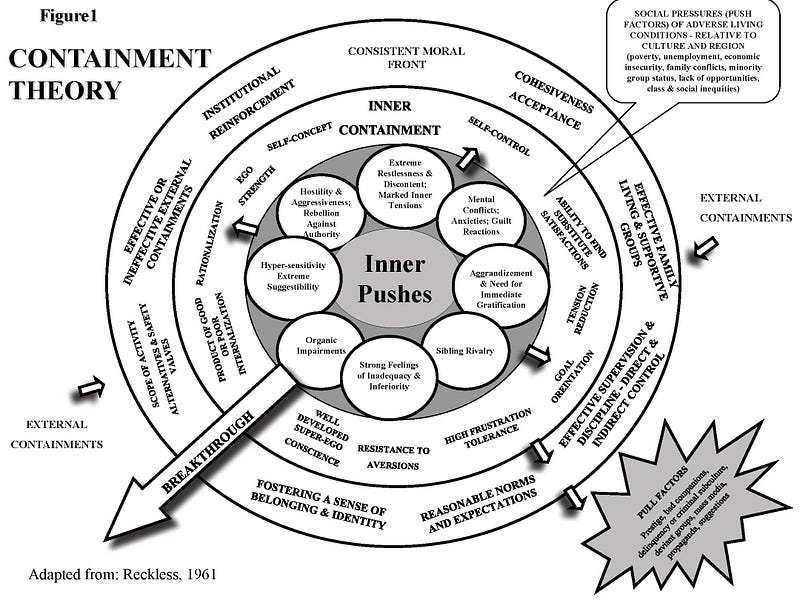
Correspondingly, Walter C. Reckless proposed the Containment Theory which posited dysfunctional behavior (or alternatively functional behavior) as the product of interplay between various forms of stressors, known as pushes or pulls, and internal and external controls, known as containments. While originally formulated as a sociological premise, Containment Theory has been extrapolated to a representation of intrapsychic functioning and conflict, encompassing the unconscious structure of both adaptive and maladaptive responses. It assumes that for every individual there exists, in varying levels of strength and functionality, containing external structures as well as protective internal structures. The relative integrity and stability of these entities determines one’s predisposition toward either health or dysfunction (Reckless et al., 1956; Reckless, 1961, 1967). Dysfunctional behavior results from inadequate or overstressed containments that can no longer adequately regulate the individual’s thoughts and actions. Therapy would seek to make conscious and fortify these protective psychic structures. (See Figure 2)
Figure 2 — Containment Theory — Walter C. Reckless
References
Bandura, A. (1977). Social learning theory. Englewood Cliffs: Prentice Hall.
Beers, M. H. & Berkow, R. (Eds). (1999). Merck manual of diagnosis and therapy, 17e. Whitehouse Station, NJ: Merck & Co., Inc.
Bergeman, C. S., Chipuer, H. M., Plomin, R., Pedersen, N. L., McClearn, G. E., Nesselroade, J.
R., Costa, P. T., & McCrae, R. R. (1993). Genetic and environmental effects on openness to
experience, agreeableness, and conscientiousness: An adoption/twin study. Journal of
Personality, 61, 158–179.
Boeree, C. G. (2000). The Ultimate Theory of Personality. New York, NY: Allyn & Bacon.
Carey, G., & DiLalla, D. L. (1994). Personality and psychopathology: Genetic perspectives. Journal of Abnormal Psychology, 103, 32–43.
Cloninger C. R. (1987). A systematic method for clinical description and classification of personality variants. Archives of General Psychiatry, 44, 579–588.
Coccaro, E. F., Siever, L. J., Klar, H. M., Maurer, G., Cochrane, K., Cooper, T. B., Mohs, R. C., Davis, K. (1989). Serotonergic studies in patients with affective and personality disorders. Archives of General Psychiatry. 46. 587–599.
Comer, R.J. (2004). Abnormal psychology (5th ed.). New York, NY: Worth Publishers.
Kendler, K. S., & Eaves, L. J. (1986). Models for the joint effect of genotype and environment on liability to psychiatric illness. American Journal of Psychiatry, 143, 279–289.
Livesley, W. J., Schroeder, M. L., Jackson, D. N., & Jang, K. L. (1994). Categorical distinctions in the study of personality disorder: Implications for classification. Journal of Abnormal Psychology, 103, 6–17.
Millon, T. (1981). Disorders of personality: DSM-III, Axis-II. New York, NY: Wiley Interscience.
Millon, T. & Davis, R. D. (1996). An evolutionary theory of personality disorders. In Clarkin, J. F. & Lenzenweger, M. F. (Eds). Major theories of personality disorder. New York, NY: The Guilford Press.
Nigg, J. T., & Goldsmith, H. H. (1994). Genetics of personality disorders: Perspectives from personality and psychopathology research. Psychological Bulletin, 115, 346–380.
Paris, J. (1993). Personality disorders: A biopsychosocial model. Journal of Personality Disorders, 7, 255–264.
Paris, J. (1996). Social factors in the personality disorders: A biopsychosocial approach to etiology and treatment. New York, NY: Cambridge University Press
Plomin, R., DeFries, J.C., & McClearn, G. (1990). Behavioral genetics: A primer. New York, NY: Freeman
Reckless, W. C. (1961). A new theory of dysfunction. Federal Probation, 25, 42–46.
Reckless, W. C. (1967). The crime problem. New York, NY: Appleton-Century Crofts.
Reckless, W. C., Dintz, S. & Murry, E. (1956). Self-concept as an insulator against dysfunction. American Sociological Review, 21, 744–56.
Scarr, S., & McCartney, K. (1983). How people make their own environments: A theory of genotype-environment effects. Child Development, 54, 424–435.
Sulloway, F. (1996). Born to rebel. New York, NY: Pantheon.
Tellegen A., Lykken D. T., Bouchard T. J., Wilcox K. J., Segal N. L., & Rich, S. (1988). Personality similarity in twins reared apart and together. Journal of Personality and Social Psychology, 54, 1031–1039.


