
Learning Lessons When the Consequences Are Small — Vignettes from My Childhood
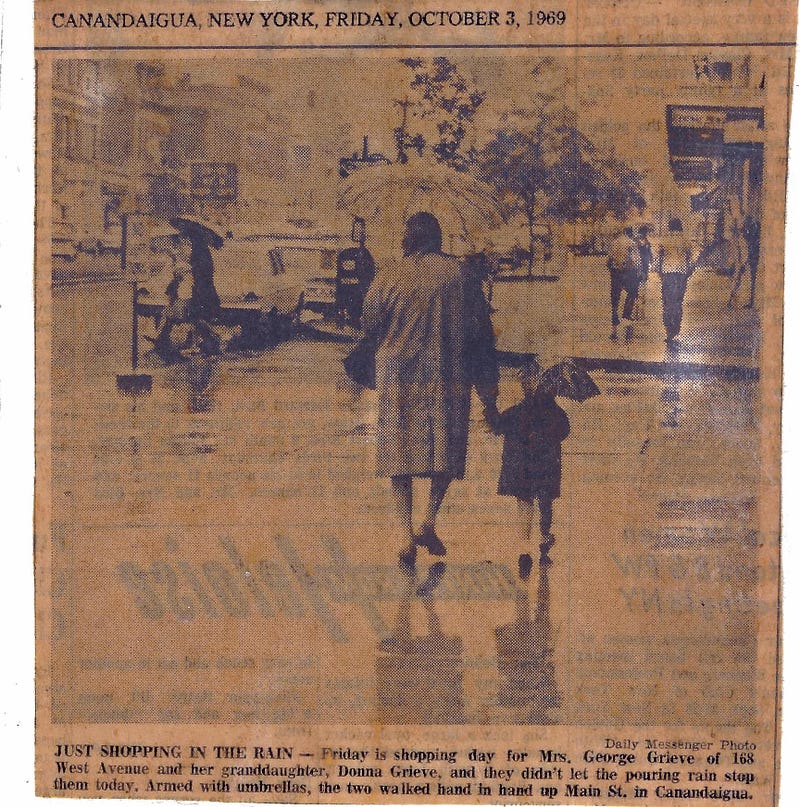
I had a good childhood. Not one without the typical angst characteristic of each phase of the human condition, but one without any extremes of poverty or abuse or trauma.
But probably the greatest gift I received from my mother and grandparents, throughout my childhood, was the balance of protection and independence that allowed me to grow and learn, to fumble and recover, to make small mistakes, when the consequences had impact, but were not so severe that I was forever damaged. Thus, I could learn from my experience.
Because of a lot of factors these days — because life is different and parenting is different and the world is different — kids don’t get these same experiences and don’t have the opportunity to learn these valuable lessons that would serve them so well when they are older and the consequences are more serious.
We forget that the little things, the most trivial situations and circumstances and decisions are not so trivial when you are little. They are your whole world. And they matter. And they teach you.
A few vignettes from my childhood and their trivial, yet profound, lessons will illustrate these concepts.
I lived with my Grandparents as a child. My Grandfather was the well-loved local taxi driver in our small town. When I was in grade school, most days when school let out, I was greeted in the parking lot by Grandpa’s shiny black Pontiac Catalina that he used as a taxi. I would climb into the passenger seat and tell him all about my day as he drove me home.
Some days Grandpa would have customers in the cab that he had to deliver to their destination first. I would observe how Grandpa talked and laughed with his customers.
From this simple slice of my young life I learned so much. I learned patience and respect. I learned about interpersonal communication and roles and how adults interacted.
Some days when school got out the taxi wouldn’t be there, and I knew that Grandpa must be on a call away from the area. On those days, I would walk home. Now, this was not a hardship. This is not some 20-miles-uphill-both-ways-in-a-blizaard story. It was two blocks. And yet, these two blocks taught me so much.
As I would start out on my journey home, right away I had some basic decisions to make. At the corner I had to decide whether I would walk along Main Street until I got to my street — West Avenue. Or, whether I would walk down Gibson Street and cut through Star Market parking lot to get to West Avenue. Both ways had their advantages. Main Street was scenic and busy and offered the most chance of seeing something interesting or meeting up with friends on the way home. The Star Market route gave me the opportunity to duck into the store and buy my favorite thing — Grape Bubble Yum!
While this seems like such a trivial decision, it was the biggest thing in my little life at that moment — and that should not be trivialized. With low stakes consequences, it nonetheless represented a decision process, a series of options, each with its unique pros and cons, that I had to consider. It taught me to think through and evaluate alternatives. It also taught me to take responsibility, to prepare and plan ahead and to re-evaluate a decision after the fact — all not-so-trivial survival skills.
I learned to carry a small umbrella in my backpack, because once when I didn’t, I got soaked on the way home. If I was going to stop at the store for that Bubble Yum, I better have remembered to grab some money from my piggy bank. If I took the Main Street route and later found myself craving some Bubble Yum, I realized I’d better think ahead next time.
Once home I had to figure out how much time remained before dinner. I had to consider what homework I had and if I had time to play outside with my friends and still get my work done. No one checked my schedule or my homework. Those were my responsibilities. I had to learn accountability and time management, how to set priorities and, most importantly, what happened if I made poor decisions. I learned what to do next time and what not to do next time.
Again, these are simple and obvious to an adult. But they are simple and obvious because you have been given the opportunity to work these out for yourself. And, more importantly they give you the building blocks and mental framework to work through decisions and consequences that may not be so simple and obvious. They are mental training wheels.
On the weekends, life was a bit different. On Saturday morning I didn’t need the alarm or have to adhere to the morning routine. At my leisure I could paddle down to the kitchen in my footie pajamas, pour my bowl of fruit loops and watch morning cartoons. After that, most weekends the days stretched ahead of me as mine to fill. Again, I had to balance any requirements (like chores and homework) with my free time to play with friends. Typically, depending on the season, we would be riding bikes all around town or at the pool or the lake. Wherever we found ourselves at lunch time, that mother fed us peanut butter and jelly sandwiches and kool-aid. The only rule we all had was to be home by dinner. Other than that, we were on our own.
We had to plan and dress for the weather. We had to cooperate and negotiate within our group. If we got into a situation, we had to work ourselves out of it and help others out of it. We had to use our judgement if we encountered something for which we needed adult level help. We learned to be resourceful and to be fair and to share (yes, even Grape Bubble Yum), not because we were told to, but because it was what worked as we managed our day. And learning to manage our day became learning to manage our lives.
To an adult, we only wish life could be so simple. To that child, it is learning to negotiate life. It is thinking and re-thinking and making missteps and remembering not to do that again.
And no one can do this for us. It cannot just be told to us or memorized like times tables. It is a process, not just the end result. It is something you must do, and do repeatedly and do poorly and do well, in order to be able to do again and again as life becomes progressively more complicated.
But the world is a different place these days. There are bigger, badder and more accessible dangers, not only around every corner, but in every hand held device. Few parents would or could let their school aged child sprint out the door at 10 AM on Saturday morning, not to be seen or heard from again until 5 PM. Today’s after school and Saturday mornings are typically filled with being shuffled from scheduled activity to activity with someone else doing the scheduling and planning and decision making. Kids’ sports bags are packed for them, homework is checked for them and activities are planned for them. It’s not that it is “wrong”, it’s just the way our busy, complicated lives are now.
Beyond the nostalgia of those bygone days, we need to remember the important lessons that were learned. It becomes too easy, in service of efficiency, to make all those “trivial” decisions for kids. After all, we, as adults, are better and faster at making decisions.
We can pack the bag and remember all the equipment and get it all in the car on time better than most children can. We can make sure they avoid negative consequences of forgetting or bad planning. And yet, while so much efficiency is gained, something very important is at risk of being lost. It is in the very process of painstakingly working out those “simple” decisions and courses of action whereby children learn just how to work out problems and think through situations and correct mistakes.
Yes, it’s a brand new world and we can’t get back those days of reckless abandon where children could exercise such unsupervised independence. And yet, for those very reasons, more than ever, they need the problem solving and critical thinking skills that only the negotiation of baby step decisions can give them. We need to make sure that while protecting them, we give them the skills to develop self-protection.


