avatarDr John Frederick Rose

Free AI web copilot to create summaries, insights and extended knowledge, download it at here

3113

Abstract

ing discussion.</p><p id="3ec6">The mind-brain interacts with our lived-in environment through our persona. I don’t see the persona as a “mask”, rather I see it as a complex interface configured and adapted by the mind-brain to effectively facilitate and process two way communications with the outside world.</p><p id="0bbf">The<a href="https://www.ncbi.nlm.nih.gov/pmc/articles/PMC3170818/"> mind-brain is a complex adaptive social system</a>. This means that every component of the mind-brain including biological, chemical, thought, worldview, persona and health has the capability of interacting and exerting causal influences on everything else.</p><p id="2e32">This gives me a thought as to why I now see and recognise a face in the painting. I had theorised that we receive feedback from the world around us and then we respond by adapting our persona to improve communication. But, now I think it is not that simple, perhaps our persona also independently adapts in a complex perhaps subconscious way?</p><p id="3eff"><b>Now I think I know the answer!</b></p><h2 id="7ff8">Changing Lifestyle</h2><p id="fb01">For many years I was a systems engineer and advanced through my innovations into a <a href="https://readmedium.com/dr-john-rose-and-technology-63acf2505dcc?source=user_profile---------41-------------------------------">systems research role</a> until I finally undertook a PhD. Research involves collaborating with both academic and industry researchers. I had to socialise my ideas and convince sceptics of their value. Furthermore, I had to accept criticism in a positive manner.</p><p id="6b9d">The PhD started a change in me that was accelerated as I moved into making teaching and lecturing my work focus. The need for group collaboration, making presentations and socialising created a more outward facing me. But, I still had troubles with bottled-up emotions.</p><p id="7074">In 2019, I joined medium.com and then <a href="undefined">Dr Mehmet Yildiz</a>’s Illumination publications as a writer. My intention was to express (better than saying expel) my emotions through writing. Now in 2022, after COVID lockdowns, I believe that I am on the way to achieving my emotional goal.</p><p id="ec86">I feel comfortable socialising and collaborating with people from all walks of life. I think it is this move from introversion to very mild extroversion that triggered the adaption of my persona to process and pass subjective (emotional) inputs to my mind-brain. In processing these subjective inputs, my worldview was expanded and in turn new ideas emerged that I could effectively socialise.</p><p id="605e">In short, I could now express and accept emotions and this enabled me to subjectively see the face in Vincent van Gogh’s painting.</p><h2 id="22ce">Another Thought.</h2><p id="5a5c">Meditating on the face in the painting, I realised that the changes in how I process emotions had been more advanced in 2019 than I first supposed. I remember being moved by <a href="undefined">Susannah MacKinnie</a>’s stories where she skillfully merged prose and art to form a holistic emotional exp

Options

erience. I loved her crafted stories then and now.</p><p id="081f">Blessed be.</p><div id="bb53" class="link-block"> <a href="https://readmedium.com/who-am-i-d5b6fe3fd3a6"> <div> <div> <h2>Who Am I?</h2> <div><h3>Hiding Behind my Persona.</h3></div> <div><p>medium.com</p></div> </div> <div> <div style="background-image: url(https://miro.readmedium.com/v2/resize:fit:320/1*5Z0al56FEhaBKixHW5ihvQ.jpeg)"></div> </div> </div> </a> </div><div id="5e82" class="link-block"> <a href="https://en.wikipedia.org/wiki/Carl_Jung"> <div> <div> <h2>Carl Jung - Wikipedia</h2> <div><h3>Carl Gustav Jung ( YUUNG ; born Carl Gustav Jung, German: ; (26 July 1875 - 6 June 1961) was a Swiss psychiatrist and…</h3></div> <div><p>en.wikipedia.org</p></div> </div> <div> <div style="background-image: url(https://miro.readmedium.com/v2/resize:fit:320/0*69HC6O0knWsi50zQ)"></div> </div> </div> </a> </div><div id="d2ca" class="link-block"> <a href="https://en.wikipedia.org/wiki/Mechanism_(philosophy)"> <div> <div> <h2>Mechanism (philosophy) - Wikipedia</h2> <div><h3>Mechanism is the belief that natural wholes (principally living things) are similar to complicated machines or…</h3></div> <div><p>en.wikipedia.org</p></div> </div> <div> <div style="background-image: url(https://miro.readmedium.com/v2/resize:fit:320/)"></div> </div> </div> </a> </div><div id="2542" class="link-block"> <a href="https://www.ncbi.nlm.nih.gov/pmc/articles/PMC3170818/"> <div> <div> <h2>Understanding complexity in the human brain</h2> <div><h3>Although the ultimate aim of neuroscientific enquiry is to gain an understanding of the brain and how its workings…</h3></div> <div><p>www.ncbi.nlm.nih.gov</p></div> </div> <div> <div style="background-image: url(https://miro.readmedium.com/v2/resize:fit:320/0*u5M2l-9KAmNgzY3J)"></div> </div> </div> </a> </div><div id="30ed" class="link-block"> <a href="https://readmedium.com/dr-john-rose-and-technology-63acf2505dcc"> <div> <div> <h2>Dr John Rose and Technology.</h2> <div><h3>Technologies I have Studied, Researched and Used.</h3></div> <div><p>medium.com</p></div> </div> <div> <div style="background-image: url(https://miro.readmedium.com/v2/resize:fit:320/1*XS5LeOMJp0z44I6VRt2rbw.jpeg)"></div> </div> </div> </a> </div></article></body>

Perceptions and Art.

Why do I see a face in Vincent van Gogh’s Starry Night?
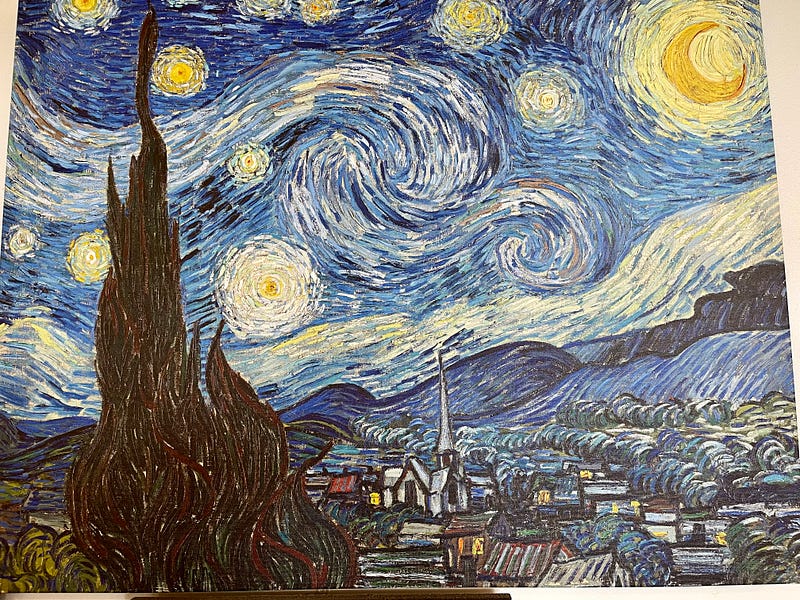
The Starry Night is an oil-on-canvas painting by the Dutch Post-Impressionist painter Vincent van Gogh. Painted in June 1889. Picture of author’s print by John Rose.

Genesis.

I have always loved this beautiful painting since I first studied it over 60 years ago. After my PhD, I decided to buy the biggest and best print that I could afford. It has graced my apartment, just above the computers for a good few years.

Here’s my problem. If I look at the swirl in the middle section of the picture I see a face. My engineer son does not see the face. Furthermore, it is only in the last three or so years, that I have become aware of the face. Do you see it?

My question is simple. Why do I see a face?

Visionary Painting

Some art critics like Meyer Schapiro highlight the expressionistic aspects of the painting and theorize that the “hidden content” of the work makes reference to the New Testament book of Revelation, revealing an “apocalyptic theme of the woman in pain of birth, girded with the sun and moon and crowned with stars”.

Meyer Schapiro, in his role of art historian, considered the artistic expression of Vincent van Gogh’s painting in spiritual and religious contexts. Conversely, in my role as an engineer, I applied a mechanistic viewpoint to the painting and failed to associate the painting’s patterns with a face.

In retrospect, the face has always been there for people to see. I’m reminded of the saying that “Beauty is in the eye of the beholder” which implies that the perception of beauty is subjective — what one person finds beautiful another may not. I believe I didn’t see the face originally as I did not apply a subjective, spiritual eye to appreciate the painting.

My new question is: What changed me so that I now see the face?

Persona.

Christina Sponias has discussed the persona put forward by Carl Jung and I think this concept is key to answering my question. My thoughts on identity looked at the persona from a complex systems perspective and that is the basis for my following discussion.

The mind-brain interacts with our lived-in environment through our persona. I don’t see the persona as a “mask”, rather I see it as a complex interface configured and adapted by the mind-brain to effectively facilitate and process two way communications with the outside world.

The mind-brain is a complex adaptive social system. This means that every component of the mind-brain including biological, chemical, thought, worldview, persona and health has the capability of interacting and exerting causal influences on everything else.

This gives me a thought as to why I now see and recognise a face in the painting. I had theorised that we receive feedback from the world around us and then we respond by adapting our persona to improve communication. But, now I think it is not that simple, perhaps our persona also independently adapts in a complex perhaps subconscious way?

Now I think I know the answer!

Changing Lifestyle

For many years I was a systems engineer and advanced through my innovations into a systems research role until I finally undertook a PhD. Research involves collaborating with both academic and industry researchers. I had to socialise my ideas and convince sceptics of their value. Furthermore, I had to accept criticism in a positive manner.

The PhD started a change in me that was accelerated as I moved into making teaching and lecturing my work focus. The need for group collaboration, making presentations and socialising created a more outward facing me. But, I still had troubles with bottled-up emotions.

In 2019, I joined medium.com and then Dr Mehmet Yildiz’s Illumination publications as a writer. My intention was to express (better than saying expel) my emotions through writing. Now in 2022, after COVID lockdowns, I believe that I am on the way to achieving my emotional goal.

I feel comfortable socialising and collaborating with people from all walks of life. I think it is this move from introversion to very mild extroversion that triggered the adaption of my persona to process and pass subjective (emotional) inputs to my mind-brain. In processing these subjective inputs, my worldview was expanded and in turn new ideas emerged that I could effectively socialise.

In short, I could now express and accept emotions and this enabled me to subjectively see the face in Vincent van Gogh’s painting.

Another Thought.

Meditating on the face in the painting, I realised that the changes in how I process emotions had been more advanced in 2019 than I first supposed. I remember being moved by Susannah MacKinnie’s stories where she skillfully merged prose and art to form a holistic emotional experience. I loved her crafted stories then and now.

Blessed be.

Emotional Wellbeing
Van Gogh
Art
Critical Thinking
Recommended from ReadMedium