
Paulina Porizkova Removes the Filters on Beauty and Aging
The former supermodel, 57, offers an honest look at what it means to be an older woman in her new memoir, ‘No Filter’
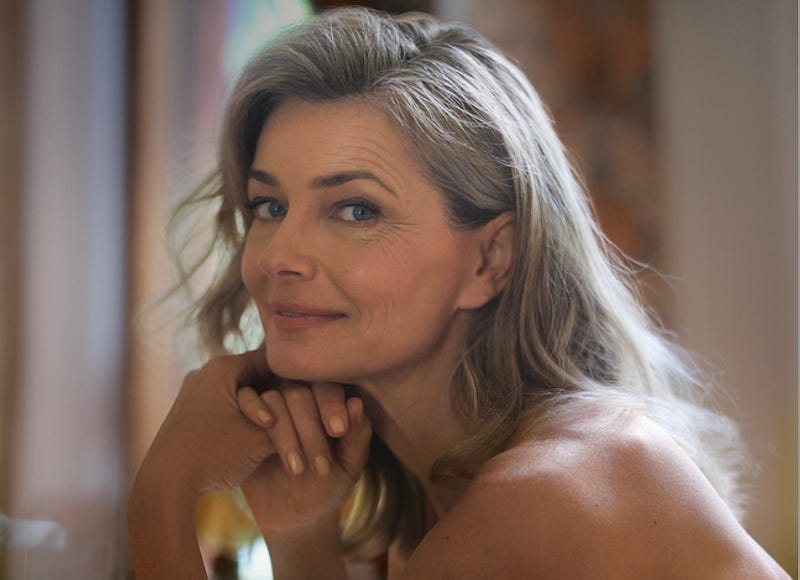
Paulina Porizkova was one of those faces that I saw repeatedly when I was in my 20s, whether in ads, on the cover of magazines like Vogue, Sports Illustrated or People, which twice dubbed her as one of the “50 Most Beautiful People in the World,” or in pictures with her rock star husband, the late Ric Ocasek of the Cars. She truly was, and is, a beautiful woman.
But what exactly does being beautiful mean? That is one of the many topics she addresses in her new memoir, No Filter: The Good, the Bad, and the Beautiful, which will be published Nov. 15, and one that will no doubt strike a chord with many women at midlife (well, along with her discussion of handling her money — I include her story in my book, Not Too Old For That: How Women Are Changing the Story of Aging — and one that is important for all women to understand).
Growing up in Sweden (to which her family had fled from Soviet-occupied Czechoslovakia), Paulina never saw herself as beautiful. That all changed when she started modeling at age 15 — the height that made her stick out as a youth and earn the nickname “Giraffe” was an asset as a model, although she admits even then she still had doubts about her beauty.
When she was 20 and the new face of Estée Lauder, a journalist asked her what she thought the responsibility of beauty was. The question stumped her. And shamed her.
“Her question made me feel defensive. It seemed like she assumed that there was a responsibility to beauty — that beauty was a gift to be used virtuously, for moral good. But does being beautiful mean that you have a greater responsibility to be virtuous? By that same logic, would someone less beautiful have less responsibility to be virtuous?”
Paulina admits she was an “arrogant asshole” when she was making lots of money modeling.
“Give a teenager loads of money, no rules, and lavish praise for her ability to look stunning and fit into sample-size clothing, and moral responsibility probably isn’t what she spends most of her days thinking about. Nevertheless, her question stuck with me for the following thirty-six years. What is the responsibility of beauty? What is the responsibility of someone who has been given the gift of beauty?”
When your gift is beauty, she says, developing it and maintaining it — as women often try to do as they age — is seen as vain and narcissistic. But other gifts that also are physical and require maintenance are viewed differently.
“An older athlete who strives to maintain their athleticism and compete with younger athletes is regarded as brave. An older model who strives to maintain their beauty and compete with younger models is often regarded as unnatural, embarrassing.”
She writes that she still isn’t sure what responsibility — if any — a person gifted with beauty has. That said, she is aware of what it’s like to lose beauty in a youth-obsessed society.
“I wish I could say that I’m happy with looking my age. I wish I could tell you that I am at a point of blissful peace about my wrinkles and have accepted how I look now. But I haven’t. It’s a daily struggle of self-acceptance. I have to keep reminding myself that it’s what happens when you’re lucky enough to get older. You know how you don’t get wrinkles? You die young.”
Exactly. And yet, as she observes, society’s narrow and static version of what’s beautiful doesn’t accept how a woman ages, although throughout history, what’s considered beautiful has changed. And it judges us harshly for undergoing a natural and ongoing process, getting older.
“We try to own beauty, but it cannot be owned. Beauty is like love in that way. It is a feeling, not an object. It’s an adjective, not a noun. Beauty is not responsible for your reaction to it. You are responsible for your own reactions when experiencing beauty.”
Sadly, society’s reactions are dismissive of older women’s beauty, what with our wrinkles, sagging and crepey skin, age spots and etc. Which is why so many women fear getting older and turn to procedures, which, she notes, help women “regain prettiness” and visibility.
Yet when we talk about the invisibility of older women, we often aren’t always on the same page. There are so many first-person essays of “the moment I became invisible” that it’s hard to know if there’s a universal moment — we just “know,” or accept, that it’s inevitable. (I have yet to read a first-person essay by a middle-aged man about the moment that he felt invisible. Not to say that they don’t feel that way; it’s just that no one expects them to.)
For some women, “invisibility” means the loss of the male gaze. For some, it’s about the general loss of being seen as desirable. For some, it’s about being dissed by younger people (including younger women). For some, it’s about employment discrimination. For some, it’s about ableism. For some, it’s about racism. For some it’s about discrimination on all the levels, full stop. For all women, however, it’s exclusion from data — perhaps the most harmful type of invisibility. If older women aren’t included in research, we miss out on crucial resources and services. That can do actual harm to us, unlike losing the male gaze!
Does a woman’s lost— actually, changing — beauty alone make us invisible?
Paulina introduces a concept in France I’d never heard of before, “jolie laide,” which translates into “pretty-ugly” — a sort of celebration of unconventionally attractive but nonetheless compelling women, ones with character. It reminds me of how historian Betsey Prioleau describes the lure of seductresses in her book, Seductress: Women Who Ravished the World and Their Lost Art of Love.
Some of the women she profiles were nowhere near what society would consider beautiful or even attractive, and some weren’t even young, but all were strong, sexy, sensual, confident, smart and accomplished women nevertheless, who knew the power of their femininity. They offer lessons all women today might want to consider.
“They teach women they don’t have to cave into traditional femininity. Better still, they don’t have to be beautiful or young, hold their tongues, play tricks, or teeter on Manolo Blahniks to captivate men. The seductress’s biggest lesson is the importance of cerebral lures. The most powerful mental charm was, and is, the allure of a big, forever-interesting person.”
A big, forever-interesting person? A jolie laide? Yes please.
I appreciate Paulina’s honest memoir and follow her on Instagram, where she expresses herself with no filters. Imagine if all women did that.
Hey, I’ve written a book on changing the narrative about aging as a woman, “Not Too Old For That: How Women Are Changing the Story of Aging” (April 2022). Order it here and follow me on Medium, Twitter, Facebook and Instagram. If you want to support my work and have unlimited access to my writing and the writing of all Medium writers, please become a member here. And if you’re interested in individualizing your marriage, please check out the book I co-authored, The New I Do: Reshaping Marriage for Skeptics, Realists and Rebels. You can support your local indie bookstore (please do) or order it on Amazon. We’re also on Audible.


