
To Men Who Read: Can We Get Some Support Here?
To Women Who Write: You Need to Up Your Game
How many films about writers can you think of? Top-of-mind. And… go!
Now, how many of those films were about female writers? Any? One? Two?
The Misery of being an unintentional Ghost Writer.
I’ve seen at least a dozen films with the story centered around a writer or author protagonist. Some, I’ve really enjoyed, like “Misery” (based on the Stephen King novel), “Adaptation” (with Nicolas Cage portraying the real-life writer, Charlie Kaufman), “The Ghost Writer” (Ewan McGregor…rawr!) and “Barton Fink” (love the Coen brothers’ films).
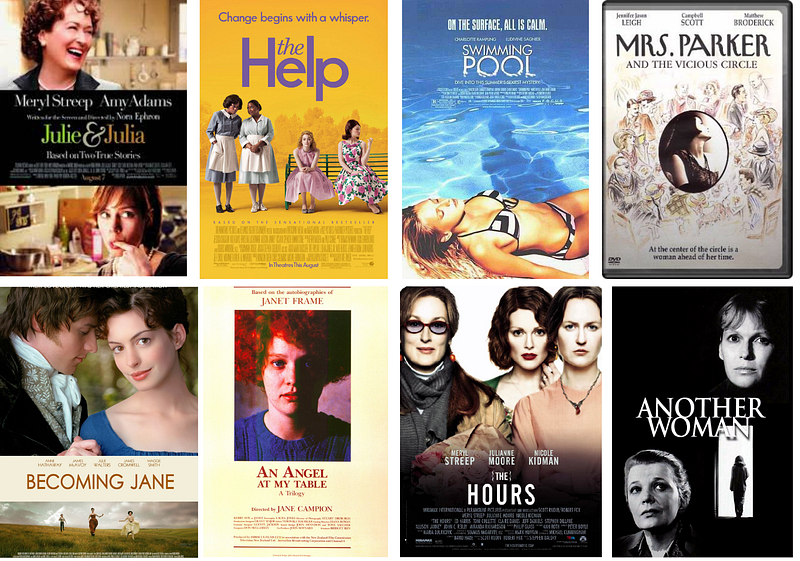
But I could only remember having seen two films about female writers—“The Help” and “Julie and Julia.” So, I consulted the Google Oracle to see what I might have forgotten. Google failed me.
Or, perhaps, it’s popular culture that has failed all female authors.
I looked at list after list and found over 120 films about authors and writers. How many stories were about ladies who write? Just eight.
“The last thing I want to see at the movies is a version of my reality. I don’t want to see art imitating life.”
I suspect the quote above, by Fran Walsh, the Oscar-winning screenwriter for Best Adapted Screenplay for “Lord of the Rings” in 2003, was made in the context of adapting fantasy books to film.
Personally, I do want to see art imitating life. I desperately want to see my experience as a woman, who is a working writer and novelist, represented in movies.
A Google search for films about prostitutes takes me to IMDb and their Top 100 titles. How many movies about prostitutes are there? Obviously, more than 100. One could conclude that prostitution is more prevalent as a career for women than writing is. But I don’t believe this is true.
In the author world, women write as many books as men do. So why does Hollywood appear to have such a bias against making films about female writers?
Perhaps it’s because in Hollywood ‘writer’ means ‘screenwriter’ and, if one looks at who the best screenwriters are—the ones worth acknowledging with awards—women appear to be somewhat of an anomaly based on who’s been taking home the Oscars.
There are two statues for Best Writer. One award is for Best Adapted Screenplay of which women have taken home seven since 1932—five of which were shared with men, like Fran Walsh’s, which she shares with Peter Jackson.
As an aside, I suspect you didn’t even know that Peter Jackson has joint custody of “his” Oscar until this story. Isn’t it interesting that an award shared equally by two people is remembered as being won by the male co-writer?
The other Best Writer Oscar is for Best Original Screenplay and over the last thirty years, four female screenwriters have taken it home. Full custody, no sharing.
- Callie Khouri for “Thelma & Louise” (1991)
- Jane Campion for “The Piano” (1993)
- Sofia Coppola for “Lost in Translation” (2003)
- Diablo Cody for “Juno” (2007)
In 2018, three of the seven nominees for Best Original Screenplay were women. A man won. (Kudos to the first Asian man to take home the Academy Award, Kumail Nanjiani for “The Big Sick.”)
And to be fair, between 1938 and 1985, five female screenwriters shared an Oscar for Best Original Screenplay with a man. That’s just ten Original Screenplay awards in eighty years.
Well, maybe the problem is that women don’t write quality films. If they did, they’d have more statues, right? I don’t think so since, in the last 28 years female screenwriters have been nominated for the Best Original Screenplay Oscar 25 times. We’re present and writing quality stories. We’re just not getting the spotlight.
I think that screenwriter, producer and director, Nora Ephron shared the secret to why women are way over-represented as prostitutes in films and way under-represented as writers:
“Most directors, I discovered, need to be convinced that the screenplay they’re going to direct has something to do with them. And this is a tricky thing if you write screenplays where women have parts that are equal to or greater than the male part. And I thought, ‘Why am I out there looking for directors?’ — because you look at a list of directors, it’s all boys. It certainly was when I started as a screenwriter. So I thought, ‘I’m just gonna become a director and that’ll make it easier.’”
Hollywood isn’t the only one discriminating against female authors.
One way books get noticed is by being reviewed in literary publications. A good review leads to higher sales which leads to being listed on the New York Times or USA Today bestseller lists. Being on “a list” leads to even more sales which leads to a higher author profile.
So, how do female authors fare in literary publications? Just as poorly as in their representation in Hollywood.
In the 2017 VIDA Count, which calculates the gender disparity in major literary publications and book reviews, researchers found that in the main 15 print publications only two published 50 percent or more women writers, five represented women between 40 and 49.9 percent, five between 33 and 38 percent of the time. And two publications, the London Review of Books and The New York Review of Books, had the worst gender disparity with only 23 and 27 percent of reviews about books by female authors.
And 2017 was not an anomalous, “just a bad year” for women. It seems those last two literary publications are “just bad publications” for women.
In 2014, the London Review of Books featured 527 male authors and critics, compared with just 151 women while The New York Review of Books featured 677 male authors and critics, compared with just 242 women.
It’s a vicious circle, Mrs. Parker.
Since literary publications drive book sales and book sales drive advances and advances play a role in how books are priced, the following data should be of little surprise.
One year ago, in April 2018, sociologist Dana Beth Weinberg and mathematician Adam Kapelner analyzed over two million book titles published in North America between 2002 and 2012. What they were trying to determine was whether the gender wage gap we see in traditional jobs also applied to traditionally published and indie authors. And what they found was shocking. Or was it no surprise?
“Titles of traditionally published books by female authors are priced approximately 45% lower on average than those by male authors according to 2002–2012 data derived from R. R. Bowker’s Books in Print, a comprehensive bibliographic catalog used by retailers and libraries.”¹
In part, this huge discrepancy is based on the way different genres are priced and who typically writes those genres. Romance books, for instance, are priced lower than science books. And, more women write romance while more men write science books. But, even accounting for those differences, the researchers still found that “that prices for authors with identifiably female names were 9% lower than for male authors.”
But wait! There’s more! (or less if you’re a female author)
In August 2018, UC Berkeley Assistant Professor David Bamman analyzed 100 of the most recent interviews in the New York Times’ By the Book section in a study called Attention in By the Book.
This is what Bamman found:
“Women interviewed by BTB in the aggregate mention men and women as authors about equally (48.9% women/51.1% men, 264 mentions), while men interviewed mention other men four times as frequently as women (20.8% women/79.2% men, 231 mentions).”
To be clear, if the New York Times is a reflection of the real world, it means that women read books that are written by men and women in equal numbers, but men read four books by male authors to every one book that’s written by a woman.
No wonder so many female authors choose to use initials or male pseudonyms when writing genres that men tend to read, like science fiction, action and adventure and horror.
On the upside, women read way more books than men do.²
What’s a girl (writer) to do?
Pull up her socks and ignore the fact that she doesn’t see herself represented in mainstream media portrayals of authors, is less likely to see her name as a by-line in a major literary journal or her book title on a major bestseller list and that she’ll make less than the men who share her job title?
Why should we expect that being an author would be any different than any other job?
Oh— I know! We should expect it to be different since we are the ones with the power of the pen.
Women: Your assignment if you choose to accept it
① Add *your* quotes to Goodreads and IMDb
If you’re a female writer and haven’t been quoted, don’t assume it means you’re not quote-worthy. Men also dominate the world of quotes, especially in Hollywood, but also in certain book genre areas. One way to raise the profile of women writers and authors is to get our quotes into the wild so they’re shared on Pinterest boards and Instagram posts.
If nobody’s quoting you, quote your damn self!
② Grab the spotlight—and point it at yourself
I’m a leader in two thriving writing communities: one meets monthly in the real world and has over 60 members, all women. The second is an online community with 81 members that includes 12 men. There’s very little overlap between the two groups.
Getting these female authors to grab the spotlight and shine it on themselves and their books is like asking them to strip naked on a train. Our humility is not serving anyone: not readers who won’t find our books, not movie watchers who won’t see themselves reflected in films, and certainly, not we the writers.
Get yourself on podcasts, write articles for mainstream media, share your words here on Medium, go on social media and crow about your writing accomplishments.
③ Lift other female authors up
Sometimes it’s easier to shine a light on someone else, so find some women writers you admire and rave about them with your people.
Ask your library to bring in titles by under-acknowledged writers. Make an extra effort to leave book reviews on Amazon and Goodreads for books written by women—men, you can do this, too!
Men: Your assignment, please accept it
① Read more books by female authors.
In the next six months, compared to the last six months, double the number of books you read that were written by women. If that number was zero, start with one.
② Review books by female authors.
Leave a star and comment review on Amazon—and Goodreads, if you’re there—for every book you read that was written by a woman. The review need not be longer than two sentences. Your manly name will lend unbalanced and in this case welcome weight, just by being there.
③ Recommend books by female authors.
Your friends trust your judgement, so give them a reason to pick up a book written by an author who has XX chromosomes.
A female writer and a prostitute walk into a bar
They both have great stories to share. But the story from the prostitute has been told 100 times while the story that the writer has is fresh. Who lands the deal with the film producer or literary agent?
Let’s all work together to create a “never saw that coming,” surprise ending to the set-up.
1. See the full study: Comparing gender discrimination and inequality in indie and traditional publishing
2. Survey of 8959 American’s reading habits done in August 2018 in a YouGov Omnibus survey.
Thanks for reading! If you enjoy stories about media you might enjoy this one, too.