
Past and Future Collide At the Top of Rockefeller Center
Views from Central Manhattan, 2007
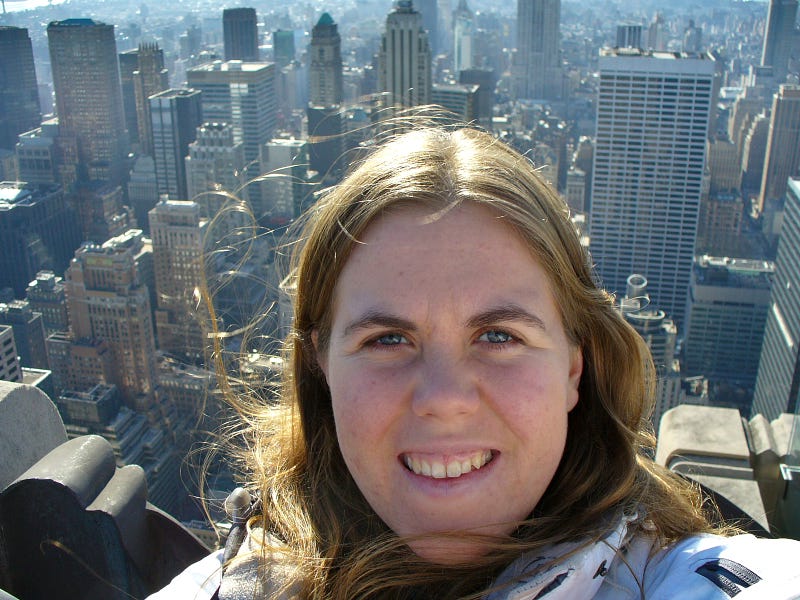
In December 2007, right in the middle of the New York City holiday season, I had a few hours to kill while my friend who had come up from our college in Philadelphia with me did a job interview.
My wanderings led me to Rockefeller Center, with its famous Christmas tree and ice skating rink out front. An advertisement caught my eye: take an elevator up to the “Top of the Rock” to enjoy an observation deck eight hundred feet above the ground.
I’d already been to the top of the Empire State Building a few years before, where the view of the city was magnificent. Intrigued, I paid the entry fee to Rockefeller Center and was soon soaring upward, landing seventy stories up in the sky.
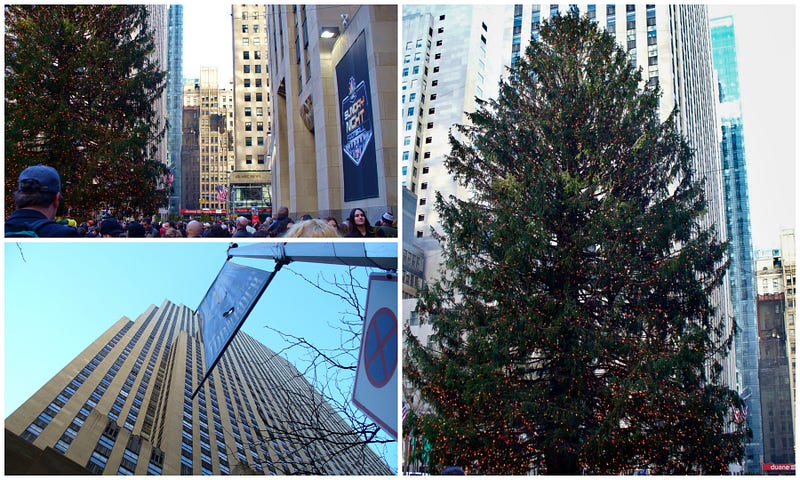
From the “Top of the Rock,” the history of New York City spread out before me.
Looking south toward lower Manhattan, the Empire State Building was the crown jewel in my view. My excursion was in 2007, remember, so the One World Trade Center skyscraper had yet to be built.
The Empire State Building, all 102 stories of it, was built from 1930–31 in only 410 days — a remarkably short time period for such a great achievement.
Its design was changed fifteen times until its builders could ensure it would be the world’s highest building, a title it maintained until 1970, when the first tower of the World Trade Center was built.
The Empire State Building was originally supposed to be an ordinary 25-story office building. How different the beautiful skyline of New York would look had that original plan gone through!
Interestingly, the building’s construction came at the height of the Great Depression, starting just a year after the stock market crash. The owners, who had invested so much money to build a skyscraper, didn’t make a profit on renting out the office space until the early 1950s.
The Empire State Building’s four upright columns had to support a building that would weigh ten million pounds. Every day, 16,000 partition tiles, 5,000 bags of cement, 450 cubic yards of sand, and 300 bags of lime arrived at the construction site.
There were cafes, concession stands, and water taps high up in the sky so workers didn’t have to waste time descending to the ground to eat and drink.
Historian John Tauranac says that materials for the building came from lands near and far: “Limestone from Indiana, steel girders from Pittsburgh, cement and mortar from upper New York State, marble from Italy, France, and England, wood from northern and Pacific Coast forests, [and] hardware from New England.”
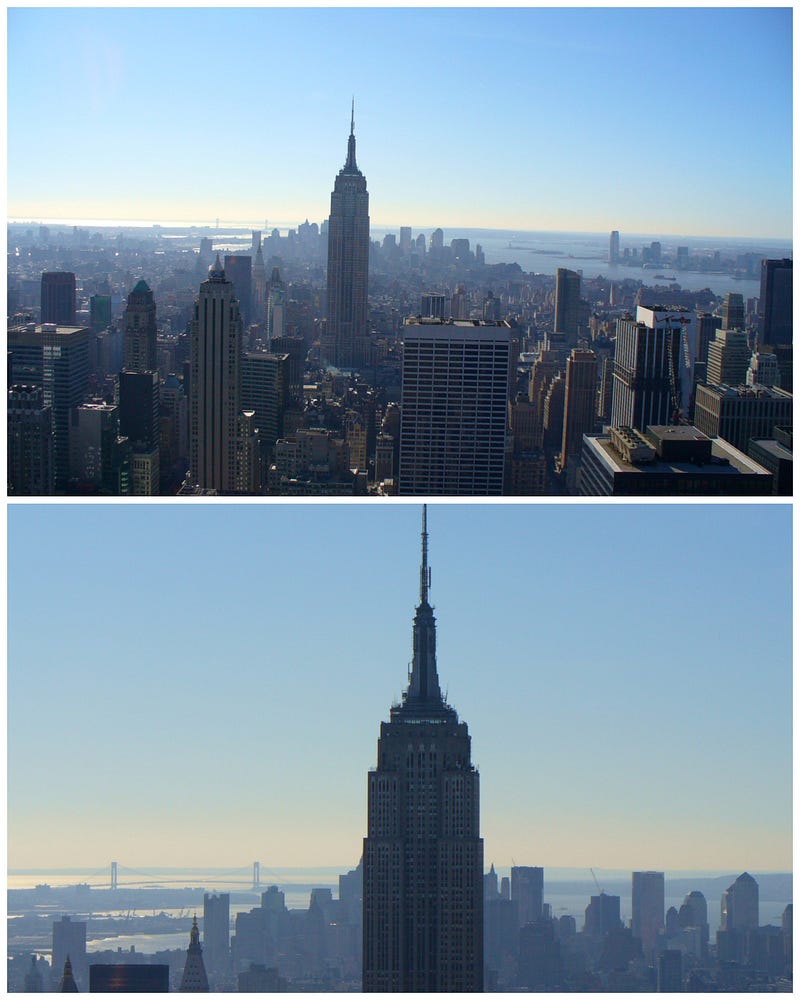
In my first photo above, way, way in the distance in the water to the right, you can see the Statue of Liberty, a tiny pinprick standing proudly in the harbor since 1886.
Most people know the statue was a gift to the U.S. from the people of France, but did you know the metal framework was built by Gustave Eiffel? The very next year, he would begin construction on the Eiffel Tower, which was built between 1887–89.
And did you know that the statue’s actual name is “Liberty Enlightening The World”? It bears small details that I didn’t notice even when I was up close, taking a tour boat from Battery Park that went right the island.
In Liberty’s left hand is a tablet that bears the date July 4, 1776 in Roman numerals. At her feet are broken chains and shackles, commemorating the end of the American Civil War just twenty-one years before and the abolition of slavery.
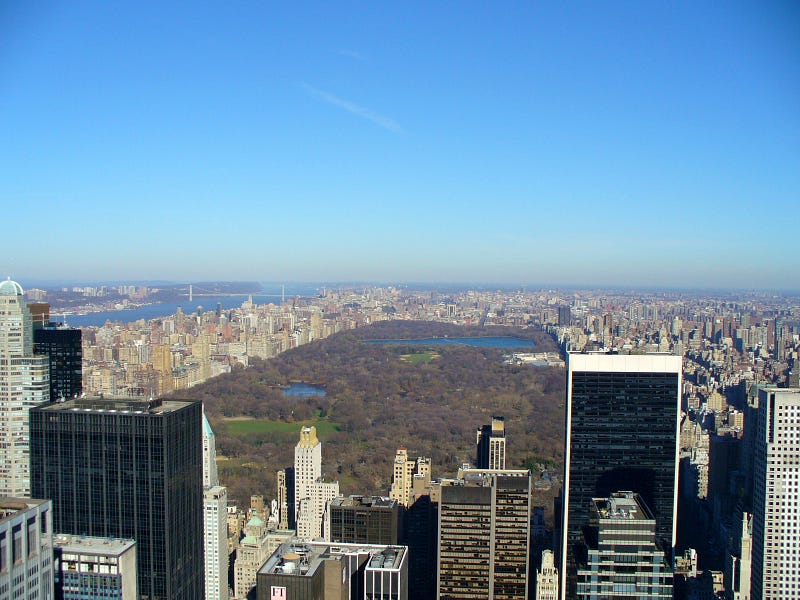
Taking quick turn to the north, I could see Central Park. The park seems enormous when you’re walking through it on tired feet, but from up here, the whole thing fit in a photograph.
Surprisingly, it’s only the fifth-largest park in the city, with Pelham Bay Park (Bronx), Greenbelt (Staten Island), Van Cortlandt Park (Bronx), and Flushing Meadows-Corona Park (Queens) surpassing it.
Central Park took much longer to complete than the Empire State Building. It was first proposed in the 1840s, and landscape architects Frederick Law Olmsted and Calvert Vaux won the design competition for the park in 1857. The park’s first areas were opened to the public in 1858, but the entire project wasn’t finished until 1876.
The land in Manhattan wasn’t simply empty until the park came along. Existing neighborhoods had to be razed, including the majority-Black Seneca Village.
The park’s design followed the 1860s and 1870s preference for natural-looking landscape design. There are eight lakes and ponds, several wooded areas, and many lawns and meadows.
Major attractions include the Ramble and Lake and the Central Park Zoo, opened in 1934 on the site of a previous 1864 menagerie. The vintage Central Park Carousel’s earliest incarnation, in 1871, was powered by a horse or mule walking in circles under its platform.
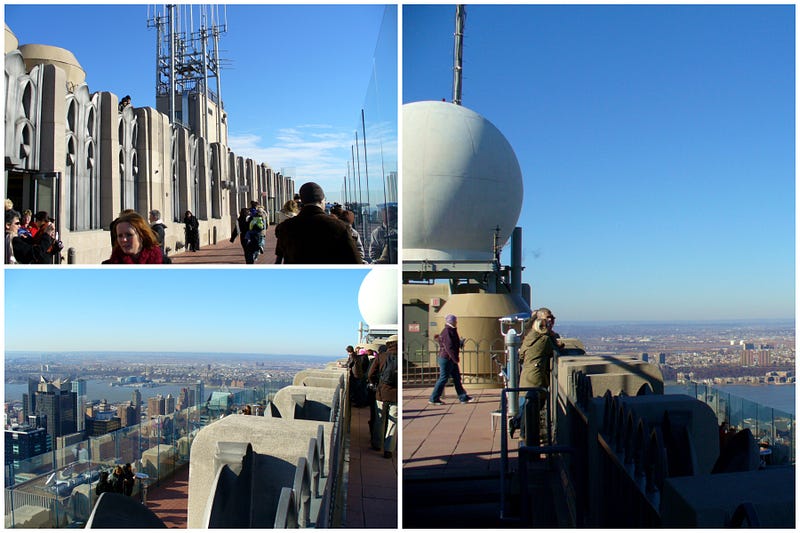
Meanwhile, on the observation deck, the future took hold. Enraptured by the view, I wanted to tell my parents back in Montana about it — right away.
The first iPhone had just come out in June of that year, and I only knew one person who owned one. I doubted my flip phone would get a signal from up in the sky. But, lo and behold, it did!
My mom answered.
“Guess where I am?” I said, breathless.
“Where?”
“At the top of Rockefeller Center! It’s awesome. I can see the whole city.”
I chattered on, spirit emboldened by the wind that whipped around me, excitement singing in my bones.
Little did I know it, but this would be the way of things from then on — cell service available almost everywhere, giving the ability to report your travel experiences in real time.
I snapped my Rockefeller Center photos with a separate digital camera, but soon even photography would become merged with the phone. It’s amazing how much has changed in only sixteen years.
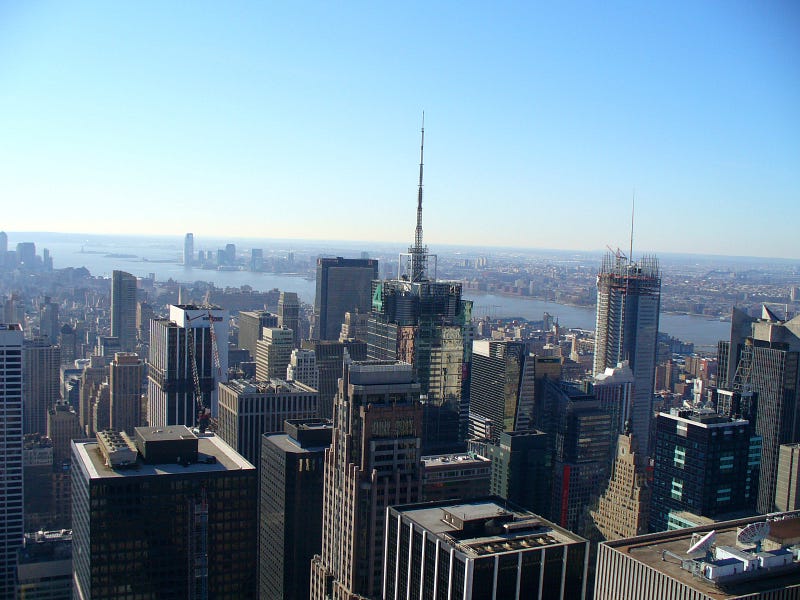
I could also glimpse the future of New York City itself. To the right in the photo above, you can see the Bank of America Tower under construction. Two years after I took this photo, in 2009, the 55-story building was completed at a cost of $1 billion.
The skyline of New York City is always changing, with buildings being demolished and new skyscrapers rising. From the top of Rockefeller Center, you can see it all: past, present, and future.
Thanks for reading my entry in the Skyscrapers Monthly Challenge, and thank you to the editors at Globetrotters (JoAnn Ryan, Anne Bonfert, Jillian Amatt - Artistic Voyages, Adrienne Beaumont, Michele Maize) for running such a great publication.
I always love Araci Almeida’s writing, and recommend her article about living in France:
Did you know only right-handed men were considered Christian in the Middle Ages? Read Jewel Allen’s article about visiting an Irish castle:


