
Pass The Salt
Actually, bypass the salt. It can kill you
When my heart decided to quiet quit and put in just a 40% effort to keep me alive — I was forced to make some lifestyle changes. The cardiac medical team that looks after my ticker gave me a list of do’s and don’ts including some dietary restrictions. Top of the list: follow a low sodium (salt) diet.
Sodium is a mineral found in food, table salt, and sea salt. We need some sodium in our system, but too much sodium causes our bodies to retain fluids. This makes the heart work harder in order to expel the fluid, which can cause swelling in our feet, legs, or belly. It can also build up in our lungs, making us cough and making it hard to breathe. Fun, eh?
The recommendation by the Canadian Heart and Stroke Foundation is very clear: you should limit the amount of sodium you consume to 2000mg or less each day. (source) That was also the advice I received from the cardiac team at my local hospital. For those of you keeping track at home:
One teaspoon of salt contains 2300mg of sodium!
To put that in context: one small tomato contains 14mg of sodium. One cup of canned tomato soup: 960mg of the stuff. Shocking, isn’t it?
In my seventy years of life, I had never paid much attention to the sodium content in food. I didn’t have to. No different from not paying attention to the number of calories in food, until I was told to lose weight. I didn’t have to. Until I HAD to. That was a shock as well.
One tablespoon of peanut butter contains 189 calories? Really?
Want to eat out?
Managing sodium intake is relatively easy when you cook at home. Fresh food prepared in our own kitchens gives us control over the sodium content. The problem arises when we consume processed foods, restaurant meals, or fast food.
That is a deadly minefield.
A McDonald’s Big Mac contains 920mg of sodium. That is nearly half of the Daily Recommended intake. Yet that is nothing compared to the Wendy’s famous Baconator which clocks in at a whopping 1,850 mg of sodium. For those of you scoring at home, that is the equivalent of TWO Big Macs.
This over-salting trend seems to be worse in North America than in other parts of the world. In Canada, McDonald’s Chicken McNuggets, for example, contain 600 mg of sodium per 100 g serving, compared to 240 mg sodium in the U.K. or France. (source)
You know this stuff can kill you, right?
In a study — published in the Canadian Medical Association Journal — Dr. Norm Campbell from the University of Calgary, an expert in high blood pressure, makes it abundantly clear:
“Too much dietary salt has been linked to high blood pressure and other health problems. Campbell estimates that there are 7.5 million Canadians with high blood pressure, and about 2 million of them have hypertension because of too much salt in their diet. We estimate 14,000 die every year, and over 40,000 are hospitalized from strokes, heart attacks and kidney failure because of this issue,” (source)
If you think I’m picking on the fast food industry let me assure you that restaurants are not much better. The Mediterranean Bowl at Joey Restaurants, for example, contains 2,530mg of sodium. That is more than the daily limit — in one dish.
The bowl is marketed as “Mediterranean” which is linked to the heart-health benefits of a Mediterranean diet, but the name is what experts call a “health halo” — a term for something that sounds healthier than it may actually be. (source)
77% of the sodium we eat comes from restaurant meals and ready-made processed foods. (source)
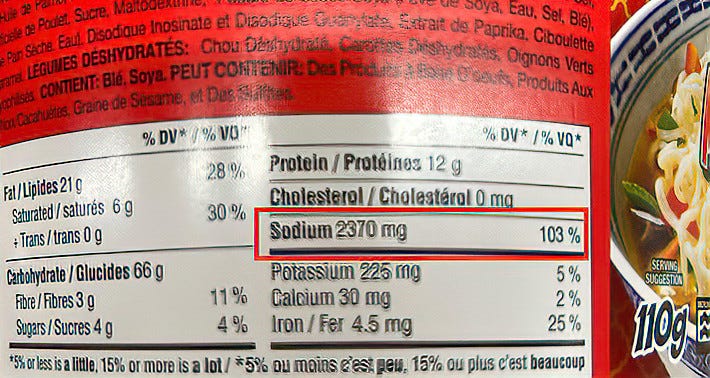
This bowl of instant noodles at 103% sodium is a good illustration of the dangers of processed food.
Read the nutritional labels of bottled pasta sauces, instant noodles, deli meats, or bottled salad dressing and you will, once again, be shocked. Even your morning cereal, like 1.5 cups of Cornflakes with 3/4 cup of skim milk, contains 380mg of sodium.
I am not a doctor and I am not offering any medical advice here, do your own research. Yet it’s a well-known fact that excessive sodium consumption has been associated with significant health risks. That is no secret.
Learning to read nutritional labels really helps to make wise decisions as to what you are consuming.
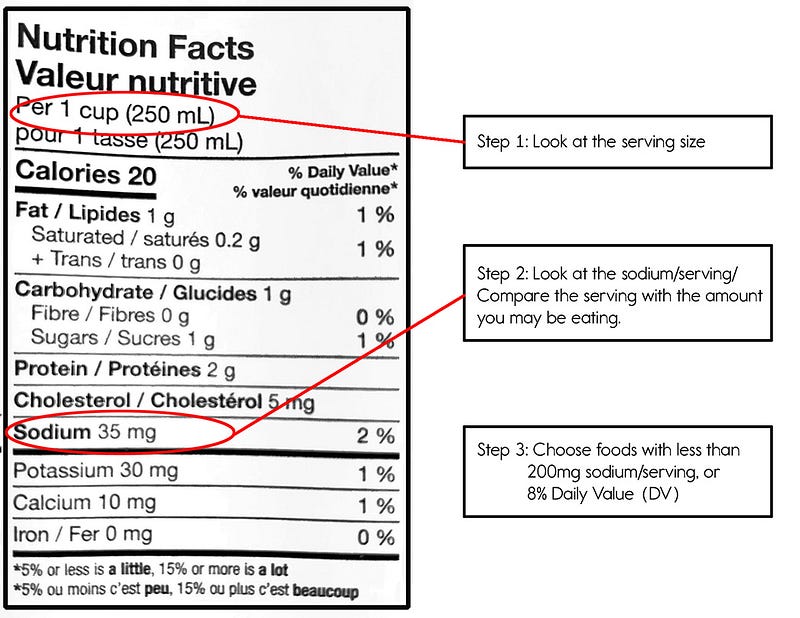
Learning to decipher the nutritional information on food labels is critical. This product for example contains 35mg of sodium per cup which is just 2% of your Daily Value. Quite reasonable.
Some people are fooled by the numbers, they see 35 mg and think that is the total amount of sodium for the entire package. IT IS NOT. The figure refers to the one-cup serving size.
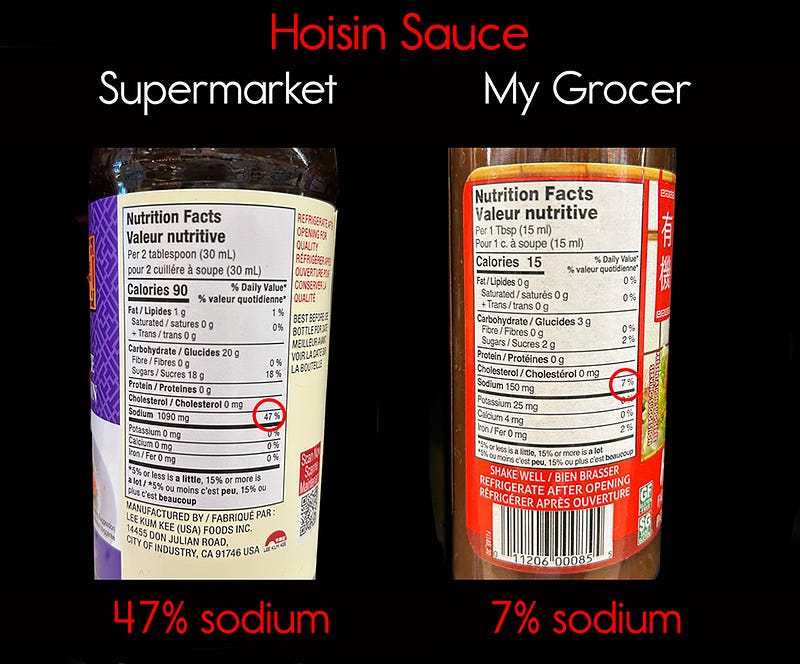
If you examine this Hoisin Sauce comparison, those figures need adjusting. 47% refers to a 2-tablespoon serving, while the 7% number refers to a 1-tablespoon serving. One is still a healthier choice but read the labels carefully when comparing.
My experience after over two years of a low-sodium diet has been a real eye-opener. The main point that I would make is that your palate adjusts to a low-sodium diet quite quickly. Soon you begin to reject salty food. Say bye-bye to anchovies and pickles.
That does not mean that you have to deprive yourself of foods you enjoy. There are plenty of low-sodium alternative products available nowadays.
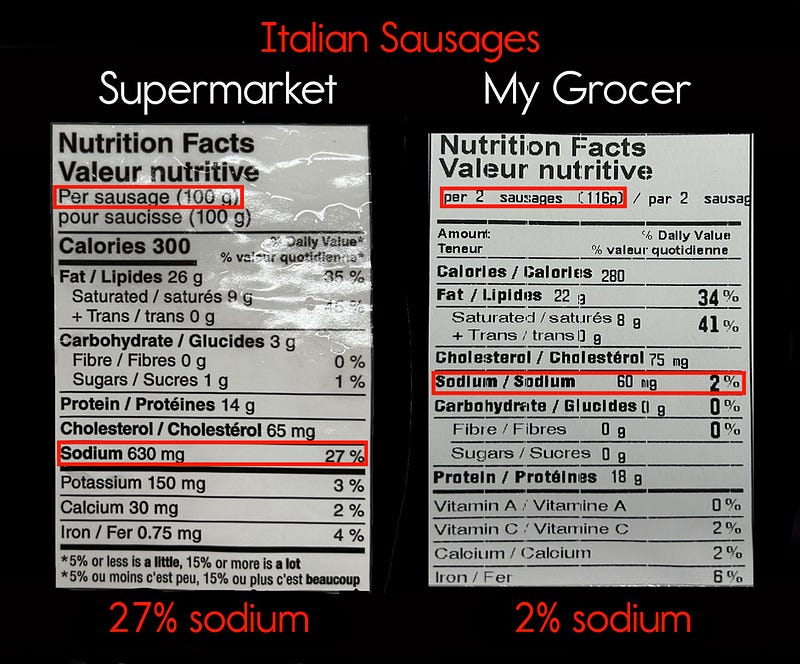
My grocer of choice stocks mostly “healthier” products, which I find very helpful. They screen the products based on their nutritional components. That means: lower fat, lower sodium, organic ingredients, fewer additives, and more environmentally conscious packaging. I pay more for that. I won’t lie. However, to stay alive, I gotta do that.
