
How I Lost 25 Pounds in 3 Months
Then my heart said: No más.
The two damaged middle-aged teachers are facing each other. One, the English teacher, is a successful writer who has lost his creative edge to alcohol. He is on the brink of being fired.
The other, the Fine Arts teacher, is a successful artist, now ravaged by a medical condition that is interfering with her ability to paint.
The scene is tender, slow, honest, smart, sensual — their intellectual sparring has been put on pause. Now their vulnerability is on display.
As he makes his move, she responds in a serene, even tone “Life keeps taking things away from me, and I’m never sure when it is the last chance I have to do something; and to do it fully.”
If that scene touched a nerve, it was difficult to conceal, as the tears rolled down my cheeks.
That was not the first time I’ve cried at a movie. I have always allowed emotions to touch me, freely and deeply. So, if my Limbic and Lacrimal systems are collaborating to create emotional tears, well… I’m OK with that.
Fortunately, I was never taught to censor my tears. Words and Pictures is no Oscar winner. On a bad day, it is a conventional, pedestrian, romantic movie. On a good day, it is entertaining, intelligent, and it was filmed where I live.
The fact that one character is an artist, like my lover, and the other is a writer, something that I aspire to emulate, provided a connection that made me give it my full attention. I enjoyed the film. So, why the tears? Well… life IS taking things away from me: an old shoulder injury means I can no longer swim, or golf. Skin cancer means that I can no longer bask in the sun. A damaged retina means I cannot see clearly out of one eye. Heart failure means I can no longer exercise. My other cancer is in remission.
So when Juliette Binoche said “I’m never sure when it is the last chance I have to do something and to do it fully,” the bell rang loudly.
Now, this is not about despondence or self-pity, but it does feel a bit unfair because prior to being diagnosed with heart failure I had been treating my body better than at any other point in my adult life.
The bitter truth
I returned from wintering in Portugal early in 2019 where I had undergone eye surgery to repair a detached retina — which required weeks of intense steroid treatment.
I went to see my family doctor for a check-up. She read the report from the ophthalmologist, made me stand on the scale, took my blood pressure, and said to me “you need to drop 20 pounds.”
She suggested an app called “Lose it” to help me manage my calorie intake.
The Plan
Well, I had never in my life been “on a diet,” so this was new territory for me. I downloaded the app and entered my age, my current weight, and my target weight:160 lbs.
The app indicated that I had to consume a maximum of 1700 calories per day to achieve that goal. I had no concept of what that was.
I soon learned that a meal at McDonald’s: a Big Mac (560), French Fries (570), ketchup (100), orange juice (180), and apple pie (270), add up to 1680 calories. With the remaining 20 calories, I could have 3 almonds as a snack. Done eating for the day. Fortunately, I avoid McDonald’s. I eat fresh healthy food that I prepare at home. Home cooking helped me design meals that fell within my 1700 calorie daily limit.
At first, it was not easy, due to my ignorance. I would have never guessed that ONE CUP of my famous Mac&Cheese contains 400 calories. Or that ONE small avocado packs 230 calories. Or that ONE tablespoon of peanut butter contributes 100 of those pesky units of energy. Seriously, one tablespoon of peanut butter doesn’t even cover a half slice of bread.
Obviously, I needed a strategy to make this plan work.
- Firstly: I had to internalize Nutritional Information labels. Food manufacturers love to trick you: the nutrition label on a bag of Lay’s potato chips reads 160 calories — in large bold letters. In small letters, it reveals that the 160 number refers to the serving size: about 15 chips. The entire bag?…1,280 calories.
- Secondly: I had to start weighing and measuring my food so I could visually assimilate what 200 grams of grilled chicken looks like. I purchased a digital kitchen scale.
- Thirdly: I had to understand the role of exercise in a calorie management program. Remember those 15 potato chips? It takes 43 minutes of walking, 15 minutes of running, or 22 minutes of bicycling to burn those 160 calories.
OK then, if I want to indulge in a glass of white wine, then I would have to walk for 45 minutes, just to break even. It became clear that some lifestyle changes would be required if I was going to reach my goal. I could not consume fewer than 1700 calories a day and sit on the couch waiting to lose weight — I would die of hunger and boredom. The “Lose It” app automatically deducts calories from your daily intake based on the physical activities you engage in. An hour of vacuuming burns 166 calories. An hour of aerobics: 290. An hour of Zumba: 400.
I understood the benefits — if I walked for 45 minutes I could have a treat, and not feel like I was committing a crime.
So when my lover asked me “Do you want to go for a walk”? I said, “Yes, I’d love to.” She thought I was joking, as I would normally decline her kind invitation. And so it started… walking a few blocks. Soon, our distances got longer, our pace faster, and our breathing easier.
Better watch it
To accurately record my activity level, I concluded that I needed a fitness tracker. I headed to the Apple Store.
The Apple Watch did a couple of things for me: it communicated with the Lose It app to record the calories I burnt through exercise, and it served as a motivator.
The Activity app built into the watch encourages you to do three things, every day.
- Number 1: Move — burn a certain number of calories per day.
- Number 2: Stand — Get off the couch at least for one minute every hour, twelve times a day.
- Number 3: Exercise — at least 30 minutes, every day.
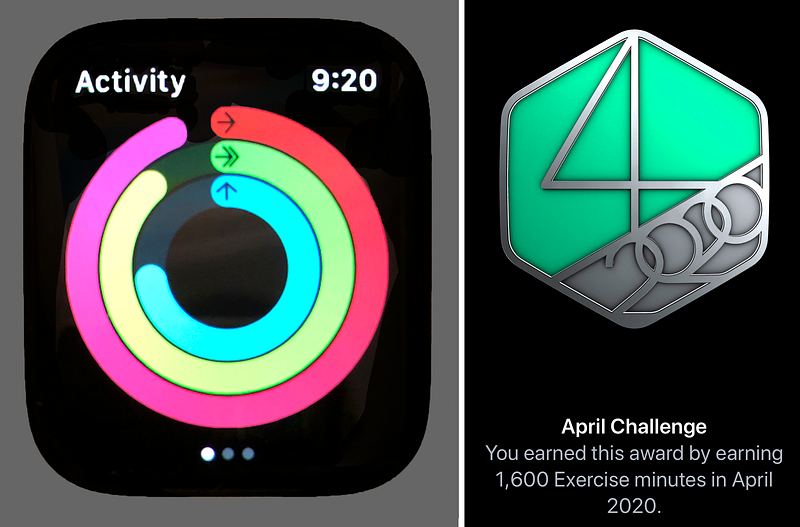
Your progress is shown on your watch as three circular bands that grow as you work towards your daily goal. When a band forms a ring it means that you have completed your task. The ultimate goal is to close all three rings… every day. The device also offered monthly challenges which served as further motivation to increase your activity level.
For a person like me — who is externally motivated — that was the perfect tool. I became obsessed. I HAD to close my rings every day.
Fit Fellows
To help me achieve my daily exercise target my loving partner surprised me with a gift: “I registered you for a fitness class” she said “It’s an introduction to the Century House Senior Centre fitness room.
“Be there on Thursday at 11:00. The instructor’s name is Myken.”
It did not sound like my cup of tea, but I did not want to seem ungrateful, so I reluctantly showed up at the allotted time. There was no one there.
I headed to the reception desk to enquire. I was informed that I was not registered for a fitness center introduction, but for a Cardio and Strength class held in the gym. I entered the gym and met Myken, who confirmed that I was registered for “Fit Fellows,” and told me to gather the necessary equipment for the class: hand weights, resistance bands, ball, and sliders.
Soon the gym was filled with music and a dozen old guys trying their best to mimic Myken’s moves. I felt totally lost and perpetually a few steps behind. The atmosphere was friendly, relaxed, and dotted with laughter as Myken joked with the participants.
I completed the class, but I felt exhausted. I was certainly NOT a fit fellow. Every muscle in my body ached, for days afterward, to remind me that I had neglected them for far too long. Soon, it got easier. My partner and I took two more weekly Cardio classes together, and a Zumba class. In case you are unfamiliar: Zumba combines dance and fitness moves.
At first, I felt totally lost and perpetually a few steps behind. There I was, me and a dozen women: dancing, sweating, laughing. I loved it. I became addicted.
My Aha Moment — that experience of suddenly understanding what previously seemed incomprehensible — revealed itself while driving home from a Zumba class with a grin on my face and feeling totally energized.
Months earlier after my first Fit Fellows session, I had felt exhausted and lifeless. Suddenly I understood why people do this: it makes you feel good.
It took me exactly 100 days to drop the 20 pounds that my doctor requested.
I went further. I dropped another 5 pounds, and when I got there I switched to a maintenance program, which allowed me to consume 2000 calories per day in order to stay at that weight; which I did for well over a year.
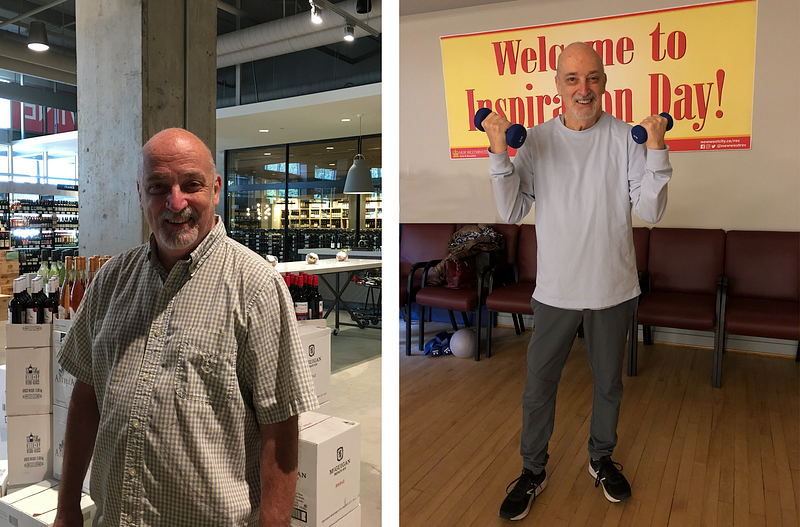
The experience was easier than I thought it would be. It took discipline, no doubt. Walking away from ice cream, french fries, and Oka cheese was difficult at first, but once the habit was broken it became a way of life.
I could not have done it without the Apple Watch keeping me motivated with monthly challenges, activity goals, daily reminders, and encouragement. Closing those Activity Rings every day was at times difficult: like when I was sick with the flu.
Heart Failure
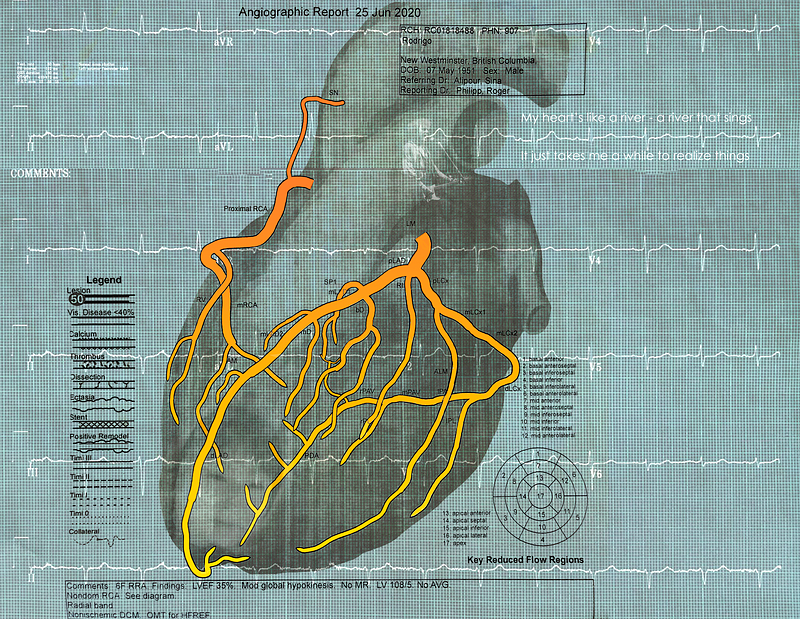
Yet, I accomplished that goal for 62 weeks, 440 consecutive days, until my ailing heart said “I ain’t gonna let you do that no more.” Excuse the pun, but I was heartbroken on July 16th, 2020: the first day I could not close my rings. I felt dejected, helpless, beaten, and disheartened. Yes, there were tears.
I find it difficult to explain how that feels. It is a mixture of frustration, impotence, and powerlessness. Unfortunately, three of the main symptoms of heart failure are: shortness of breath when you exert yourself, reduced ability to exercise, fatigue and weakness. Kind of a lethal trifecta against an active lifestyle. Sadly there is no cure for this genetic gift from my father. It is what it is.
Under normal circumstances I would view it as a glass half full kind of thing — I wasn’t supposed to make it out of the incubator, so I’ve squeezed 70 great years out of very long and improbable odds, and I would leave it at that. Yet this new reality has been difficult to accept as it decided to show up in the midst of a global pandemic.
The feeling of acceptance that I’ve been seeking is one of the five stages of the grief model developed by Swiss psychiatrist Elisabeth Kübler-Ross to describe the process we go through as we come to terms with a terminal illness.
I have concluded that the cocktail of emotions that I’ve been feeling is the product of anticipatory grief — that feeling we get from an uncertain future. My strategy to reach acceptance has been to allow myself to feel grief and move on.
Acceptance gives me a tiny sense of control — which hopefully will lead me to find meaning in this experience. Also, according to David Kessler — the world’s foremost expert on grief:
“telling your story often and in detail is primal for the grieving process…grief must be witnessed to be healed.”
Just in case you were wondering why I’m sharing this…
Yes, life is taking things away from me, and I’m never sure when it is the last chance I have to do something; and to do it fully. Will I travel to Italy? Go Marlin fishing? Explore the Bilbao Guggenheim? Revisit my birthplace? I’d like to think so.
Pessimism is an abstract concept — the glass-half-empty idea points to liquid that is not there. Optimism is tangible — the glass-half-full has discernible substance in it.
So that’s where I will hang my hat.
My lover — with her infinite wisdom — has helped me get here. “Don’t think of what you cannot do” she suggested, “think of what you CAN do.” That simple shift in perspective points to the fact that humans are built to adapt. That is what we have always done.
We cannot survive if we don’t.
