
Parmigiano-Reggiano: Cheese of All Cheeses
What better way to brush up with your cheese ABCs than with everyone’s favorite parmesan?
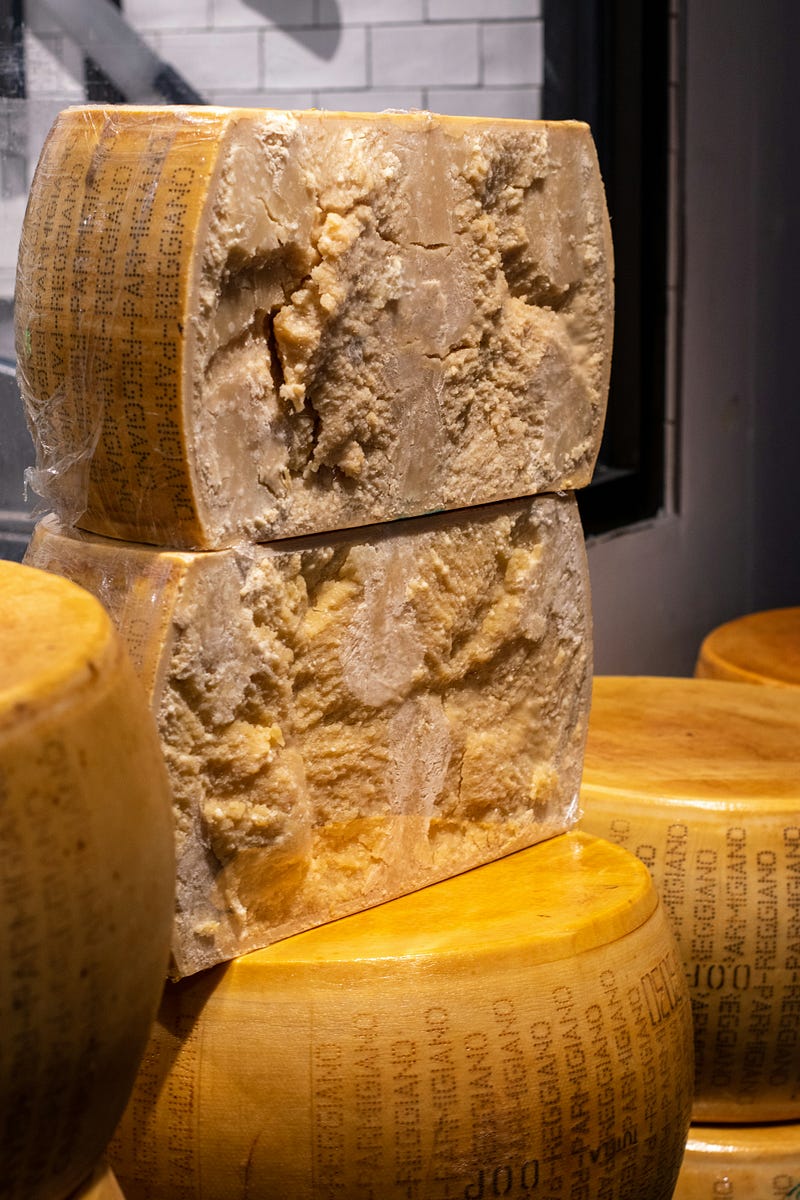
You can hardly flip through a page in an Italian cookbook without coming across a mention or two of Parmigiano-Reggiano, which many of us know as just parmesan.
Most of these recipes, as can be expected from Italian cookery, are resourcefully modest in a way that only food all’Italiana can be: They feature a handful of ingredients—all fresh, local, and in-season — and meld them together skillfully, bringing out the aromas and letting the flavors shine through.
Take the 1886 issue of The Family Advisor, a 19th-century periodical in Bergamo — a cobblestone-street, red-tile-roof city with Venetian walls all around just an hour’s drive northeast of Milan — which gives us, from the annals of time past, a recipe for creamy cooked spinach with eggs and parmesan:
“Take as much spinach as you want to, and briefly boil it. Squeeze it from the water and toss it in a hot pan with melted butter and salt. Whisk fresh eggs in a cup with Parmigiano cheese and some marjoram. When the spinach is cooked, pour the mixture in and stir, taking care not to stiffen the eggs.”
Or take the original recipe for Pasta Alfredo from the historic, 104-year-old Alfredo alla Scrofa restaurant in Rome, which turns fresh pasta, fine-grated parmesan cheese, and unsalted butter into the most decadent pasta dish you have ever had:
The delights of Italian cuisine are impossible to resist.
What It Is
Parmigiano-Reggiano is a hard cheese.
And hard cheeses are aged cheeses — from the raising of the cows to the coagulation and curdling of the milk to the brining of the cheese wheels and, most importantly, their maturation for 12, 24, 36, 48 months, or more, aged cheeses require time, dedication, and a familial reverence for tradition to get right.
Parmigiano-Reggiano is made exclusively in the Italian provinces of Parma, Reggio Emilia, Modena, the part of Bologna to the left of the Reno river, and the part of Mantua to the right of the Po river.
The cows are fed locally grown forage — no silage, no animal flour, no fermented feeds. The milk from the previous night and the day’s morning is collected and poured into large copper vats, where it is mixed with rennet and starter cultures from the previous day’s batch.
As the cheese coagulates, it forms a curd.
The curd is then spun using a tool called “spino” and broken up into tens of little pieces. A gas fire warms the vat.
Gentle cooking at 131°F (55°C) assists in the formation of a solid mass, which sinks to the bottom. After an hour or so of cooking, it is removed, strained with a linen cloth, and stuffed into a casing.
Lo and behold, a Parmigiano-Reggiano cheese wheel!
The wheel is brined in salt water for days, then arranged, in an orderly fashion, on shelves in warehouses with temperature and humidity levels reminiscent of the caves where Italian monks once stashed away their cheese wheels.
Parmigiano-Reggiano is rested for a minimum of 12 months.
(Come to think about it, that’s more time than it takes to carry a baby.)
During that time, the cheese ages gracefully: It loses moisture and gains flavor. Losing squeakiness, it becomes grainy and crumbly, with an edible albeit gum-achingly difficult to chew rind that protects the goodness inside.
The farms and dairies keeping this tradition alive are monitored closely— and regulated stringently — by the Parmigiano-Reggiano Consortium, the organization that sets the rules for the production of parmesan and protects the trademark worldwide.
Where It Comes From
It’s said the recipe for parmesan was created by 12th-century Benedictine and Cistercian monks.
The monasteries, tucked between the hills of Italy’s mountainous Parma and Reggio Emilia provinces, herded cows for milk. Cheese-making was a way to preserve the milk for later consumption.
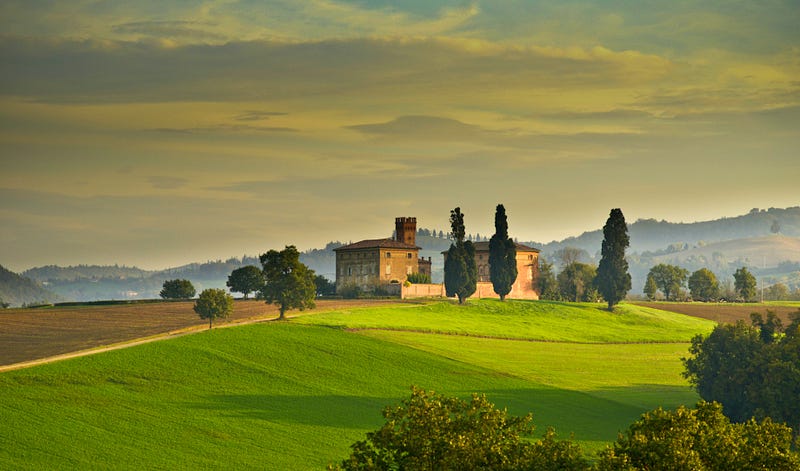
The monks maintained a monopoly over parmesan’s production for perhaps a couple of centuries, and the cheese became famed for its sweet, savory flavor throughout Italy.
Eventually, wheels of Parmigiano-Reggiano made their way to the ports, and they became an export — a taste of Italy, if you will, accessible only to the high ranks of Middle-Age Old-World society.
With the discovery of the New World, parmesan sailed across the Atlantic to become the favorite cheese of none other than Benjamin Franklin, one of the seven Founding Fathers of the United States.
In his book “Benjamin Franklin’s Life in Italy,” 20th-century Italian politician and then-mayor of Rome Luigi Rava writes about a letter that Franklin penned while on a trip to Italy in the year 1769:
“And for one I confess that if I could find in any Italian travels a recipe for making parmesan cheese, it would give me more satisfaction than a transcript of any inscription from any stone whatsoever.” — Benjamin Franklin
It took four years, as told by the American Philosophical Society, until a letter from Italy with the ingredients, steps, and techniques finally arrived in Franklin’s mailbox.
Whether cheese produced outside of Parma, Reggio Emilia, and nearby provinces can be called “parmesan” has since been the matter of a heated debate — and legal dispute.
Fast-forward to present-day Europe, and “parmesan” is “Parmigiano-Reggiano.” No cheese that doesn’t meet the strict rules of the Consortium can be labeled either way, however it is produced.
Stateside, things are different. And admittedly more nuanced.
United States trademark law gives protection to the term “Parmigiano-Reggiano,” but not to “parmesan.” In practice, this means that parmesan can be any cheese made anywhere and with any recipe if sold outside of Europe.
Don’t get me wrong; this isn’t to imply that all parmesan-labeled cheese in the US is bad.
There’s plenty of joy, for instance, to be derived from a good piece of Argentinian Reggianito. Still, if you want an authentic, traditional cheese for your salads and pasta dishes — and you know what I’m talking about if you’ve tried it — the only option to opt for is Italy-imported Parmigiano-Reggiano.
How to Buy It
Buy your cheese from a family-owned deli or a cheesemonger you can trust. By doing so, you keep the economy of Main Street, and not Wall Street, running.
Pre-shredded cheese has lost its best aroma and flavor, to one extent or another. Vacuum-packed wedges are fine, but nothing can really rival the richness of Parmigiano-Reggiano cut to order from a cheese wheel behind the counter by someone who knows what they’re doing.
If buying wedges, look for the European Union’s red-and-yellow Protected Designation of Origin (PDO) seal:
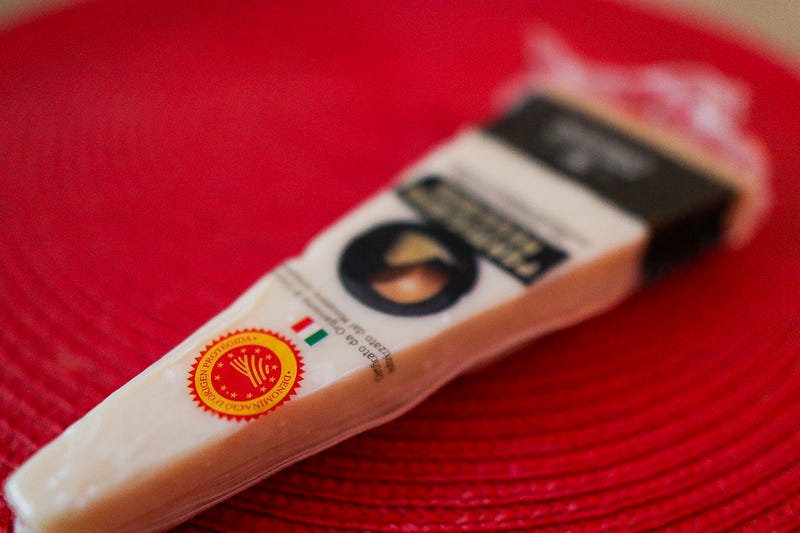
Sometimes, the seal is in Italian, in which case it will state, “Denominazione d’Origine Protetta” and abbreviate to “DOP.” (Same thing. Different languages.)
Cheeses cut to order don’t have a seal, since they’re not sold come pre-packaged. But you don’t have to be a cheese pro to verify their authenticity. Look for an embossed “PARMIGIANO-REGGIANO” marking on the rind, uppercase and with a dash:
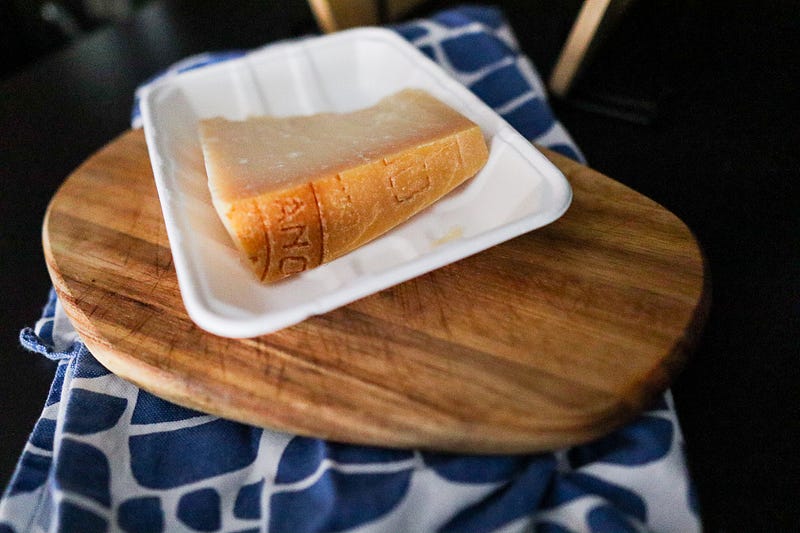
If you’re shopping on a tight budget, keep an eye out for pre-cut Parmigiano-Reggiano cheese in the baby bin. (The “baby bin” is that self-serve corner of the cheese counter with the small scraps of cheese, vacuum sealed or wrapped in plastic, for two-three dollars the piece.)
Ways to Use It
Though most of us slice parmesan onto salads or grate it onto hot pasta dishes, there are more ways to incorporate this hard Italian cheese into your cooking.
Some of my personal favorites are Pasta Cacio e Pepe and Pasta alla Carbonara, in which the parmesan is combined with other ingredients to create a creamy cheese sauce without the need for cream.
For Cacio e Pepe, the pasta is cooked, then tossed with salty and starchy cooking water, finely-grated parmesan, and freshly cracked black pepper in a bowl, at a distance from the heat, so the cheese melts instead of curdling.
By including egg yolks and browned guanciale, Carbonara brings a new level of richness to the humble cheese sauce. The key is to use fresh, room-temperature eggs and toss the pasta strands with the sauce over just enough heat to kill the bacteria but not make an omelet.
Parmesan may not melt well, like all other hard cheeses, but it can certainly add a finishing touch to New York Style and other American pizza styles. (This is where I direct you to fellow Medium foodie Linda Lum’s fabulous round-up, “The United States of Pizza.”)
Don’t limit yourself to the usual Italian and Italian-American cuisine, try something new! Eggplant parmigiana and chicken parm are great, don’t get me wrong, but if you’re craving something special, you can try making Donato Russo’s parmesan sauce for an omelet (from minute 5:20):
And let’s not forget sandwiches.
There’s an art to making Italian panini (when I talk to friends about food, many are surprised to learn the singular form is panino). And if the bread is your canvas, then parmesan should be one of your brushstrokes.
Storing It
Unopened, vacuum-sealed parmesan can be kept in the fridge in its original packaging. Once opened, wrap the cheese in paper — be it wax or parchment — then *loosely* in plastic before refrigerating it. The cheese needs to be able to breathe.
Most home cooks’ fridges are big and offer an abundance of storage options:
I like to keep my cheeses in the cheese-and-meat or crisper drawer, depending on how crammed my fridge is. (As you can probably guess, being a frequent food writer comes with the demands of being a voracious eater, to the great angst of my personal trainer.)
Thanks to its low moisture level, parmesan can stay unrefrigerated for longer periods than other types of cheese. Even so, don’t leave it out for too long, as it may get sweaty and dry out. The sweat can be wiped off with a paper towel, but the dryness is unsalvageable.
Still, don’t wait too long to use up the parmesan once it’s opened. The enticing smell, mouthwatering taste, and that ideal crumbly consistency won’t last forever. No good things do.
P.S. Thanks for reading! I post on Medium every week. Get an email whenever I do by going here →
You can also follow my Medium publication called Tastyble, where I — and other food writers — publish stories that get you cooking.


