
An Ode to Pasta Carbonara
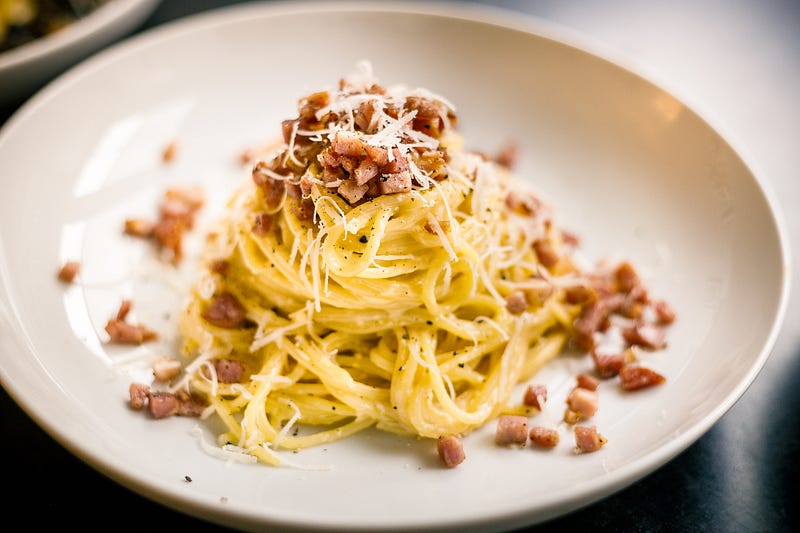
Pasta carbonara is a mainstay of Rome and its surrounding Lazio region; a favorite of both locals and tourists alike.
Made with long strands of pasta, egg yolks, grated pecorino cheese, and thick-cut guanciale browned in a skillet — tossed together in the residual heat of the skillet and liquified with a bit of salty, starchy pasta water — carbonara is the classic Italian dish we all crave and love.
Carbonara’s origin story, like that of many other traditional Italian dishes, is a subject that’s greatly debated.
Some believe it’s what 20th-century Roman coal miners ate for lunch (in Italian, one of the meanings of the word “carbonaro” is “coalman”).
Others claim that Renato Gualandi, a chef from Bologna hired to cook for the lunch of the meeting between the English Eighth Army and the American Fifth Army during World War II, invented it with ingredients solely from US military rations.
And still some trace its beginnings in Neapolitan cuisine from the 19th and even 18th centuries.
Indeed, Ippolito Cavalcanti’s 1839 Neapolitan cookbook, Theoretical-Practical Cuisine, contains a recipe for Ordura di Tagliolini, which involves tossing cooked pasta with grated parmesan and raw eggs, rolling it into balls with a lard stuffing, dusting the balls in flour, and deep-frying them to a crispy crust and a golden brown color.
“Make the tagliolini pasta with fine flour,” the recipe calls. (Considering the text’s age, my translation of it has been adapted rather than done mot-a-mot.) “Boil the pasta, then mix it with parmesan or caciocavallo and a well-beaten egg, tossing it gently on the heat in a saucepan until the cheese and the egg are cooked.”
While one would think that Cavalcanti’s recipe ends there, it actually continues: “Add the flour to a breading tray, arranging the pasta in large amounts on it. Form cutlets with your hands, adding a filling of raguncino, lean meat, or cubes of lard in the middle and closing the cutlets diligently before coating them in beaten egg, then flour, and then breadcrumbs, and frying them to a golden color.”
(I tried the recipe — and can speak to the good taste of 19th-century Italian aristocracy.)
For his Ordura di Tagliolini recipe, Cavalcanti is said to have taken inspiration from the Sartù alla Moda recipe in the 1773 cookbook The Gallant Chef, written by 18th-century Neapolitan chef, man of letters, and philosopher Corrado Vincenzo.
Vincenzo’s recipe calls for a similar technique as Cavalcanti’s. However, instead of forming multiple stuffed “cutlets,” the carbonara-like pasta is turned into a single ball stuffed with veal and baked like a cake.
“Cook the tagliolini in broth and cool them,” he says. “Combine them with egg yolks and parmesan so that they constitute a ball, the center of which you must stuff with veal cooked in water, coated with butter, and seasoned with cream and truffles. Bake and serve hot.”
It is evident, then, that Italians have been mixing pasta with raw eggs and grated cheese for centuries.
Whoever whipped up Pasta alla Carbonara left us not with a recipe, but with a technique for preparing pasta.
The hearty Roman dish can be made with any pasta — although, traditionally, Italians prepare it with bucatini or spaghetti. The go-to meat is guanciale. Still, pancetta or even bacon can, and often are, used. The cheese can be grated Pecorino Romano, Parmigiano Reggiano, or both. Some add raw eggs; others just the yolks.
It could be said that the only two non-negotiables in pasta carbonara are the addition of a tongue-numbing amount of freshly cracked black pepper and the use of a splash or two of pasta water to help make a sauce out of the grated cheese and raw yolks.
Carbonara is also a humble dish, in that it requires just a handful of simple, easy-to-source ingredients. (Though this may not be the case for those who’ve tried to find guanciale beyond Italian borders.)
But don’t be fooled by the simplicity of this dish.
If you’ve never tried cooking it before, carbonara can be *notoriously* tricky to get right.
Mistakes regularly begin with the pasta. Regardless of the shape, it must be cooked al dente, in a tall enough pot of generously salted, vigorously boiling water. Many overcook their pasta — to a mouthfeel that is best described as mush — resulting in carbonara that disappoints when bitten into.
Next is the guanciale. The skin, covered in spices that burn easily, should be trimmed. This keeps the spices from burning, which in turn prevents the meat from becoming bitter. Prior to being browned, the meat should be cut up into cubes thick enough to give the dish texture, but compact enough to nevertheless be chewable. The browning should be done slowly, over medium heat, so that the meat’s surface browns but doesn’t char.
Equally tricky is the sauce. Never, ever use cream. The creaminess of pasta carbonara comes from the tossing together of the grated cheese with the raw yolks and a splash or two of pasta water. This is best done in the skillet where the guanciale has been browned (to avoid a greasy carbonara, the late and great Antonio Carluccio would soak up some fat with a paper towel).
The skillet, and the guanciale and fat in it, must be kept at low heat. Otherwise, the guanciale’s hot, liquified fat will overcook the eggs — producing a pasta omelet — and splatter all over your stove as soon as it comes into contact with the pasta water.
To make matters more delicate, there’s also the question of safety. Upon cracking, the eggs may get cross-contaminated with salmonella. To be certain of the raw yolks’ safety, one must temper them in a hot water bath, the way one would do with mousse or custard.
Lastly, there’s the pepper. Black pepper plays a supporting role in most dishes. But in Pasta alla Carbonara, it’s one of the main characters. It’s important to use freshly cracked pepper. Pre-ground pepper has lost much of its heat; it simply won’t be as spicy and fragrant.
All of this is by no means to discourage you. Nowhere is the saying, “If at first you don’t succeed, try again,” more true than in cooking — and Pasta alla Carbonara is a dish worth trying again for. Because once you’ve mastered it, it’s bound to become both a family favorite and a way to awe guests at any dinner party.
(Besides, even if you make a mistake that makes your carbonara clumpy or watery, you can always use it as a raw material for Vincenzo’s pasta cake or Cavalcanti’s pasta cutlets. In both cases, the result would be delicious.)
Bucatini Carbonara Recipe
The quantities in this recipe are enough to feed 3 to 4 people.
Ingredients
- 3 egg yolks, separated from the whites
- 1 oz (30 g) Pecorino Romano cheese, grated
- 1 oz (30 g) Parmigiano-Reggiano cheese, grated
- 3½ oz (100 g) guanciale, or pancetta, or smoked bacon
- 12 oz bucatini
- 1 handful black peppercorn
Steps
- Prep your ingredients: Separate the eggs from the yolks, trim and cut the guanciale, and grate the cheese. (Optionally, for added safety, temper the eggs in a hot water bath.)
- Bring a tall enough pot of liberally salted water to a rolling boil over high heat. Proceed to the next steps while waiting for the water to boil.
- Heat the black peppercorns over medium heat in a pan until the essential oils that they contain are warm enough to perfume your kitchen. Transfer them to a pepper mill and set them aside.
- Add trimmed and cubed guanciale to the same pan, keeping the heat on medium. Let the meat cook, occasionally turning it, as it browns on the surface and as its fat renders inside the pan.
- Once you can see big bubbles forming and bursting in the water, reduce the heat to medium-high and add the bucatini. Cook the bucatini to al dente while simultaneously browning the guanciale.
- Reduce the guanciale’s heat to low approximately 2–3 minutes before the pasta is done cooking. (If there’s too much lard in the pan, soak some of it up with a paper towel.)
- When the bucatini are cooked, fish them out and transfer them to the pan, then toss them with the guanciale. Remove the pan from the heat. Add the grated pecorino and parmesan, then the egg yolks, and then crack a generous amount of black pepper on top. Toss together to incorporate, employing a pasta fork and the pan’s movement.
- Adjust the consistency of the sauce to your liking by either thinning it with pasta water or thickening it with more grated cheese.
- Plate, garnish with more black pepper, and enjoy while still hot.
P.S. Thanks for reading! I post on Medium every week. Get an email whenever I do by going here →
You can also follow my Medium publication called Tastyble, where I — and other food writers — publish stories that get you cooking.