
‘Park Downhill’ to Help Finish a Piece of Writing
At the end of the day, stop somewhere fun — so it’s easier to get started tomorrow
Like most writers, I procrastinate incessantly.
So after 25 years of doing magazine journalism, I’ve learned a bunch of ways to trick myself into working when I don’t feel like it.
One of my most successful tricks?
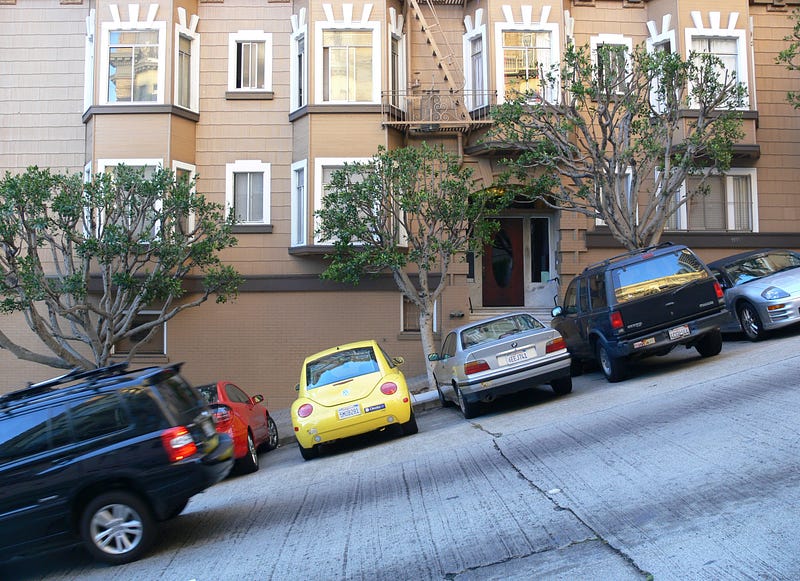
“Parking downhill.”
Parking downhill is about picking the right time to stop working.
It works like this: If you’re near the end of your workday, you should stop working when you’re in the middle of something that’s fun, interesting, or easy.
That way, when you sit down the next day, work won’t feel so intimidating. You’ll be starting up in the middle of some fun and engaging task. You’ll probably remember, from the previous night, precisely what was fun and engaging about it — so you’ll be eager to get back to the keyboard and finish up.
I first learned of this concept way back in 2005, from Merlin Mann’s wonderful productivity blog 43Folders. In a blog post called “Park on a downhill slope,” Mann described “parking downhill” as a piece of advice that came from his reader Jeffery Windsor …
[Make] it easy to start work in the morning — by always leaving off at a point where it will be easy, intuitive, and interesting to pick things back up. Instead of grinding away until you’re drained and out of enthusiasm, quit while you’re on a roll.
(Astute commenters in the blog noted that the phrasing “parking downhill” seems to have originated in Joan Bolker’s 1998 book Writing Your Dissertation in Fifteen Minutes a Day. I found a copy, and discovered that she herself attributes it to the MIT writing instructor Kenneth Skier!)
As Mann noted, famous writers have espoused versions of this advice over the years …
I’ve heard that Hemingway advised writers to “leave some water in the well” by stopping in the middle of a paragraph or sentence.
Whoever came up with it, the advice is brilliant.
Like I said, a big chunk of avoiding procrastination is about emotional regulation. Procrastination tends — in my case, anyway — to be ultimately about fear.
The reason I avoid sitting down to write is because I’m worried I’ll immediately get stuck. I’m terrified that the words (or concepts) won’t come; that it’ll be too hard for me; that I’ll suck at it then and the next day too and so everything will doomed for me forever. A miserable cycle of septic self-talk, as it were. (We writers love to catastrophize.)
So by setting myself an easy writing task for when I first sit down, it helps prevent that loop of fear.

What consists of “easy” work?
It’s up to you to figure that out. It’s different for everyone. A couple of my gambits include …
- I stop work right after I finish writing an outline for an article. I’m a very structural writer; before I can focus on writing sentences I need to have a really detailed outline in hand, one that specs out what each section and each paragraph is supposed to be doing. It takes a ton of work to create such an outline! But once it’s done, writing the sentences is — for me — the easier part. So I’ll sometimes “park downhill” by stopping right after I complete an outline. When I sit down the next day, the whole plan will be laid out in front of me, and writing will be a lot easier.
- Other times, I’ll stop after I’ve written my intro. The intro to a piece of nonfiction tends (again, for me) to be really hard to nail; it determines the forward inertia of the rest of the article, so I tend to chew it over for hours and hours. But once I’ve written a really good intro? I’ve got excellent momentum! It’s time to stop and park downhill — because that momentum will be make it easier to start up the next day.
- Parking downhill even works with research, I’ve found. Sometimes, I’ll prepare a list of people to email for interviews, knowing that it’s not that hard to knock out a dozen emails first thing in the morning. Other times I’ll stop working just as I’m about to read a really interesting chapter in a research book; it’ll be something to look forward to the next day.
One of the reasons parking downhill works, some theorize, is that it leaves your mind gently ruminating on the piece of work you stopped on. “Gently” is the key word here. If you’ve left yourself a terrible, dreaded task to begin the next day, you might perseverate on it overnight — which just leads to misery and, probably, insomnia.
But if you know you’ve got something intriguing and not too hard, your back-brain can sometimes kinda bake on it, usefully, overnight.
Parking downhill isn’t just for writing, mind you. It works for nearly any kind of work where procrastination is a danger.
I know programmers who’ll stop working just when they’re about to write a simple, satisfying function; designers who’ll leave a intriguing piece of sketching for the next morning; lawyers who’ll stop just as they’re about to launch into the fun, chewy part of a brief, so they’re looking forward to it the next day.
People are idiosyncratic, so odds are there’ll be something entirely different that you find easy. But whatever it is, if you’re near the end of the workday and you reach that point, stop! Park downhill.
You’ll thank yourself in the morning.
BTW, if you liked this post, it’s one in a series of posts of “writing tricks and strategies” I’ve cobbled together after 25 years of magazine writing and blogging.
The others are:
- “You Don’t Have Writer’s Block — You Have ‘Reporter’s Block’”
- “The Trick to Knowing When You’re Done With Research”
- “Switching to a Different Word Processor Can Kickstart Your Writing”
Clive Thompson publishes on Medium three times a week; follow him here to get each post in your email — and if you’re not a Medium member, you can join here.
Clive is a contributing writer for the New York Times Magazine, a columnist for Wired and Smithsonian magazines, and a regular contributor to Mother Jones. He’s the author of Coders: The Making of a New Tribe and the Remaking of the World, and Smarter Than You Think: How Technology Is Changing Our Minds for the Better. He’s @pomeranian99 on Twitter and Instagram.


