
Switching To A Different Word Processor Can Kickstart Your Writing
How one weird trick — harnessing the “novelty effect” — can help when you’re trying to revise a piece
This story is behind Medium’s membership paywall, which means the writer earns through our Partner Program. To become a Medium member, click here.
Writing is hard. But you know what can be even harder?
Rewriting.
Often I’ve written something — a magazine piece, a blog post, a chapter in a book — and I have to rewrite it. Maybe the editors have asked me to shorten or restructure it. Maybe the language in my first draft was dishwater-drab. Either way, I have motivate myself to re-open the file and git ‘er done.
But rewriting requires me to do something that’s cognitively and emotionally tricky: I have to regard my writing with fresh eyes. I need to be a little bloodless, and see it from an alien perspective. Huh, why did the stupid writer do that? It clearly doesn’t work; I’ll improve it.
Sometimes, achieving that emotional distance is easy! If I’ve been away from a piece for a long while — many days or weeks (or even months) — then the writing really is alien. I’ve practically forgotten much of what I wrote. Diving in and changing things is easy. (This is also why having a great editor is so useful: They give you an outside view on your writing, to help you be a bit more objective.)
But other times, changing anything is agonizing. I’m too wedded to my original words. I’ll spend hours picking at the edges of the draft — changing a few words here or there. But can’t achieve the level of surgical sociopathy necessary to be decisive, and seriously rejigger things.
A happy accident with an old computer
Then one day, several years ago, I stumbled across One Weird Trick that helps kickstart my rewriting.
I switched to a different word processor.
The first time I tried this, it was a pure accident. It was January of 2013, and I was struggling to rewrite the last few chapters of my first book. Despite having great notes from my editor, I was blocked. I couldn’t bring myself to tinker with the prose I’d already written. I just sat there, staring and moving the cursor around.
Then suddenly, my Mac Powerbook began to flicker ominously. The motherboard was dying; when I took it in for repair, they told me they’d need to hang onto it for three weeks (its ancient parts were on backorder).
To keep working, in desperation I switched to my old, decrepit Dell 700m Windows laptop, which was at that point nine years old.
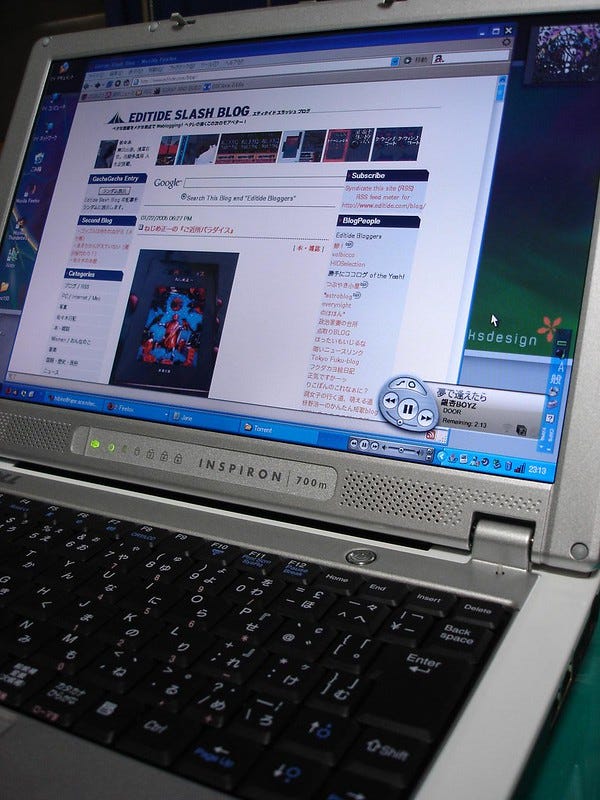
Wow, that laptop was lousy. The keyboard was cramped, with chiclet-sized arrow keys. The trackpad was … subpar. The screen was the size of a piece of toast. And it had a truly antediluvian version of Microsoft Word. It was a totally foreign environment compared to the Mac I was used to.
But curiously, it supercharged my writing. When I looked at the text of my book on that lousy screen, it felt strange and foreign: Different fonts, a different layout of the word-processor options, different keyboard.
Suddenly I was able to easily distance myself. The prose looked like text somebody else had written. Hacking away at it with a meat cleaver didn’t feel personal any more.
I dove in immediately, and in a few weeks did more productive rewriting than I’d done in the previous few months.
The power of “the novelty effect”
So — why did switching to an odd new writing environment suddenly unlock me?
I think it’s because of what’s known as the “novelty effect”: Whenever we change our technological environment, our performance temporarily improves. There’s something about the just-slightly-off strangeness of our new situation that reinvigorates us.
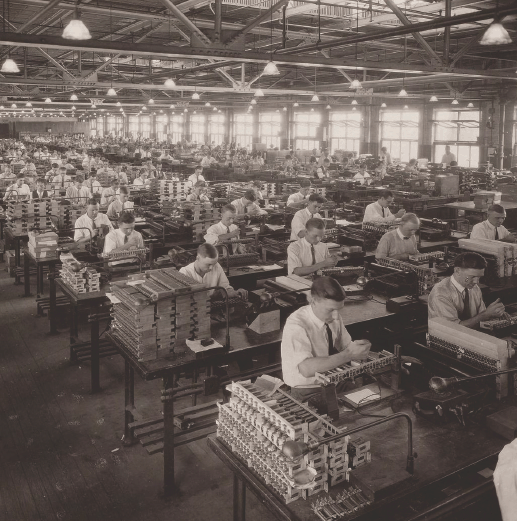
Psychologists first noticed the novelty effect back in the 1930s, during a fascinating experiment at the Hawthorne factory of Western Electric. Federal researchers decided to change the lighting levels to see if it would improve the productivity of the workers. At first, the researchers raised the lighting levels. Productivity went up! Then they experimented with lowering the lighting levels. Again, productivity went up.
This is what’s so interesting about the novelty effect: It almost doesn’t matter what type of change you make to your work environment — just so long as you make a change. So long as it renders your work slightly askew, you get a novelty effect. (Trivia: Because the discovery was made at the Hawthorne factory, it’s also sometimes called “The Hawthorne Effect”.)
This, I think, explains a big part of why switching to my old computer suddenly jolted me into a mindset for re-writing. The old version of Word — and the different laptop screen, and even the crappy old keyboard — made the file feel suddenly different.
Novelty effects don’t last very long; novelty, being novelty, quickly boils away. But you don’t need the effect to last for more than a few hours. You just need the spur to get yourself writing again.
When you’re stuck on writing, try a different digital environment
These days, if I’m stuck on a piece of writing, I actively try to trigger a novelty effect, by switching to a different writing environment.
I’m fortunate enough to own a couple of different computers (a 2017 Macbook Pro, a 2010 Thinkpad running Linux, and a 2015 Dell desktop running Windows). I find that flitting from one to another can help trigger a novelty effect just strong enough to get me un-stuck.
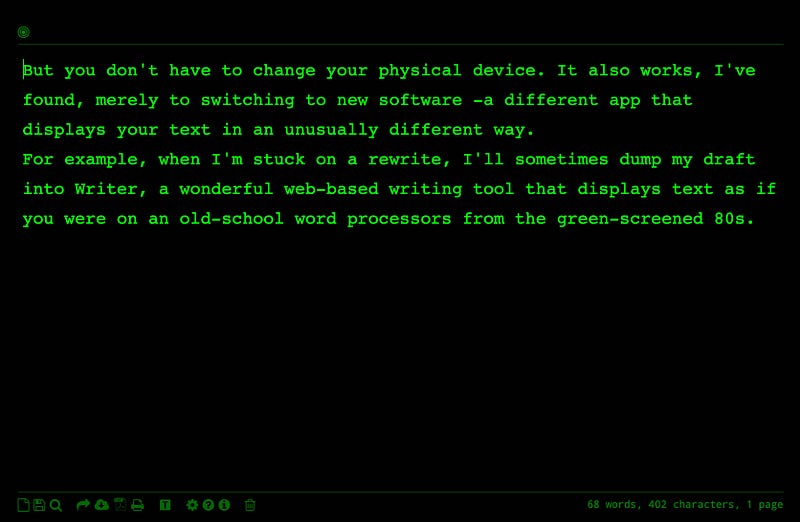
But you don’t have to change your physical device. It also works, I’ve found, merely to switch to new software—a different app that displays your text in some curious new fashion.
For example, I’ll sometimes dump my draft into Writer, a wonderful web-based writing tool that displays text as if you were on an old-school word processors from the green-screened 80s. Like so …
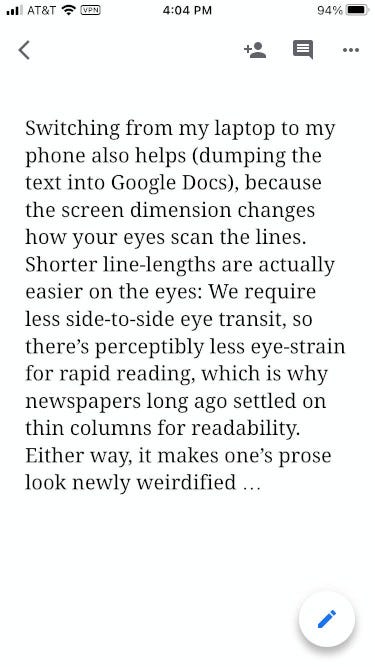
Or sometimes I’ll work on my phone using Google Docs, because the tall-and-skinny screen-dimensions change how my eyes scan the lines.
More trivia: Shorter line-lengths are actually easier on the eyes. They require less side-to-side eye transit, so there’s perceptibly less eye-strain for rapid reading, which is why newspapers long ago settled on thin columns. Either way, editing one’s prose on a phone weirdifies it …
Another (obvious) hack: I’ll print my story and read it on paper, like an animal. As copy-editors taught me aeons ago, one’s eye moves differently across a printed page than across a screen. I often find I’m less jittery and more attentive when I’m working on paper. (Plus, marking things up with a pencil actives all sorts of kinesthetic and proprioceptive parts of my brain, which can, too, help shift my thinking.) And of course there’s also a novelty effect: If you’re accustomed to seeing your words in the slithy, easily-cut-and-pasted digital realm, the mulish immutability of a printed document can, again, usefully alienate you from your own writing.
(Frankly, even changing the font can help trigger a novelty effect. I’ve occasionally put a draft into goofy-looking fonts like Comic Sans or Lobster to make me less wedded to my writing. The converse can work too: Putting in a veddy fancy font can convince me that I’m, like, rilly smart.)
Anyway, the point is: If you’re stuck on a piece of writing, try this out. Change something up and trigger a novelty effect — to look at your work with fresh eyes.
BTW, this post is part of a series I’m slowly assembling on my writing tips and techniques — ideas I’ve built over 25 years of doing journalism. I’ll probably try to do one every few months or so. The first one ran in July, and addressed writer’s block: “You Don’t Have Writer’s Block. You Have ‘Reporter’s Block’”. If you liked this one, check out the first one too.
Clive Thompson is a contributing writer for the New York Times Magazine, a columnist for Wired and Smithsonian magazines, and a regular contributor to Mother Jones. He’s the author of Coders: The Making of a New Tribe and the Remaking of the World, and Smarter Than You Think: How Technology is Changing our Minds for the Better. He’s @pomeranian99 on Twitter and Instagram.