
With Author’s commentary
PARENT’S RIGHTS, Section 2
In 4 Parts
The Parent’s Rights listed below came from REACH OUT AND TEACH, a parent handbook distributed by the American Foundation for the Blind. Although written for parents with young blind children, these guidelines speak to ALL parents. They help us to maintain a healthy perspective, especially when working with professionals such as our child’s teacher(s) or doctor(s). And, as I have found, at the end of the day, the age of the loved one doesn’t matter. The work doesn’t end till the end. For some, maybe even beyond.
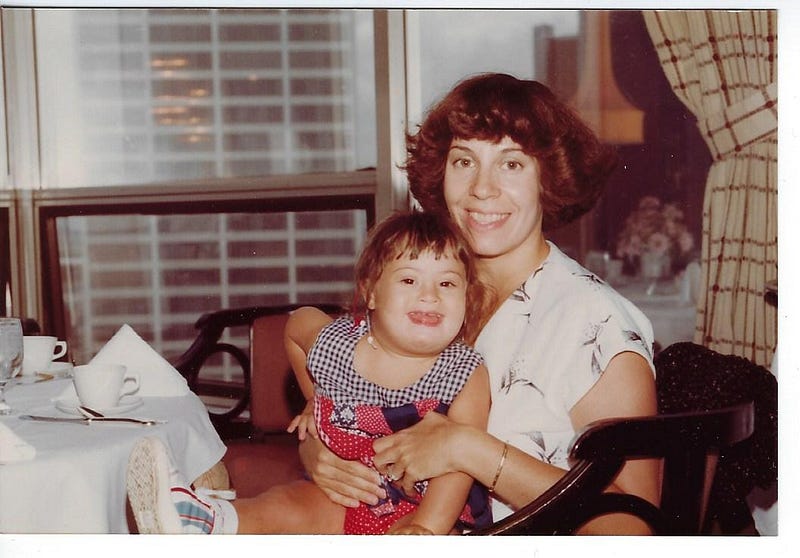
4. THE RIGHT TO KEEP TRYING — Parenting is not easy, but all parents try to do the best job they can. It sometimes becomes harder when well-meaning friends and professionals tell you that you have set goals that your child will never be able to reach. There is nothing wrong with you if you are not willing to give up.
Author: I know there are parents who get really tired and give up. Often it’s easier to listen to the “goo roos” who believe they are right. Do “it” (whatever “it” is) their way. I never thought of myself as a rebel, but I have been banging my head against a proverbial wall for years. This self-abuse continues. It’s amazing that my brains haven’t leaked out. I’ve bitten my tongue so much that I’m surprised I have any left.
The journey has been winding, jerky, difficult, painful and, thankfully, often filled with wonderful successes and joys. My daughter’s outcomes often have differed from the ones I had envisioned, but usually are the ones she is meant to have (by whose criteria of meaning, though? Hmmmm). Learning to celebrate all the tiny steps, even miniscule “wins” are important and extremely necessary. They illustrate the unseen parts absorbed into the progress of my other children. The comparison in the early days was valuable, though sometimes painful to observe.
5. THE RIGHT TO STOP TRYING — Well-meaning friends and professionals have also told parents that they do not work often enough or long enough with their handicapped children. YOU are the one who lives with your child; YOU are the one who is being asked to do one MORE thing; YOU are the one who is somehow expected to accomplish at home what trained teachers have not been able to do at school. If you just cannot do it tonight - okay. that is your decision.
Author: There is soooo much in this “Right”. My daughter went through school in what I consider the Sweet Spot of Phoenix, AZ public school education. I’m so grateful school days for us are long over. There seemed to be enough teachers and special education professionals back then, certainly in my school district. At the end of the day, though, we are a family. Leila is my daughter, and there are other family members — 3 children in all and a husband. Oh, and there’s myself. It’s a tightrope act with a typical family. In one with a child with disabilities the rope I on which I balanced was thinner.
We followed through at home with various therapies we were taught to do. It took weeks for Leila to hold up her head, months for her to be able to sit up without support, years before she walked, speech was slow…. Teachers worked hard, too, some not in the right way, but that’s another story. How lucky was Leila? Just ask some of the teachers whose students didn’t get follow-up at home. Many parents wouldn’t or weren’t able mentally to do that. Can you imagine how that frustrated dedicated teachers?
I have burned out a few times, not necessarily working with Leila, but doing the ancillary activities for her and others’ benefit. That manifested in not being able to do one more thing, to not being able to bring myself to do one more thing. Sometimes we just had be the family, play, love, sleep.
The “SHARING” Down Syndrome Parent Support Group helped, sharing what worked, what didn’t, how to navigate the school system. I don’t recall any “shoulds” from them, just things to try, things that worked, things that didn’t work. We formed because there wasn’t enough information out there that we could acquire except through group effort. It made a huge difference to me and to all of us.
6. THE RIGHT TO SET LIMITS — There are limits to what one person can do; you shouldn’t expect yourself to think about your child all the time. And your child shouldn’t expect to be the center of attention. You are not SUPER-PARENT.
Author: Who, me? Maybe it would help if I put on one of the super capes with the logo that I made for the kids many years ago (the flip side has the Batman logo, but I don’t think he’s the right super hero).
I believe it helped that Leila is the “sandwich” child, the in-between sibling. She had her older sister and younger brother for role models, for better or worse. They provided more stimulation and normalcy. I certainly was kept hopping. Everyone had activities and religious school.
But so did I. Aside from the “SHARING” work, school meetings, and field trips, I also went to the theater, to which I especially looked forward, became a Bat Mitzvah with other adults at the age of 40, sang in the temple choir, and learned to chant Torah, which for me was a lot of fun and a great musical challenge. I also created greeting cards with personalized, rhymed script and illustrations I made myself. Ed Emberley’s Drawing Books were a great help for me to hone the necessary designing artistic skills. These activities kept me sane. Well, I suppose that depends on one’s definition of sanity!
It was my great fortune to be a stay-at-home mom at the time so I could do all these extra things. For that I am grateful to my late ex-husband.
The Parent’s Rights (12 in all) article was published by me as an editor of SHARING in the March 1987 edition, the newsletter of the “SHARING” Down Syndrome Parent Support Group, which I co-founded in 1983.

Check Out PARENT’S RIGHTS Section 1, Section 3, and Section 4


