
Challenge
Pareidolia: Nature’s Art & Writing Prompts
Is It Writer’s Block, Or a Creative Urge Fighting for a Different Mode of Expression?
It’s tempting to blame a drought of words on a case of “writer’s block.” I joked, recently, with friends, “If I’m writing, drinking a beer, and start to feel a blockage, do I have ‘novel Corona virus’?” It’s a tired joke, already, but the idea that writer’s block is a disease — something that might pass, like a cold, given a bit of time and chicken soup — is laughable.
Writer’s block, in my experience, is a sign that there’s a creative urge, battling for expression, but stubbornly refusing to use its words. The harder we fight against it, the more we try to force the words, the more “blocked” we become. We want to write, but the urge wants to play on a different playground. We say, “Novel. Now.” The urge laughs, hands on its hips, and says, “Wet clay. Fingerpaints. Crayons — all 128 colors. Now.”
We should cherish the fact that we still have this playful, silly, creative urge. Rather than approach it with authoritarian rule and discipline, forcing it to conform, we can first try to embrace it and get it to work with us.
Grab a camera or a sketch pad. Go for a walk — whether it’s sunny, azure skies dotted with powderpuffs and wisps of white, or a warm and rainy day, tempting you to jump into mud puddles while you inhale the metallic tang of petrichor. Stop thinking about “writer’s block,” and allow yourself to find beauty in small, ordinary things. Observe. Do not write. Do not even take notes. Sketch and doodle, take photos to jog your memory.
Playing with Pareidolia
My friend, Rasheed Hooda, wrote about how his writing is inspired by an exercise from photography class, and an assignment to “see faces in everything.” He asked me to take a look at his article, and perhaps to suggest a different title:
All I could think of was something like, “Playing with Pareidolia” — which he rejected, eschewing the “$5 word” in favor of “50 cents words.” I laughed and told him that I’d write it , then— I have no qualms about driving readers to the dictionary!
What is pareidolia? Our brains seek to find recognizable patterns in what we see and hear around us. This is why we sometimes see faces in a flower, or a bathroom faucet — or Jesus on a grilled cheese sandwich. This is pareidolia. There are many theories as to why, and whether it is symptomatic of a delusion. Perhaps it can serve as the spark needed to get creatively “unblocked.” It is all a matter of perspective and degree.
Carl Sagan believed pareidolia to be a survival mechanism, allowing us to recognize human faces at a distance or in poor visibility, but sometimes this mechanism results in “false positives.” Pareidolia, unfortunately, inspires and bolsters numerous, unfounded conspiracy theories. But for many artists and writers, it’s one secret to jump-starting creativity:
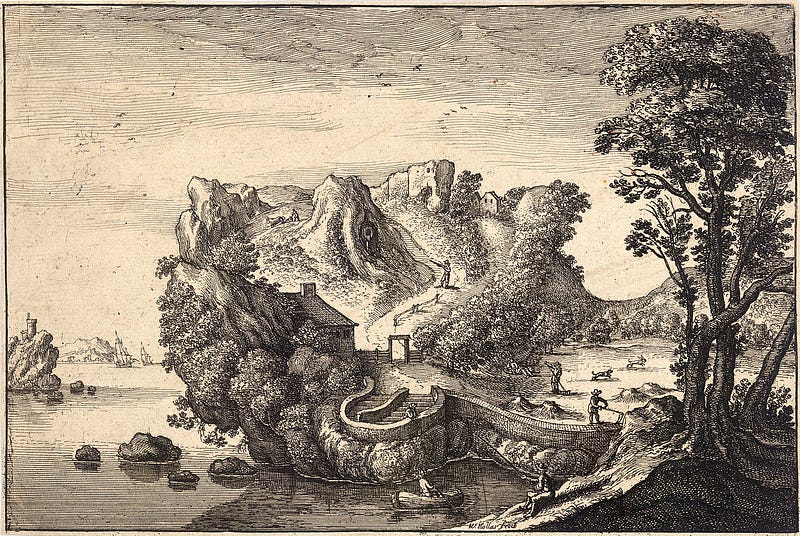
Leonardo da Vinci wrote about pareidolia as an artistic device. “If you look at any walls spotted with various stains or with a mixture of different kinds of stones, if you are about to invent some scene you will be able to see in it a resemblance to various different landscapes adorned with mountains, rivers, rocks, trees, plains, wide valleys, and various groups of hills,” he wrote in a passage in one of his extensive notebooks.
Sometimes artists use this phenomenon to their advantage by embedding hidden images in their work. Observers often view other objects in Georgia O’Keeffe’s flower paintings, for example. (Source)
I am amused when my breakfast looks back at me, complaining that the pan is too hot. Eggs become the basis for a character that may one day feature in a story, but for now are posted on Instagram for followers to giggle over.
An old friend posted a photo of a statue on Instagram, and wrote: “Best story about this famous statue (without looking it up) wins …” He didn’t post a deadline, and I wasn’t really trying to “win.” But the statue struck me funny and my brain began seeking patterns — a loose little “plot” to explain the symbolic imagery in a work of art I’d never seen before:
Amphitrite was in despair. Her unruly children had gone off to play upon the beach. She had been searching for them for hours; it was time for their lunch.
They forgot to wear their sunscreen, and the Sun God dried up the ocean and burned them to a crisp to teach them all a lesson. (It was not a very effective lesson, but ancient Greek Gods were not very strong on logic.)
Meanwhile, without water, the sailors had nothing to do but get drunk and laze about on the sea wall, telling stories about the great white sharks they’d caught, over the years, and how many wishes they’d finagled out of the toothy beasts. The shark, stranded on the sand below the drunken sailors, began to chortle — knowing the truth, and knowing he could eat them at any time if he really wanted to — all he’d have to do is stop chortling long enough to ask Poseidon to give him legs, just like Ursula the Sea Witch did for that little Sea Monkey the HUMANS called “Arielle.”
As Amphitrite heard the shark’s chortling, she mistook it for the laughter of her tiny urchins and had a let-down — her milk flooded the beach and restored the ocean! The pirates, drunk as they were, drowned. The shark, uninterested in bloated pirates, dined that night on what it thought was bacon. Eventually, Amphitrite’s children were reconstituted from the acid in the shark’s stomach, and cut their way out, swam to shore, rejoined their mother, invented zinc oxide, and lived happily ever after as life guards in Florida.
Naturally, I did some digging, after the fact. Do you know how hard it is for me to resist the temptation to Google everything? I assure you, though, that I did not cheat — that should be obvious if you follow my links! Famous or not, I had never heard of Kara Walker’s “Fons Americanus” — but as I read about her and her work, I felt pretty sure I’d enjoy getting to know her over coffee. Our minds seem similarly bent.
Suspending Judgment Lets the Creative Urge Out to Play
I started to say that the story I invented about “Fons Americanus” wasn’t very good, but that inner urge reminded me that someone once got well paid for a story about a tornado full of sharks…
Not all stories are meant to be great literature. Right now, the world needs a dose of frivolity and laughter.


