
Panpipe
The most iconic Peruvian tune is about a raisin bird?
Today’s New York Times Spelling Bee letters:

A, D, E, I, P, X, and center N (all words must include N)
Merriam-Webster says…
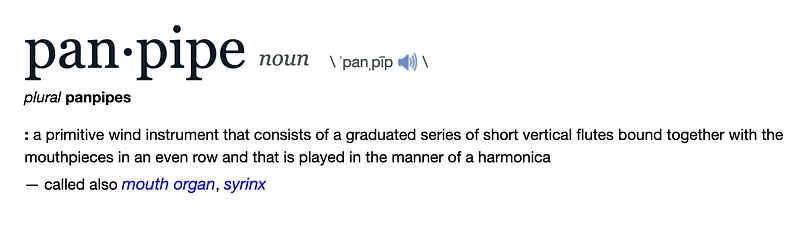
Silly little dictionary! Don’t you know that panpipe can’t possibly be a word if the New York Times says it ain’t?
For further fascinating facts, check out the Spelling Bee Master.
What’s your favorite dord* from today’s puzzle?
My Two Cents
The panpipe (one word) may be better known as the pan flute (two words). In both cases the “pan” part does not refer to cookware, but to Pan, the ancient Greek god of the wild, shepherds and flocks, nature of mountain wilds, rustic music, impromptus, and sex. Yeah, he got around, despite having goat horns and legs.
Pan is often depicted playing a flute made of reeds:
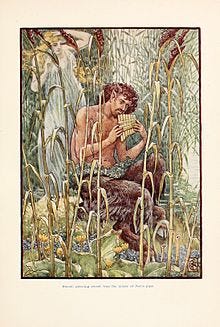
That flute is also called a syrinx, in honor of the eponymous nymph who was trying to hold on to her chastity while fending off the lascivious god.
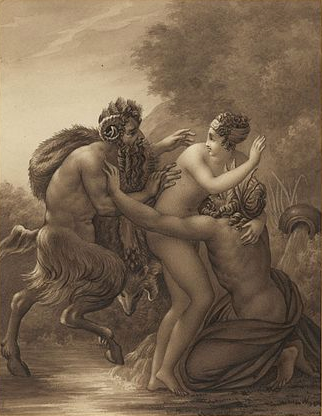
I have no clue who the guy on the right is and why Syrinx thought smothering him with her breasts would help her stay chaste.
In any case, when she sought help from other nymphs at a riverbank, they turned her into water reeds. Not to be outsmarted, Pan then cut the reeds and fashioned them into a panpipe. Thus he was able to keep his lips on Syrinx for the rest of his–-and her — life. Oy!
The word panic originally meant “a contagious emotion such as was supposed to be due to the ancient Greek god Pan” (perhaps while blowing on Syrinx) before it developed its modern meaning of “a sudden overpowering fright”.
And the word syrinx, aside from being used for the musical instrument, also refers to the vocal organ of birds at the lower part of the trachea. Birds use the syrinx to produce their calls and songs without the benefit of vocal cords (or vocal chords, for that matter).
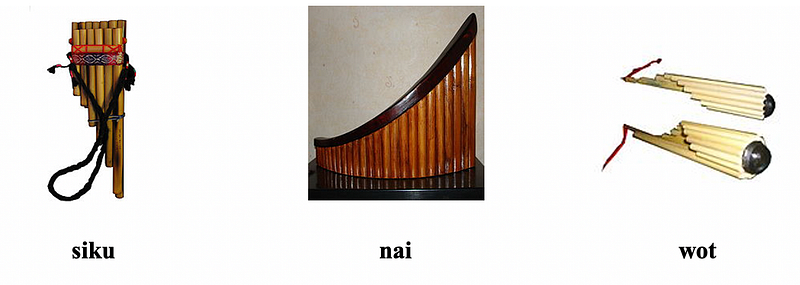
Variations of the panpipe have been used for centuries by several cultures, which have also given the instrument different names. The indigenous peoples of the Andean region in South America use a siku, the Romanians have a nai, and Laos has a circular panpipe called the wot.
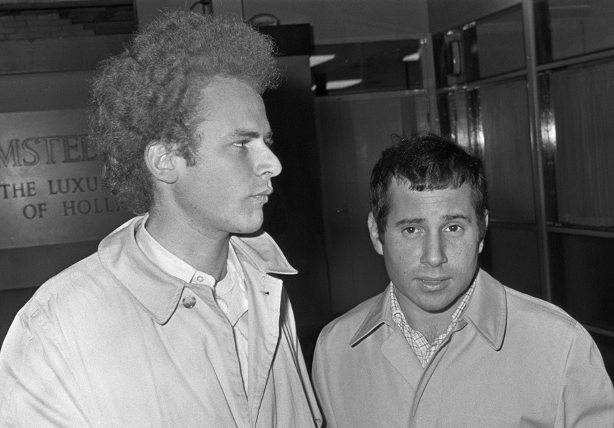
Paul and that other guy with the weird hairdo
Paul Simon and Art Garfunkel became the biggest thing in folk-rock music and one of the best-selling musical acts of the 1960s a few years before I was born. By this I mean to clarify that my birth had nothing whatsoever to do with their success.
Their biggest hit album, Bridge over Troubled Water, was also their last studio album. It was released in 1970, the same year they disbanded. The record includes a few of their most popular songs: “The Boxer” (my favorite Simon & Garfunkel song), “Bridge over Troubled Water”, “Cecilia”, and “El Condor Pasa”.
That last song is also known as “If I Could”, and features a panpipe as one of the instruments in the background:
The raisin bird
As it happens, “El cóndor pasa” is probably the best-known melody from Peru, and had been around for about five decades before Paul Simon heard it being played by the band Los Incas in Paris in 1965. The name of the song literally translates as “the condor passes (by or through)”.
As an aside, a very good Venezuelan friend of mine once told me that when she was a kid she thought the song was about a “condor that looked like a raisin” because in Spanish the verb pasa is a homonym of the noun pasa, which means “raisin”.
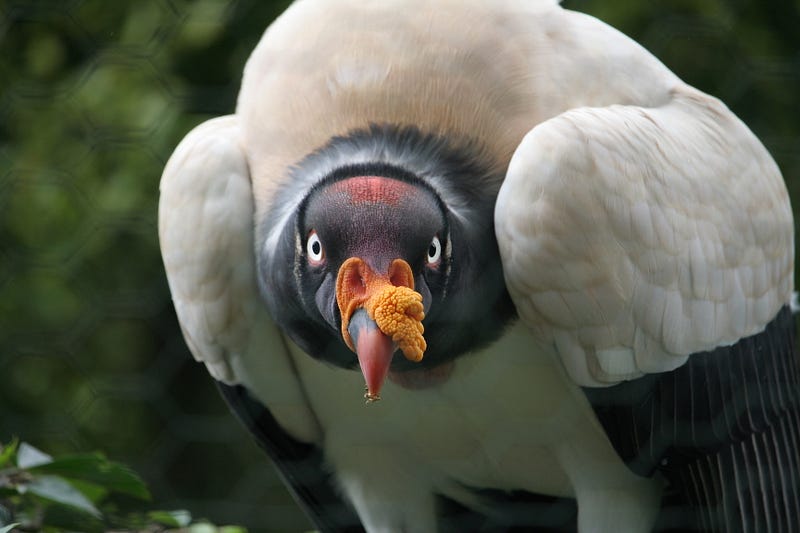
So, whenever she heard the song, she imagined a huge, wrinkled, purple bird, kinda like this one:

Simon became friends with Los Incas band members, toured with them, and even helped them produce their first album in the U.S. Unfortunately the band’s director gave Simon erroneous information about the song “El cóndor pasa”, unknowingly claiming it was a traditional Peruvian composition and in the public domain.
Simon & Garfunkel released their cover of Los Inca’s version of the tune in 1970, adding the now-famous lyrics in English (I’d rather be a sparrow than a snail; I’d rather be a hammer than a nail, I’d rather write on Medium than on Substack, etc., etc.). Later the same year, a man by the name of Armando Robles Godoy filed a copyright lawsuit against Paul Simon.
You say Robles Godoy’s name doesn’t ring a bell? Well, he was none other than the son of Daniel Alomía Robles. That doesn’t ring a bell either? Don’t feel bad. I hadn’t heard about either of them until today, despite growing up in what is technically one of the Andean countries (Venezuela) and having heard both the original tune and the Simon & Garfunkel song a bunch of times.
Alomía Robles was the original composer of “El cóndor pasa”, which was a composite of three sections of a musical score for a zarzuela called… El cóndor pasa. (A zarzuela is a Spanish opera that alternates between spoken dialogue and singing, and usually has a light, comical theme.)
Alomía Robles performed the song for the first time in 1913, but he legally registered the piano melody in the U.S. Library of Congress twenty years later. Smart guy!
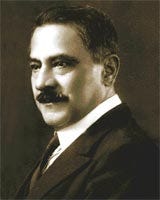
You can see the twinkle in his eye as he peers into the future and sees all the royalties his son will get.
That’s exactly what happened. Armando Robles Godoy won what turned out to be one of the friendliest lawsuits in the history of the United States. As he himself explained:
“It was an almost friendly court case because Paul Simon was very respectful of other cultures. It was not carelessness on his part”… He happened to hear the song in Paris from a vernacular group Los Incas. He liked it, he went to ask the band for permission and they gave him the wrong information. Jorge Milchberg told him it was a traditional folk song from the 18th century and not my father’s composition. It was a court case without further complications.”
Here is the original, full musical score of the zarzuela El cóndor pasa. There are seven parts in all, but please pay attention to the ones at 00:00–01:50 (prelude), 11:32–12:37 (Kashua dance), and 14:45–15:57 (pasacalle). This last part is the main theme in Simon & Garfunkel’s “If I Could”.
Now listen to a version of Alomía Robles’s piano piece that was copyrighted. First comes that prelude, then the Pasacalle (“If I Could”), and the tune ends with the Kashua dance.
I don’t know about you, but I think it was genius how Daniel Alomía Robles combined the three sections of his musical score and turned them into an iconic song that has practically become Peru’s international anthem.
Despite this brilliance, and the fact that Simon & Garfunkel introduced panpipe music to a large chunk of the United States population, the editors of the Spelling Bee decided that the word panpipe is a dord.*
You can check out my previous entry on another dord* here:
*What the heck is a dord, you ask? Here’s the answer:


