avatarAmy Marley

Free AI web copilot to create summaries, insights and extended knowledge, download it at here

7822

Abstract

ment structure.</p><p id="5401"><b>3. No event chronology fragments understanding</b></p><p id="54f9">With no concept of time, models cannot order historical events into coherent narratives for queries seeking timelines or tracing progression.</p><p id="4b64"><b>4. Entity-centric reasoning fails without coreference</b></p><p id="8276">Devoid of entity linkage, facts about the same real-world entities scattered across documents cannot be effectively synthesized.</p><p id="7cb6">To address these issues, knowledge graphs explicitly encode multiple semantic connections:</p><p id="56b5"><b>1. Topical relationships</b></p><p id="4a06">Keywords signify similarity of passage topics using lexical signals beyond latent vector proximity.</p><p id="8602"><b>2. Hierarchical document structure</b></p><p id="0d73">Encoding section/paragraph structure grounds passages in the document topology providing useful contextual signals.</p><p id="72a0"><b>3. Chronological event order</b></p><p id="42d6">Linking temporally related passages chains them into evolving narratives aiding reasoning of time-based queries.</p><p id="4b7f"><b>4. Real-world entity references</b></p><p id="f0c4">Coreference links tie references to the same entities across documents enabling consolidated, entity-focused reasoning.</p><p id="e581">This multi-faceted concept connectivity empowers complex reasoning chains reaching across diverse passages in ways isolated vectors simply cannot replicate.</p><h1 id="e04e">II. Improved Question Answering Performance</h1><p id="ec9c">Knowledge graphs overcome the isolation of vector search by interlinking related conceptual passages extracted from source documents.</p><p id="efbd">Studies evaluating this effect quantitatively demonstrate significant gains over regular vector retrieval augmentation strategies:</p><p id="f165"><b>1. Increased answer accuracy</b></p><p id="df5b">In the paper discussed, on complex queries requiring cross-domain scientific reasoning, knowledge graphs achieved 100% accuracy whereas vector search only reached 60% correctness.</p><p id="80c1">By chaining facts across documents, knowledge graphs provide missing contextual connections that empower more precise responses. Vector similarities fail to capture such inferences between disjoint passages.</p><p id="ad04"><b>2. Reduced hallucination risks</b></p><p id="46f8">With vectors, unsupported speculation often fills gaps left by lack of contextual signals between search hits.</p><p id="6d71">But in knowledge graphs, answers trace back to factual pathways relating concepts anchored across documents. This evidentiary grounding leaves less room for hallucinated content.</p><p id="bf63"><b>3. Interpretable reasoning trail</b></p><p id="5b15">Models leveraging knowledge graphs can explain the specific chain of relationships underpinning any generated response since the graph encodes pathways between concepts.</p><p id="60d0">No such transparency exists in passage vectors which lack explicit links. This interpretability promotes trust and accountability.</p><p id="20a3">The rich tapestry of conceptual connections weaved by knowledge graphs translates empirically into sizable improvements in answer accuracy, hallucination resistance and interpretative transparency over prevalent vector search RAG techniques.</p><h1 id="56e7">III. Structural Inductive Biases</h1><div id="0601" class="link-block"> <a href="https://readmedium.com/leveraging-graph-algorithms-to-enable-responsible-ai-reasoning-2d38f23f6bd6"> <div> <div> <h2>Leveraging Graph Algorithms to Enable Responsible AI Reasoning</h2> <div><h3>Large language models have shown immense promise in their ability to generate remarkably human-like text. However…</h3></div> <div><p>medium.com</p></div> </div> <div> <div style="background-image: url(https://miro.readmedium.com/v2/resize:fit:320/1*IUQXClgsylKo1722zpgvcA.png)"></div> </div> </div> </a> </div><div id="6d36" class="link-block"> <a href="https://towardsdatascience.com/embeddings-knowledge-graphs-the-ultimate-tools-for-rag-systems-cbbcca29f0fd"> <div> <div> <h2>Embeddings + Knowledge Graphs: The Ultimate Tools for RAG Systems</h2> <div><h3>The advent of large language models (LLMs) , trained on vast amounts of text data, has been one of the most significant…</h3></div> <div><p>towardsdatascience.com</p></div> </div> <div> <div style="background-image: url(https://miro.readmedium.com/v2/resize:fit:320/0*Xc7_S5MKwLdVKahn)"></div> </div> </div> </a> </div><div id="e88b" class="link-block"> <a href="https://hub.superlinked.com/improving-rag-performance-with-knowledge-graphs"> <div> <div> <h2>Improving RAG performance with Knowledge Graphs - VectorHub</h2> <div><h3>VectorHub</h3></div> <div><p> VectorHubhub.superlinked.com</p></div> </div> <div> <div style="background-image: url(https://miro.readmedium.com/v2/resize:fit:320/)"></div> </div> </div> </a> </div><p id="d010">Knowledge graphs provide an architectural scaffolding of concepts and relationships lacking in unstructured vector spaces. This topology enables encoding beneficial reasoning constraints.</p><p id="2ee2"><b>Harnessing connectivity patterns through algorithms</b></p><p id="2779">Sophisticated graph algorithms can computationally extract insights about information reliability, narrative coherence and entity consolidation by analyzing connectivity patterns.</p><p id="12c5">For example, centrality algorithms like PageRank can programmatically score source credibility based on document hierarchies and citation networks. Community detection spots coherent conceptual clusters. Entity resolution jointly analyzes references.</p><p id="0a0c"><b>Infusing topology into vector spaces via embeddings</b></p><p id="b8aa">In addition, knowledge graph embeddings inject topological inductive biases into vector spaces:</p><ul><li>Position embeddings place related entities closer based on graph proximity</li><li>Relation embeddings model types of connections</li><li>Constraint embeddings enforce logical patterns</li></ul><p id="3beb">This teaches statistical models valid traversal pathways, temporal flows and entity merging.</p><p id="4033"><b>The result — structured reasoning shortcuts</b></p><p id="3283">Together knowledge graphs, algorithms and embeddings provide powerful inductive biases for reliable and efficient reasoning — avoiding blind speculation by compactly encoding insights about hierarchies, narratives and entities.</p><p id="dcf1">The structured shortcuts act as cairns to guide language models, saving them from rediscovering basic knowledge patterns. Systematic inductive scaffolding stimulates responsible reasoning anchored to reality.</p><p id="ec3a">Knowledge graphs provide an architectural scaffolding of concepts and relationships lacking in unstructured vector spaces. This topology enables encoding beneficial reasoning constraints.</p><p id="8098"><b>Harnessing connectivity patterns through algorithms</b></p><p id="ae9e">Sophisticated graph algorithms can computationally extract insights about information reliability, narrative coherence and entity consolidation by analyzing connectivity patterns.</p><p id="95b5">For example, centrality algorithms like PageRank can programmatically score source credibility based on document hierarchies and citatio

Options

n networks. Community detection spots coherent conceptual clusters. Entity resolution jointly analyzes references.</p><p id="6d15"><b>Infusing topology into vector spaces via embeddings</b></p><p id="90af">In addition, knowledge graph embeddings inject topological inductive biases into vector spaces:</p><ul><li>Position embeddings place related entities closer based on graph proximity</li><li>Relation embeddings model types of connections</li><li>Constraint embeddings enforce logical patterns</li></ul><p id="f7b4">This teaches statistical models valid traversal pathways, temporal flows and entity merging.</p><p id="2862"><b>The result — structured reasoning shortcuts</b></p><p id="3824">Together knowledge graphs, algorithms and embeddings provide powerful inductive biases for reliable and efficient reasoning — avoiding blind speculation by compactly encoding insights about hierarchies, narratives and entities.</p><p id="4c4e">The structured shortcuts act as cairns to guide language models, saving them from rediscovering basic knowledge patterns. Systematic inductive scaffolding stimulates responsible reasoning anchored to reality.</p><h1 id="c3e6">IV. Responsible Reasoning</h1><p id="a9bf">As AI assistants are entrusted with more impactful roles, ensuring their responses are accurate as well as transparent becomes imperative.</p><p id="019a">Knowledge graphs inherently encourage responsible reasoning along both dimensions:</p><p id="9fcc"><b>1. Accuracy through interconnected grounding</b></p><p id="8496">Tracing answer chains along multi-hop graph pathways tethers responses to evidentiary reasoning, improving reliability. Reasoning along inferred vector similarities risks ungrounded speculation unchecked by knowledge links.</p><p id="de3c"><b>2. Interpretability from explicit structure</b></p><p id="47af">Unlike vectors immersed implicitly within neural nets, knowledge graphs manifest reasoning concepts explicitly in inspectable nodes and relationships. This builds trust by making visible how conclusions are drawn.</p><p id="b06d"><b>3. Reduction of embedded model biases</b></p><p id="d5aa">Isolating the knowledge representation in transparent graphs keeps potentially biased reasoning models separated. Hard-coding unfair biases in opaque models is concerns for vectors endemic to neural systems.</p><p id="38ca">Knowledge graphs promote responsibly balancing accuracy with interpretability. The explicit graphs enable qualified reasoning while still being inspectable for unwarranted imbalances.</p><p id="e44f">This combination of precision and transparency is essential as advanced reasoning systems progress into decision-making roles. Knowledge graphs chart the path ahead for reliable and accountable AI.</p><p id="0bf9">Furthermore, Knowledge graphs provide a powerful avenue for implementing data flywheel strategies to proactively detect potential hallucination risks:</p><ol><li>Diagnostic “stress testing” queries designed to probe the knowledge graph’s boundaries could surface vulnerability signals:</li></ol><ul><li>Missing entities/relations causing reasoning gaps</li><li>Islands of disjoint facts indicating shaky regions</li></ul><p id="d95a">2. Watchlisting and flagging subgraphs frequently activated by problematic queries traces likely sources of inaccurate speculation</p><p id="4d7b">3. Graph analytics help computationally diagnose structural deficiencies:</p><ul><li>Sparse connectivity</li><li>Overly narrow source diversity</li><li>Limited external validation links</li></ul><p id="9703">4. Guided data remediation then targets identified fragile areas:</p><ul><li>Cross-linking new source documents</li><li>Interpolating related facts</li><li>Seeking expert validation for claims</li></ul><p id="2067">Continual active interrogation maintains oversight on the knowledge graph’s rumor resilience through rapid data iteration.</p><p id="f219">So responsibility involves not just accuracy and transparency — but perpetual vigilance through structured data flywheels tightening fidelity via constant targeted improvement responding to diagnostic feedback.</p><p id="21e6">Knowledge graphs provide the substrate for this responsible proactive hallucination detection workflow. Their graphical nature lends itself perfectly to rapid targeted remediation stabilizing reliability.</p><h1 id="219b">The Future of Reasoning</h1><div id="c6d6" class="link-block"> <a href="https://ai.plainenglish.io/towards-hybrid-reasoning-assimilating-structure-into-subsymbolic-systems-05cf9d34d13d"> <div> <div> <h2>Towards Hybrid Reasoning: Assimilating Structure into Subsymbolic Systems</h2> <div><h3>The recent advances in large language models (LLMs) have demonstrated their remarkable fluency and adaptability when…</h3></div> <div><p>ai.plainenglish.io</p></div> </div> <div> <div style="background-image: url(https://miro.readmedium.com/v2/resize:fit:320/0*eGM2m2KLi_-FD6K0)"></div> </div> </div> </a> </div><p id="ef0b">As AI assistants aim to handle increasingly open-ended user queries across every domain, pushing the boundaries of automated reasoning is imperative.</p><p id="45a3">Flat vectors hitting limits on complex inference highlight the need for structured knowledge representations scaling to meet rising expectations of expansive understanding.</p><p id="0825">Knowledge graphs provide such a scalable substrate for enlarging reasoning horizons:</p><p id="8677"><b>1. Unlocked potential for true multi-document comprehension</b></p><p id="535b">By contextualizing facts across documents via explicit relationships, knowledge graphs enable genuine multidocument inference rather than isolated passage-based matching. This is foundational for assistive AI.</p><p id="e6ca"><b>2. Increased coverage through continuous knowledge accumulation</b></p><p id="3d54">Knowledge graphs treat facts as modular nodes that can be continuously integrated as new documents are onboarded. This inherently extensible structure supports constantly accruing knowledge required for open-domain breadth.</p><p id="0d77"><b>3. Mimicking the interconnected nature of human expertise</b></p><p id="18f6">By linking concepts reflecting associations expert reasoners make, knowledge graphs better model the rich tapestry of cross-linked mental models underpinning exceptional human question answering capacities.</p><p id="fd07">Ultimately modeling the judicious interrelating of concepts seen in mastery accelerates automated reasoning, illuminated ahead by knowledge graphs.</p><p id="8b25">The combination of scalability, granular expandability and mimicry of networked expertise establish knowledge graphs as vital drivers of AI’s next evolution in reasoning.</p><h1 id="4822">In Plain English 🚀</h1><p id="3ef4"><i>Thank you for being a part of the <a href="https://plainenglish.io"><b>In Plain English</b></a> community! Before you go:</i></p><ul><li>Be sure to <b>clap</b> and <b>follow</b> the writer ️👏<b>️️</b></li><li>Follow us: <a href="https://twitter.com/inPlainEngHQ"><b>X</b></a><b> | <a href="https://www.linkedin.com/company/inplainenglish/">LinkedIn</a> | <a href="https://www.youtube.com/channel/UCtipWUghju290NWcn8jhyAw">YouTube</a> | <a href="https://discord.gg/in-plain-english-709094664682340443">Discord</a> | <a href="https://newsletter.plainenglish.io/">Newsletter</a></b></li><li>Visit our other platforms: <a href="https://stackademic.com/"><b>Stackademic</b></a><b> | <a href="https://cofeed.app/">CoFeed</a> | <a href="https://venturemagazine.net/">Venture</a></b></li><li>More content at <a href="https://plainenglish.io"><b>PlainEnglish.io</b></a></li></ul></article></body>

PEN TO PAPER | MOMENTS OF HEALING REFLECTION

Pain with Purpose
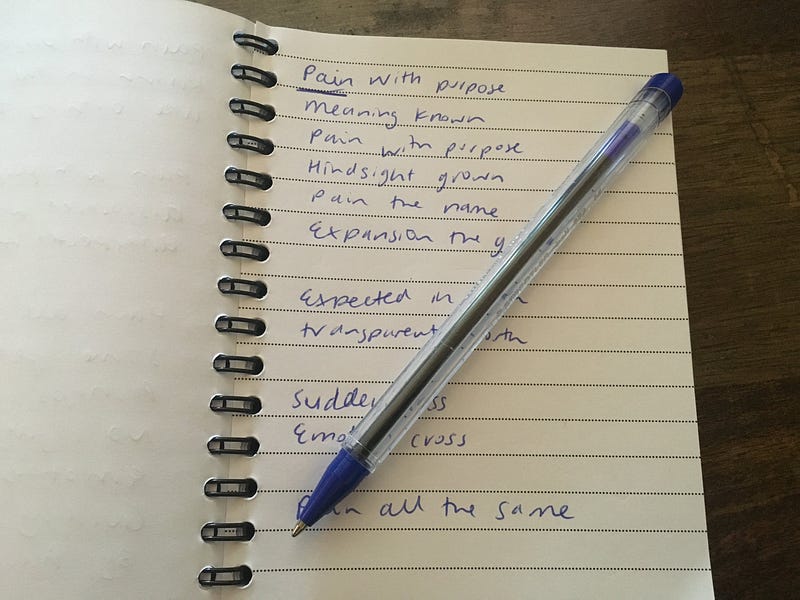
Pain on the page — photo my own

Pain with purpose Meaning known Pain with purpose Hindsight grown Pain the name Expansion the game

Expected in birth Transparent worth

Sudden loss Emotions cross

Pain all the same Meaning to tame Identity shifts Pain with purpose Journey of life gifts Pain with purpose

This piece was tough to write. It had been on my mind all week, but I had been putting it off.

When I put my pen to paper this morning, I was all set to write about bliss.

My hand instinctively wrote the word “Pain” — I knew the time had come to shine the light.

Earlier this week I read these pieces by Tony Young, Jr.

It was the day I found out some news from a loved one.

It has been simmering in the back of my throat since.

Yep, my throat is where I hold a lot of my unprocessed emotion. My tears were sitting patiently there, waiting to flow down my cheeks.

Bottled up words sitting right next to them.

My jaw, slightly clenched, unnoticed until noticed.

Feeling tired, but not knowing why.

Trista Ainsworth’s words gifted me comfort in knowing we all have days of lower energy.

Then came Paroma Sen’s piece. Convincing myself, I was in a season of bliss. Replying as much in the response I left. Lying to myself-for the world to see! Ignoring the signs once again.

When I woke up, I had an anxious feeling.

Confusion.

When “pain” appeared on my page, I knew today was the day to process.

The pain doesn’t belong to me. Even still, I feel it. It belongs to my little brother. In a few short years, he has been on a massive rollercoaster of highs and lows.

Meeting his now-wife, travelling overseas together, buying a house, marrying, announcing twins, losing one of them in utero at 30 weeks, welcoming a new baby while burying another, adjusting to being a dad, and now — the loss of his father in law. A sudden accident on the other side of the world.

He was at a friend’s wedding when the news was delivered. Only hearing one side of the conversation, he initially thought it was about his daughter. The pain of losing her twin hit him with full force.

An immediate sense of relief, when he found out, it wasn’t her, before the reality of the situation sunk in.

His wife and almost one-year-old daughter, now set to travel during a time of restriction. Away for at least two months because of current world events.

He deals with it on the surface with humour and strength. I know the darkness sits, waiting for him to process. It appears in his way — usually amongst his mates over drinks. He grieves when he can let down his guard. I typically get the aftermath when he laughs at himself for being human.

His wife processes through action. Planning, organising, doing and sharing her emotions.

They are both learning how to accept the difference in processing.

We each process in our way.

Writing — the healer for me. My lump is still there, but I know why now. I can feel it getting smaller. I know I can show up for my brother and his family with open ears and arms.

Life is full of painful moments. They are unavoidable. It is life.

Pain a builder of strength and connection — when we choose to let it.

Thanks, Suntonu Bhadra for gifting me the healing power of putting pen to paper.

The explanation of the poem lengthy, but it was what flowed after putting pen to paper and felt they belonged together.

Thanks for reading

Thanks for being you

Paper Poetry
Poetry
Pain
Growth
Life Lessons
Recommended from ReadMedium