
Paddington and Pisco
Author’s note: ‘Paddington and Pisco’ is the fourth chapter of my book ‘From dementia to adventure, which explains my reasons for traveling to Peru in 2001. You can also read the first chapter, Dementing in London. Take a look at the full index of chapters or dive straight into the jungle chapter called By boat to Iquitos.
Dinnertime in Pisco and I am catching flirting looks from the girls touting to get me into their restaurants. I decide to try each in turn, the restaurants, not the girls! This is one of the bonuses of traveling in a country so poor compared to your own, you can eat out at restaurants nearly every day instead of now and then for a special occasion. Yet here it seems that all people in society eat out at restaurants. The food is cheaper to buy in a restaurant than buying from supermarkets and cooking it yourself. There is an upmarket restaurant with its swish décor and air conditioning that only the wealthy and the tourists can afford, right through to the front room of someone’s house that has two or three wooden tables with red and white chequered plastic tablecloths selling a three-course meal at the cost of about 50p. Lomo Saltado again. A wonderful dish. I wonder if I can eat it every day in Peru.
After my fill, I stroll round to The Balconies pub to try some of the famous Crystal larger that is advertised everywhere. Five jugs of the Peruvian nectar later and Monica and Albert, the bar staff, are now my best friends. I have forgotten that no one goes out here till midnight and am still on English time with most people still mid-way through their siesta.
The Balconies pub does indeed have a few small balconies where you can sit and watch life in Pisco pass you by. Taxis hoot their way around the square whilst boys and girls dance around in its warm inner sanctum. Families of three generations or more do the parade of the town acknowledging friends and greeting each other warmly. Monica is doing her best to greet me warmly and loves it when I sing the real words to her favorite Bon Jovi song. Albert is cool in his way and probably does likewise with the female tourists and the three of us hold our mini party until other paying guests arrive. But the Crystal is taking hold and it is time for a late siesta. My time clock is still adjusting to local time because all the locals are coming out from their siesta as I am heading to my bed.
I am woken from a drunken slumber by the night porter.
“NIL!”
“Umm”
“Nil…it’s Monica…she wants you.”
“Ok.”
“Nil? You coming?”
“Un Minuto,” and I pull myself from my blissful sleep. Monica and Albert have come across as such genuine people in the bar and have not held back from who they are; they possess none of that British reserve that prevents you from getting to know someone and I like that. When I was packing my stuff back in England I decided to take a few things with me to give away as presents to the locals. My work colleagues had given me a little Paddington Bear and I told them that I would return him to his birthplace safely back in the deepest darkest Peru. Tonight seems the right time. I greet Monica with my present in hand.
“Oh, Neil he’s sooooo lovely.”
“He’s yours.”
“He’s sooooo English.”
“I suppose he is.” We meet up with Albert who is just as chuffed with his Jack Daniel’s shot glass. There is something untouchable about the giving of presents with no desire for return. With their gifts firmly clutched in their hands, they take me to a nightclub which judging by the name has something to do with Gold.
At a time when all the other tourists are tucked up in bed getting ready for their early morning start for the Isla Ballestras day trip, I am doing the Essex version of the Samba marveling at how the Peruvians do things with their hips that are surely against the law in public. The nightclub bangs out Latin tunes to the swirling crowd and the blond guy stands and watches the Peruvians do what they do best, fiesta.
Many couples are sitting around the edge of the dance floor entranced in each other’s company as a suave young man offers his hand to a young lady. She accepts and disappears onto the dance floor and grinds her hips with the young suitor. If the boyfriend left sitting at the table is jealous he certainly doesn’t look so and watches with pride at the way that his girlfriend dances. I think of numerous nightclubs back home where such behavior would start a mass brawl. I do however almost start a fight myself when I stumble into the toilets and a group of young lads snorting cocaine.
“No no no I’m from London.”
“He’s CIA man,” says one lad to the group as his hand goes into his pocket for what must be a knife.
“No I just want a piss,” I say nearly wetting myself. The lads mutter something and then look back at me assessing the possibility of my CIA drug-busting status.
“I’m a friend of Monica’s.”
“Monica?”
“From the Balconies pub.” And instantly the atmosphere in the room changes from murder to mirth as they laugh at me and I laugh with joyous relief.
We get chatting about the price of Cocaine back in London and they all start relaxing and we all quickly become mates, in the toilet of all places, again something that would not readily happen at home. I briefly consider the financial merits of drug-running as I discover the price in Pisco for a gram to be fifty times cheaper than back home, then decline their friendly offer to join them, remembering my episode outside of the penitentiary in Lima.
7 am arrives after a blink of sleep and soon I am standing in the main square smelling of Crystal and ready for one of the tourist highlights of Peru, Las Islas Ballestras. The full-day tour includes a tour of Paracas national reserve and we all set off with our cool young guy from the square down to the harbor. We stand waiting with the other 200 or so tourists for our speedboats to be allocated to go out some 30 minutes to the sea and around the islands themselves.
“Permiso, Permiso, Permiso…PER MISO!” the fisherman shouts as he tries to fight his way through the tourists annoyingly standing in his way. He is carrying six plastic crates full of fresh fish from the morning catch. Many of us watch him as he puts the crates down in front of a white estate car that has the back door open. Inside the car, there are already thousands of small fish, which have been thrown into the back. The tall dark man with funny green welts on his bare feet then proceeds to throw each crate of fish one by one into the back of the car, whilst another man gets into the back with all the fish and pushes them with his bare hands up to the level of the headrest on the front seats so that more fish can be thrown in. I stand amazed as this continues with crate upon crate of fish being thrown into the stinking car. I wonder which restaurants these fish are destined for and whether the car is used on Sunday to transport the family to church.
I avoid the cram for the boats and comb along the beach looking for stones. My dad has a proud collection of stones from all over the world thanks to friends and family that have traveled to far-flung places and I had promised myself that I would bring him back some special stones. It is his way of being able to travel to these places, via me, without actually leaving the security of home.
To my surprise, I stumble over something that looks like a coin. It is rusty and obviously very old and weathered by the sea but nevertheless, it seems to be a coin. When I was growing up I went metal detecting over the fields with a guy who was wanted by half of Essex police (a family friend) and he instilled in me the possibility of finding buried treasure. The lure of him finding his treasure ended up with him breaking into a jewelry shop and subsequently spending lots of time in prison. But still, I carried with me the thought that you could find treasure on the beach just swept up by the sea. And here it is in Pisco. Two old fishermen types are sitting on a bench watching the sea and taking an interest in my find. So I pace over to them with excitement on my face.
“I have just found this on the beach and I think it’s a coin.” I hand my treasure trove over to the old boys for their wise inspection.
“Hmm yes it looks like it,” says the first.
“Hmm definitely metal,” says the other as my find is verified by the local experts. Then to my horror, he snaps the coin in half with his fingers and examines the two halves closer still.
“Yes it’s a coin,” he says and I try not to show my deep distress as I thank them for their help. Bastards. One man’s treasure is another man’s junk I suppose. I console myself with a banana and some oranges and soon my turn is up for the speedboat.
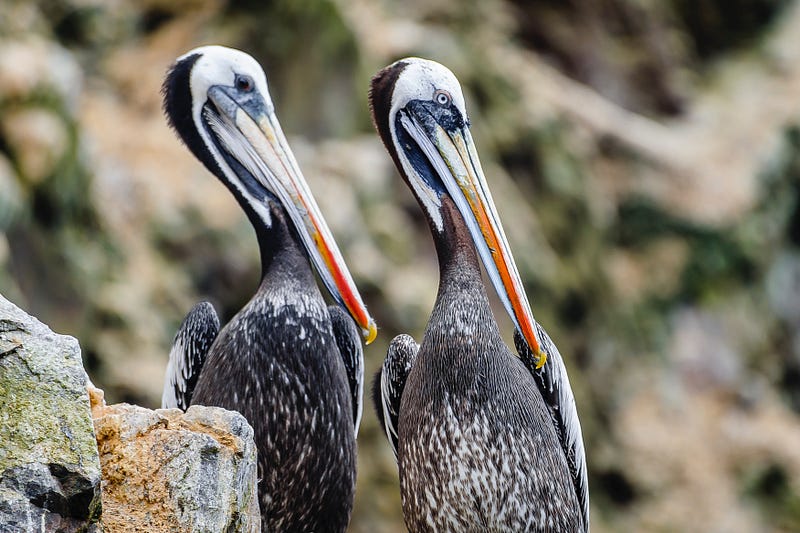
I think about my seating position on the boat and opt for the back corner, because I will get the best view. The speedboat canters past the pelicans all hunting for scraps in the harbor then we go full throttle and my seat quickly becomes wet with the spray of the sea. After my long night dancing with Monica sinking jugs of clear Crystal, this is an invigorating wake-up call.
The sea has a gentle roll to it and birds are flying in V formation just centimeters above the water. The sea swells and they disappear as if they have gone underwater only to emerge again when the water lulls. They fly with great effort yet with tranquillity and peace that is only found in nature. Soon our boat slows and I am glad of the rest from the invigorating spray. In front of us is a giant candelabra carved some two hundred meters long into the hard sandy hillside. As with many archaeological finds, no one really knows why the candelabra is there or who made it, and thus it carries with it some mystery. One theory that makes sense is that it is a marker for long-distance travelers, some kind of ancient beacon or lighthouse. That is what I like about history and archaeology that so much is just guesswork and the layman like me can look at this ancient site and have just a good guess as to the next man as to its purpose.
Our next stop is at the majestic Islas themselves. The boat’s engine cuts off as we approach the cluster of small islands. We can hear the honking of hundreds of sea lions basking onshore. There are seemingly thousands of birds circling overhead as our guide rambles off his patter about the local fauna. I can see my photo on the front cover of National Geographic now and feel privileged to be in such a place of natural beauty. The sea lions are inquisitive creatures and come within meters of our boat to the surface and get a good look at us before realizing we are staring at them, get embarrassed, go back beneath the surface only to reappear a little further away for another glance.
It’s easy to see how these animals are loved and are rightly protected. The Pacific Ocean’s power crashes water into a large hole in the rock yet the sea lions cope effortlessly in the dangerous waters. Nature’s true swimmers. Man is very cumbersome in comparison. I am amazed at how high up the rocks the sea lions can reach with a rubbery loll and jump; although far more at ease in the water they like many others in life enjoy sunbathing. Sadly we soon leave our swimming cousins and head back through the surf towards the pelicans still hanging around at shore. I can now relate to how it must feel to be incontinent and am embarrassed by the wet patch in my combats after sitting in the wet seat and turning my ass to the sun like the sea lions.
After a short lunch, we press on in our minibus to the Paracas region and the National park. There is a very interesting small museum with artifacts dating back to 5000BC depicting the hunter-gatherer society that flourished in this land. The one thing that strikes me is the ancient people's fascination with shaping the scull. As soon as babies were born they had wood tightly bound to their heads to make the head grow in a conical shape as it conveyed status and prestige in life. A flash car has almost the same effect these days. We also pay a visit to a salt mine and then stop off for lunch after navigating miles of desert in our hot little bus. It never ceases to amaze me how the drivers of these buses set off over areas where there are no clear roads and no apparent ways of getting out if anything goes wrong. Perhaps they have some hidden knowledge that I am not a party to or maybe they do not worry about such things.
At our oasis lunch spot, I walk around to the quiet side of the lake and meet Carlos. He is a young Peruvian fisherman proudly sporting a blue Paracas t-shirt. We talk about his life and about his fish. He holds aloft two fish, one on each handheld with his forefinger in the gills, which are his catch for today. They look like the plocostomuses that are hopefully still sucking the glass in my tropical tank at home.
“They are very high in protein,” he states still holding them high above his head with a satisfied smile on his face.
“Right.”
“They are an aphrodisiac.”
“Ah right, excellent.”
“Very good for the love muscle,” he says and we both start laughing as he pulls the fish down from their elevated spot and puts one on either side of his face and blows his cheeks out to look like them and I cannot help but laugh at the trio in front of me. Sure the sunlight twinkling on the lake’s waters amidst this barren desert was a nice image but Carlos’ fish faces take pride of place in my mental photo album.
Our rickety bus has suffered after a long day over terrain it wasn’t designed for and almost gives up on the way home as there is a huge clang and something heavy drops off the bus and a bump as we ride over it. The driver slows and our guide looks out of the window and with hawk eyes quickly decides it isn’t important. I am loving the shift that is taking place within me as to what is important and what isn’t.
Did you miss the previous chapter?
Can’t wait for the next chapter to be published? Join me as I head by boat to the jungle city of Iquitos
Neil Mapes Bio
Marathon runner, sea swimmer and aspiring dinghy sailor. Social entrepreneur & founder of Dementia Adventure, currently leading Green Hive in Nairn, Scotland.
Find and Follow @neilmapes
Subscribe to Neil’s Nairn Adventures on Substack
Subscribe to receive his next article by email and become a Medium member by clicking the links below:
https://neilmapes.medium.com/subscribe
https://neilmapes.medium.com/membership
Copyright © 2022 Neil Mapes. All Rights Reserved.


