
By boat to Iquitos
Author’s note
By boat to Iquitos is a chapter taken from my book ‘From dementia to adventure. You can read the next chapter in this story: Iquitos, showers and Texas Gerard. and take a look at the full index of chapters. I revisited this writing recently because I was missing travelling and decided to publish a few chapters to see if others might enjoy some vicarious travelling by reading about Peru in a previous era. I put my life in London on hold, which included working with people with dementia, to take a career break in Peru. The two-month journey took place during August and September of 2001 and involved the lone circumnavigation of an enchanting country. This chapter shares my boat journey into jungle-bound Iquitos, a place many tourists fly into rather than arriving by boat. This chapter follows previous chapters which highlight my journey in the south of Peru visiting Lima, Cuzco and Machu Picchu. I will be publishing further chapters so you can follow the story.
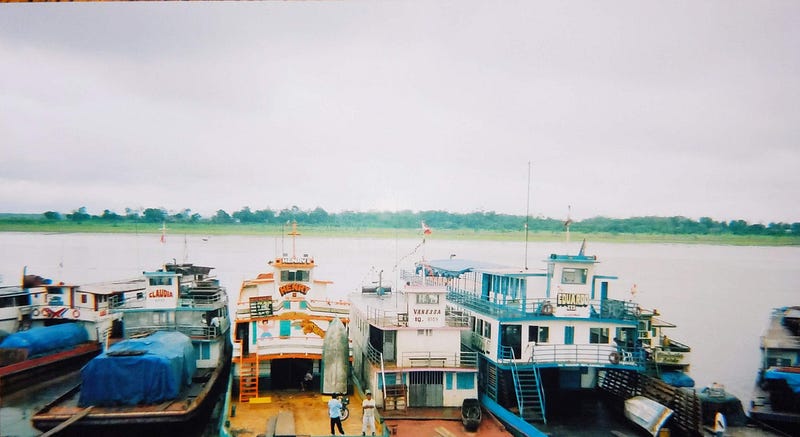
Tim and Agnes help me mount Vanessa. And it is more of a mount rather than a boarding as the metal cargo boat is still strewn with timber and rice waiting to be squeezed into the seemingly full cargo hold below. Timek and Agniewska are names that are too much of a mouthful for me and so they have become Tim and Agnes, which they seem happy with. It is interesting how people invariably want to shorten names. My brother is called Christian and the shortening of his name led to me being christened with the un-shortenable name of Neil.
Tim and Agnes have managed to keep a space near to them but a Peruvian man asleep in his hammock separates me from them. Tim helps me fasten my beautiful rainbow hammock to the pipework and it turns out that the market stall man was right about it and had not ripped me off. I sit for the first time in my hammock sweating from the bustle and frantic rush to get here on time. Vanessa looks like she has had a hard life as her metal panels are covered with scratches and dents. She is stretched to bursting point with people all tying their hammocks to her pipework and finding space for their belongings where there seems to be none. Locals are selling virtually everything in huge buckets containing anything from toothpaste to watermelon. I buy a bowl and spoon as directed by the trader and add them to my food bag.
“Do you want to tie your backpack to ours?” Agnes asks. I look at their matching blue backpacks that are secured under chain and padlock to one of the uprights of the boat.
“I think it would be a good idea, it could easily get stolen,” says Tim.
“OK thanks,” and I tie the cords of my backpack to theirs, which would make removing it difficult. A wise precaution but not something I would have worried about straight away.
“We have found Peru to be quite a bad place for us,” starts Tim.
“Really?”
“Yes, we arrived at Lima airport and this man claiming to be undercover police asks us to go with him as there are many drugs and fake money in Peru.”
“Did you go with him?”
“Of course, in Poland when we were growing up if undercover police asked you to do anything you did it. So we went with him and he stole all our cash and left us halfway down the road from the airport.”
“Oh my God, what a nightmare.”
“Yes, it was not a nice introduction to Peru,” smiles Tim with a sense of humour about the whole event.
“Then we were in a restaurant and Tim put his camera down and turned for a few seconds and when he turned back it had been stolen.”
“They must have been watching you.”
“Yes I think so,” nods Agnes regretfully.
“The camera was very expensive and I had saved money for many months and had bought it from America,” says Tim still smiling.
“You have been very unlucky,” I say trying to console their losses.
“But Agniewska still has her camera so we are ok.” I look at her camera and it too looks expensive and an ideal stealable item. I am left feeling sorry for the Polish couple and it appears they have learnt a hard lesson.
“We are pretty full eh,” I say changing the subject.
“Yes, the captain says we leave at six,” says Tim.
“Six?”
“Yes, they are still loading the boat with cargo.”
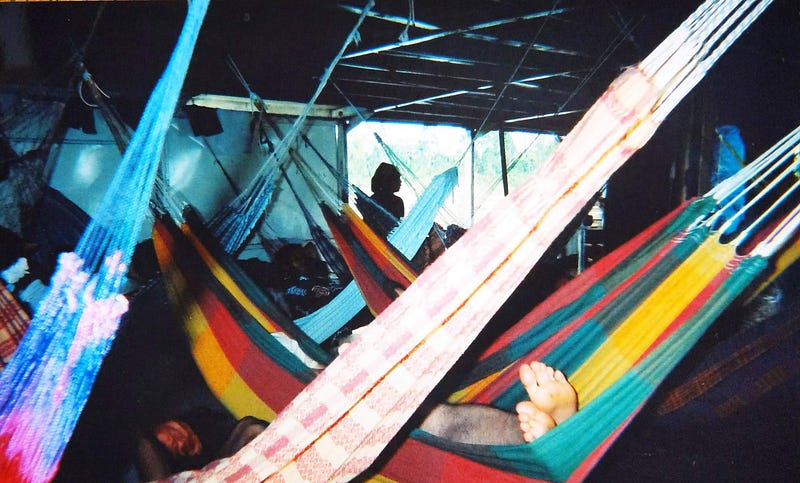
“So I guess we relax and put our feet up for a bit,” I say laying back and swinging in my hammock. It feels great to swing, I have seen it done many times in films on TV but to swing in my hammock aboard my riverboat to Iquitos feels great. We are squeezed in the length of the boat shoulder to shoulder and the motto seems to be: I swing you swing. So we all swing.
There are two ways in and out of the jungle bound Iquitos, by plane or by riverboat. Mostly all travellers take the short forty-minute flight from Lima. I, like the Poles, have opted for the river less travelled. The guidebook has said that the trip in cargo class is not for everyone and not to eat the food that is cooked on board. It is a part of the trip to Peru that I have most eagerly awaited. My favourite TV programme when I was a kid was the adventures of Huckleberry Finn, which always seemed to be playing during school holidays. A dirty bumming life by the river without school appealed and I longed to be Huck. My Huck Finn dream is to be lived, at last, they say all good things come to those who wait. We are all eager to depart as the sun sets reflecting a deep orange on the surface of the murky water. But the clanging and banging below is not a good sign and soon we are resigned to settling in for the night as the Captain announces that we will depart in the morning. Flexibility is the key with jungle travel; a five-day journey can easily become a two-week odyssey.
We all rouse to the noise of the engine starting up. It seems incredibly noisy and distinctly like a plane in taxi mode. It is kicking out grey plumes of smoke after being dormant for a few days and we certainly don’t have the worst position in the boat but do not have the best either being just twelve feet from the staircase that leads to the engine room down below. I look down the length of the 120-foot long boat and there must be over a hundred hammocks tied from the pole in the middle of the roof to the poles at either side of the boat. They criss-cross one another down the length of the boat and underneath the hammocks there are peoples belongings stashed and tied safely away. Some of the seasoned river travellers have already washed and are cleaning their teeth out of one of the six windows on the side of the boat. I have soon forgotten the noise of the engine and am greeted by Antonio.
“Hola,” the young Peruvian boy says sweetly smiling at me.
“Hola.”
“Do you have mandarins,” he quietly asks looking across at my food bag. He may only be four but he is fast learning the ways of the world.
“Antonio!” screams his mother who is breastfeeding her baby lying beneath my hammock on a thin mattress.
“Come here, sorry.”
“That’s Ok, here Antonio, have a mandarin,” and his little face shines as I give him his prize. I have made a new friend and I doubt my mandarins will last very long.
It must still be early, maybe five o’clock, as the sun is barely beginning its majestic rise into a far-reaching sky. We heave-ho away from shore and zag across the Ucayalli river heading for the Amazon river proper and I am momentarily sad to leave Pucallpa but excited and relieved to finally be on our way. Tim and Agnes smile at me from their sleeping positions in their hammocks and we can sense that our adventure has begun. My hammock is tied to the side of one of the windows in the boat and my feet sit at roughly the same level as my head as I gaze past my feet out of the window. The jungle scenery is rolling past my window like an unfolding Tarzan film without the actors and I am getting excited.
‘Hola, can I have another mandarin?’ asks my new friend. He has lasted about fifteen minutes and has the same puppy-eyed routine down pat. He gets his reward and I too tuck into my fruit breakfast with him. His mother Maria has the same warm smile and she comes over to my hammock and sits on the vacant hammock next to mine that has been left by the Peruvian who must be washing or up at the front of the boat. Empty hammocks seem to be open to all. She has with her a photo album and soon I am in the midst of another family photo session with another lady called Maria proudly showing me her family members that I will never meet.
“Now you show me your photos,” she says finally putting the album away.
“I don’t have any.”
“You don’t have any family?”
“No I have a family but I don’t have any photos of them.” She makes a funny face at me and turns rather bewildered by my response to show Tim and Agnes the photos.
CLANG CLANG CLANG and we all turn to see a huge lady smacking a metal pole with a long machete knife. Breakfast has been called. Before I can even get to my bowl and spoon the Peruvians are all standing in the queue ready for their serving. They have done this before. Tim, Agnes and I make our way to the back of the queue. The numerous hammocks tied to the boat make for a gauntlet of a trip towards the front of the boat, as rope ties quickly become nooses for tall westerners. The queue soon goes and I am rewarded with a bowl of nuclear hot grey something accompanied with stale bread. The toilet is opposite the tiny kitchen, the door is open and wafting a rank smell down the boat. Its metal confines can only be described as solitary confinement. It is the only toilet, which is also a shower for over a hundred of us. I wonder to myself how long I can balance fluid intake against dehydration so that I may never have to visit the festering toilet.
I arrive back at my hammock to find the Peruvian back in his hammock and inspect mine. He is fascinated by my new hammock and how the mesh material stays together without knots. Tim, Agnes and I eat our breakfast and come to a joint agreement by the end of the bowl that it must be watery porridge. The Poles then use their bottled water to wash out their bowls and clean their teeth, much to the amazement of the locals and I too am intrigued.
“We must use this water to clean our things as the sinks use river water which has many parasites in it,” says Tim in a medical fashion.
“Parasites?”
“Yes, when we get back to Poland we will have our stools checked for parasites.”
“Right,” I say as I head off to the sinks. I have not brought much water and certainly don’t have enough to pour over the side of the boat. And anyway I am here to go the full distance, to do what the locals do, even if this means washing my bowl in parasitic water. Millions of Peruvians have been doing so for millennia so I figure it can’t be all that bad.
The morning is spent exploring. Everyone in their own time travels the length of the boat assessing who else is on board making friends along the way. Some people are taking things to market just up the river and some are making a new start like Maria and her family who are moving wholesale to Iquitos. There is also a five a side football team who are playing in a jungle league football competition and are spending all week going downriver to play their adversaries.
Our boat is soon stopping at one side of the river to let a few white flag wavers on board who have been frantically waving from the shore. At first, I thought that the captain did not want to stop for them and at the last minute appeared to change his mind and collected them. The boat pauses momentarily by the shore and the family hurl their belongings on board and scramble on themselves just in time before the large boat pulls away. Other numerous stops are made as we pick up new travellers who add to our gypsy mass, who amazingly find space for their hammocks, and a few jump off at places with no names and disappear into the forest. I am conscious of my backpack at each stop and can’t help thinking that I would not be so worried if the Poles had not infected me with their anxiety. But maybe their message is one I need to heed as I have been very lucky up to now and being more security conscious is not such a bad thing.
CLANG CLANG CLANG! And lunch is called. The Peruvian’s had all pre-empted the call but we gringos were all too fascinated with the stop off and our backpacks and once more we are last in the queue. I am keen to get my bowl of food as I am getting quite hungry and people walk past me fighting with restricting hammock ropes carrying steaming bowls of food that seem to have chicken in them. I get my lunch ticket tallied off by the captain and I have rice and chicken, sorted…and a boiled banana? I turn and stand smashing the light bulb above my head on the low roof. Up until this point, my general appearance and presence on the boat have been the source of much staring and fascination from the locals. All the Peruvians burst into hilarious laughter and point at me towering high above them with shards of glass now filling my food. I can’t help but laugh and rub my head in true mime fashion as I head back to my hammock. This time two older women are examining my mesh hammock and they too look at it with puzzled expressions. I cannot hear them but I can imagine a whole afternoon’s conversation about how my hammock stays together without knots. I try to eat my crunchy meal but decide that glass will never replace salt as a condiment and throw it overboard for the fish. I am glad at this point that I bought some food at the market and open a tin of tuna.
I spend the afternoon dozing in my hammock, as does most everyone on the boat. There is little else to do in the heat that comes at this time of day. In between dozing I watch my Tarzan movie and smile with sweet satisfaction at my existence. Many of the shy passengers pluck up the courage to come and talk to the gringos as afternoon turns into night and we are bombarded with questions. Why had we not flown to Iquitos with all the other gringos? Why are we putting our rubbish in a bag and not throwing it in the river? And what is that liquid that you are rubbing on your skin? Soon with the aid of broken Spanish, vague English lessons develop which seem to start and end with ‘I love you’ and nervous teenage giggling. One proud boy stands and says -
“Gurns and rowses” and I wonder who is being taught what. Teaching the locals about being eco-friendly is harder than we think.
“But it is the river, it is our custom to throw rubbish in the river,” says one man with a blank expression. He and others freely throw their plastic bottles and wafer biscuit wrappers over the side without a second thought. It is difficult for one person to have much of an impact with so many but we try anyway. In years gone by most rubbish would have been biodegradable not plastic and glass but times have changed and the custom remains.
“But it is bad for the river.” I persevere with little impact as they watch in awe at Tim crunching up a water bottle and adding it to his bin bag.
Sunset starts to fall and we make our way up onto the top deck where El Capitan is guiding Vanessa along with his feet stuck through the huge wooden steering wheel as he slowly passes between wakefulness and sleep. An orange sky is ours and the air has a calmness to it with night approaching. A solitary green parrot is limping home after a long day aflight and a dolphin is glimpsed jumping ahead of the boat. The river is wide here and must be 200 or 300 metres across. Back in London I never get to see a sunrise or sunset as I am hidden between the many sky-blocking buildings, but here the whole sky is mine and after my first full day on Vanessa I am enthralled with my sunset.
CLANG CLANG CLANG! And dinner is called on the deck below us. Last again. I manage to avoid light bulbs and rope nooses and am glad to eat and am intrigued by the dryness of my hardboiled banana it has a similar texture to Tornado. My banana sits in a murky liquid that I eventually fathom to be coffee and after the dehydrating heat of the day, it is a welcome albeit strange meal. This finally overbalances my fluid intake and I am forced to visit the toilet. I close the big steel door and once inside hover and hope that all will be over quickly as the shower tap drips on me from above. I send my depth charges down the hole to the river below and jangle feverishly with the metal bolt finally getting released. I escape looking malnourished and distressed, wash my hands in the sink and then notice that the pipe that is sucking water up from the river and piped to the sinks is directly behind the hole that I have just deposited my presents for the river. Oh well, a few more parasites added to the thousands all ready can’t do any harm.
After dinner, Vanessa holds a social air. I sit for over an hour watching a Peruvian version of the card game rummy and El Capitan winning money off the locals who have dared to play. Each man takes great pleasure in slamming each card on the table in turn in a great show of machismo, but each adds money to the captain’s growing pile. Interest in the gringos has even died down this evening as we sit in our hammocks playing our own less flamboyant card game. My friend Steve taught me the wonderful card game of Shithead back in London over a bottle of Vodka and I am amazed when the Poles say they know the game. We then proceed to teach Cabeza de Mierda (shithead in Spanish) to the locals. I think of Steve and how proud he would be if he could see me now.
As the night darkens further I share my books with Tim and Agnes and we all lay back to read. The hostel in Cuzco had a small book-swapping library where I picked my White Fang book, which is a story set in dog sledge country and maybe another dream trip to be planned. The naked light bulbs overhead make reading easy but are also attracting every flying biting thing in existence, all drawn to the magnetic pull of the light and in search of new blood. I watch the mozzies circling the light bulb, like the vultures had circled above the market in Pucallpa, and then like Japanese fighter pilots dive in for the chosen flesh. They must love my new blood and pasty white skin because within minutes scores of bumps are appearing on any piece of exposed flesh. But not even the mosquitoes and the threat of malaria can bother me tonight for I am afloat on the mighty river in the Peruvian jungle.
I think I have mastered the traveller’s skill of being able to sleep anywhere and found my cradled night quite refreshing. Sunrise siesta and sunset are the only times I need to know in Amazonia and it must be shortly after four a.m. as the sun is about to make its climb into a majestic sky. I can safely say that I have never woken at this time back in England, and if so, I certainly was not refreshed. But somehow I have adjusted to the rhythm of this wonderful country and it feels great. I sit with one leg dangling out of the waist-high window, careful not to fall to my certain death down to the river below, and sketch the sunrise in my notebook. It is a scribbly affair and does not do it justice but the act of drawing the rising sun has a meditative peace to it. The air is fresh and kingfishers are hunting along the riverbank.
After more nuclear porridge we are adjusting to the heat of the morning as we come to a stop in mid-river. No one takes much notice as we have stopped many times before but after much revving of the engine and sluggish movements back and forth it appears, like our canoes on the lake in Pucallpa, we are stuck. I go up to the front of the boat with a few of the Peruvian men who are eager to help solve our crisis. As I get to the front there is frenzied Spanish flying this way and that. The young guy who was steering is getting chastised by El Capitan who may never let him steer again. Two of the little men that live in the cargo hold below the water level have emerged and are laying a dugout canoe on the water. Everyone on board is now watching these two men paddle their way around the boat stopping every ten metres or so and prodding a long piece of bamboo into the river. To my surprise, in many places, this mighty river is less than a metre deep and it is no wonder this heavily laden craft has run aground.
As if by magic a tugboat is spotted on the far bank of the river. We have not seen another boat, let alone a tug boat and I am left pondering whether the captain of the tug boat strategically sits at this low point in the river charging people to be yanked free. Either way, we are all slightly more hopeful for our fate with the knowledge it is there. It becomes clear that the captain has no radio equipment on the boat whatsoever and sends his little men over to the tug. This long old boat carrying over a hundred people and probably as much tonnage has no radio, no emergency kit, nothing. We are running on Peruvian faith and little else.
The two men set off frantically paddling way upriver and then I become aware of how fast the river is flowing. When we are moving the boat appears to be chugging along at a gentle jogging pace but now stationary in mid-river I watch the two men battling against the current and even though they have adjusted their angle to allow for being carried downstream they still end up about a quarter of a mile downriver from the tug. Eventually, the blue rescue boat is alongside our stricken craft and both captains agree a deal and money, rice and whiskey change hands. A metal rope the thickness of my forearm is then tied to the front of our boat and the tug sets about tugging. But we are unmoved.
The tug makes a daring manoeuvre around to the back of our boat, still tied to the front, and the metal rope becomes taught and flies up out of the water and almost beheads everyone leaning out of the windows who are trying to see what is going on. After acrobatically diving away from the reverse guillotine people tentatively return to the window and our boat creaks and is rocked in the water and screams fill the air. There are now eight men from our boat on the tug all with their tops off adding to the macho confusion. Much creaking, banging and shouting later and after three hours of tugging, we are finally free. At times we genuinely thought we were going to be stuck until the river level rose in the coming months or that we would sink from the efforts of the tug but we are on our way once more.
Cotamana was the big stop of yesterday and today it is Orellano and from the riverbank, I can see the main square with a concrete church, I am impressed with the clean jungle town and their proud church. A variety of cargo is thrown on board including another dugout canoe and many people come and go in the hour-long stop. Locals come aboard selling their wares and I buy a beautiful watermelon that I share with those nearest me and we all sit spitting pips into the river. Two ladies make their way through the hammocks and come to rest at the bench that sits at the foot of my hammock underneath the window. They look like life has been hard for them and are wearing old gordy dresses and they scare me with a toothy smile and a single word.
“Hola.”
“Hola” I reply and sit and watch the lady on the right drag three chickens, all tied together at one ankle, in a feathery squawking mess up to the bench. She then ties the rope to the bench and after some twenty minutes or so the chickens calm down and stop pecking one another.
I make my way up for another stint in the hole and just catch the cook preparing dinner. A girl that has been sleeping hammockless on the roof of the boat accompanies the large sweating lady in the kitchen. She looks like she is working for her meals on board. Cook is showing her how to strangle chickens. One chicken is floundering on the floor with its neck half-broken as the cook picks up another unsuspecting chicken. She yanks its head and neck hard over her bent leg and drops it to the floor. Like the first, it too is not dead just extremely distressed. Life isn’t easy for chickens in Peru. Chicken for dinner. The ladies at my bench have that look that links cats with cream. After dinner, the Poles and I go up on top deck again to the dolphin spot and breathe in the view of the snaking river.
“I think it just attracts the buggers,” I say.
“Does yours not have DEET?” asks Tim holding up and checking his repellent bottle.
“DEET or no DEET I am still getting bitten, look at my arms,” I say lifting my top as if I need to prove my argument. Tim laughs.
“They like you don’t they.”
“They sure do. Well, I am not rubbing that stuff on anymore,” I say putting away my bottle for good.
“That is not a good idea.”
“We’ll see.” Tim and Agnes share a different view of travelling from me, perhaps it is because of Tim’s medical background I am not sure. I have gelled with them wonderfully and my trip is all the richer for them being with me but they are problem-focused in their approach to many things. Like tying their bags up, the parasites and now the repellent, it is almost as if they do not wish to be part of this country but want to see this country. Everyone travels differently and there is no right and wrong way but the poles outlook doesn’t sit completely comfortably with me. To see the country you must become part of the country, doing what the locals do to a large extent even if this does mean eating parasitic river washed food. My Nan always said ‘you need to eat more than a spoonful of dirt before you die of old age.’ Tim and Agnes spend a long time on top deck getting the light right for their photos of the moonlit river. The night is almost like a day with the full moon reflecting off the black river. The Poles and I have our differences but it is certainly nice to have someone to share my experiences with and we all talk about the wonderful time onboard as night falls.
Just as we are all about to tuck ourselves in for the night the boat comes to a virtual stop and shouting interrupts our peace. I can hear the word gringo being said over and over and I look at Tim and Agnes as people start pointing over at us. I get up and stand with the Poles and we can see two men in military-style uniform making their way through the hammocks guided by the pointing fingers. A military boat is apparently at one side of the boat and suddenly I feel like a drug runner. The men look upset and have papers in one hand and their guns in the other. Shit. I look at Agnes and Tim for some reassurance but find none. Thankfully Agnes is studying Anthropology and is fluent in five languages including Spanish so this time I figure she can be the spokesperson. My experience in Nazca was enough to challenge my Spanish, one wrong word here and god knows where we might end up.
“What are your names?” We quote our names in turn but these are strange to his ear and he refers to his papers. He says something that I don’t quite understand and Agnes and Tim are now really looking worried.
“What did he say?”
“He wants to see our passports, do you have yours,” says Agnes.
“Yes, I always keep it on me, here. Don’t you?”
“No, ours are back in Lima at the Polish embassy we just have these photocopies.” And I look in horror at their flimsy pieces of folded paper and back at the official. He grabs my passport and momentarily I fear that I will never see it again but he examines it looks me up and down and I put it safely back in my pocket before he changes his mind. Agnes and the official then start up Nazca-like conversations.
“Show me your passports.”
“These are our passports.”
“No, show me your passports.”
“Our passports are in Lima, these are…”
“…Lima!?” Things are looking bad as the other official is consulted. He grabs the photocopies while Agnes pleads with the authenticity of the papers. They took us all up and down again and we are on the verge of mental collapse and feel like falling at their feet and crying and begging not to be taken to the jungle prison. Then he swiftly returns the papers.
“Ok. Have a good journey.” And they are gone.
My third day on Vanessa starts more calmly and I find my mind wandering as it is freed from its normal confines by a huge horizon. I remember days afloat an old junk trader boat in Australia. Somehow being on this boat brings back to me the emotions and feelings that I had all but forgotten or disregarded overtime in London. In essence, I am truly free here in the Amazon with just a few belongings and grounding myself in nature and its obvious abundance. I am still entranced by the jungle at my window and the parrots that squawk overhead. I am getting comfortable with my bites and even feeling at home in the cramped conditions. I have found strange security that comes from sleeping shoulder to shoulder with total strangers.
There are many more people board our boat today and continue to amaze me by finding space in which to tie their hammocks. Maria leaves me babysitting today as she takes dirty Antonio off for his wash. I have never babysat in my life as the thought has scared me witless. But join the baby on the thin mattress below my hammock and sweep away the watermelon pips and other mess. The baby boy (or girl I can’t tell which) sleeps soundly until Maria returns and I am happy with my first stint. I am sure it is not always that easy. How do people tell, just by a mere glance, if a baby is a boy or a girl? Ok so the colour of the clothes helps but other than that I finds the task is difficult at the baby stage and is not any easier at the toddler stage. But maybe I have all that to come one day. Everyone on board is managing to live in their way in the cramped conditions and there are few, if any, arguments. Even the babies just get on with things and don’t cry all that much. The babies at home always seem to be crying. Perhaps that is a sport to be added to darts and pool that the British can still do — crying. Footballers lead the way in that league.
The days are becoming lost within one another. For the last few days, I have made diary entries under August when in fact I am in September. Even the months are becoming blurry. Wonderful. That is one of the attractive things about the jungle, how easily you can lose yourself in time and place. It is a very real problem for my dementia patients back home but is a blissful change for me. Out here there is no Disneyland like signs saying welcome to Cotomana or you are now entering the Amazon River. Everything just seems to exist here in some special simplicity. But this abundant ecosystem that seems so strong is so fragile and so easily affected by us. There is a small crate no bigger than an average coffee table that has over fifty green parrots in it. But I can only guess at their colour as they are black with dirt and they are all on the verge of death in terrible conditions. A woman trying to make a few soles in the only way she knows how is parading two of the luckier birds around the boat. But these birds have their wings cut so high that when one falls to the ground it cannot beat the air and breaks its leg in the fall and limps around off-balance. Small turtles sit in a tub over on the other side of the boat; they will probably never see open water again. I am deeply sorry for the animals and look up into the sky and am glad for the birds that fly free and know nothing of their brother’s fate. I am tempted to buy a few caged birds and let them go but this is not possible either as they couldn’t fly away if they had the chance. I am left with my frustrations and the realisation that every country and society has its beauty and its way of raping nature. Somehow the fate of the chickens seems less harsh now; at least their death is a relatively quick one.
I awake on my last day afloat to a cockerel cock-a-doodle-dooing and yet another breathtaking sunrise. Each morning and every evening I have been awake to witness one of the treasures of the world and am often left calm and inspired. The Poles and I have become very close over the last five days and I have learnt a lot about Poland and the life they have lived and do not envy them. Our boat takes a clear right turn into the bigger Amazon River and our journey is almost at an end. I have finished White Fang and am thinking about colder climbs and teams of huskies and other adventures. I still haven’t washed but did come close when the shower soaked me on one visit to the toilet. It will be nice to get clean in Iquitos and I am sure that my fellow travellers will be pleased also. Tim, Agnes and I are glad to be arriving safely, with our backpacks, in our jungle destination. The trip has been most memorable and I am sure it will have its hold on me long after I leave these lands. Vanessa squeezes her billowing gills in amongst the other boats in the thriving atmosphere of the docks in the dry season. We get ready to dismount and our boat fills with dodgy helpful Iquitos men offering to carry our backpacks to a waiting taxi. We politely fend them off and our river journey has ended.
Read the next chapter in this story: Iquitos, showers and Texas Gerard. Here is the full list of chapters.
Footnote: By boat to Iquitos is an account of a river journey made by the author in 2001. If you would like to read more about this two-month journey in Peru, ‘From Dementia to Adventure’ — also by the author, is available on the Books store on Google Play.