
Pablo Picasso: Relentless Innovator
_-_BEIC_6356204.jpg#/media/File:Vincenzo_Carrerese_Paolo_Monti_-_Servizio_fotografico_(Milano,_1953)_-_BEIC_6356204.jpg)
New here? I recommend you learn about the Cool Continuum first. You can also buy the book to access 60+ artist profiles and the practical guide.
When it comes to artists who’ve fundamentally shaped the world of art, Pablo Picasso is undeniably in a league of his own. Indeed, Picasso didn’t merely dip his toes into the art scene; he cannonballed into it, leaving ripples that continue to resonate through time.
Born in Spain in 1881, Picasso displayed a prodigious artistic talent from a young age. The youngster received formal art training from his father, a painter and art teacher. Yet Picasso’s creativity refused to be constrained by traditional art education. He bore an insatiable curiosity and a ceaseless drive to navigate new artistic territories.
Picasso’s voracious creative appetite led him through distinct stylistic periods: the melancholic Blue Period, the contemplative Rose Period, the African art-inspired Period, and finally into Cubism, the avant-garde style he co-founded with Georges Braque. Cubism shattered conventional perspectives, reconstructing objects and figures into geometric forms and offering multiple viewpoints simultaneously. This innovative approach revolutionized visual art, extending its influence to sculpture, literature, and even architecture.
Consider “Les Demoiselles d’Avignon,” a painting that marks a radical shift in Picasso’s style and the birth of Cubism. The painting’s fractured depiction of five nude women was initially met with shock and disdain, but it ultimately heralded a new artistic epoch. Picasso, unperturbed by critics, continued to push boundaries and dismantle norms.
Just when the art world thought it had caught up with Picasso’s revolutionary ideas, he shifted the paradigm again. This time, he turned to collage, incorporating unconventional materials like newspaper clippings and fabric into his artwork. This novel technique not only blurred the lines between high and low art but also introduced an entirely new visual language.
Despite Picasso’s innovation, he was not an artist who discarded the past. Instead, he engaged with it, reinterpreting and transforming it. His series of 58 paintings based on Diego Velázquez’s “Las Meninas” is a testament to this. He took an iconic work from the Spanish Golden Age and reimagined it through the prism of Cubism, thereby connecting historical art traditions with contemporary ones.
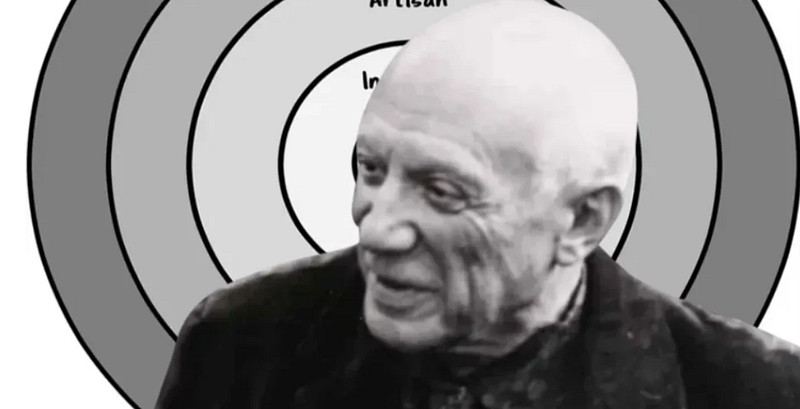
Picasso’s influence can’t be overstated. His relentless innovation inspired countless artists and continues to reverberate through the art world. His spirit of invention, his defiance of convention, and his ability to continually transform his art and the art world are why he is an ‘Innovator’ on the Cool Continuum.
Picasso once said, “I am always doing that which I cannot do, in order that I may learn how to do it.” This constant drive to learn, to experiment, and to innovate was at the heart of Picasso’s art. His extraordinary output — an estimated 50,000 artworks including paintings, drawings, sculptures, ceramics, prints, textiles, and rugs — acts as compelling evidence of his ceaseless artistic exploration.
In the landscape of art history, Pablo Picasso looms large, defining the terrain and influencing the climate around him. His life and work remind us that art thrives on experimentation and that the true Innovator is one who, like Picasso, is never content to rest but is always seeking the next horizon.
Cool Continuum is a collaborative effort by Jason S. Comely and ChatGPT. For more artist profiles and ideas on how you can make your mark on the art world, follow me on Medium.