
Overcoming a Legacy of Suicide
Family, fate, and mental illness
Trigger warning: Suicide, mental health, depression
In 1946, a 49-year-old former model stood at the edge of the Pacific Ocean in Santa Monica late at night. She was a daughter of Norwegian immigrants, and though her name was Gerta, everyone called her Gigi. After a long marriage, her husband had left her for a younger woman. Her only child, a son named after his father, had a busy life of his own and was settling down with his new bride.
There, under the stars, with deliberate footsteps, she entered the water.
A year later, across the country, Louise, a 72-year-old Norwegian immigrant stood on the top of a high-rise building in New York City. Her husband had died a few years earlier. She was riddled with arthritis, working as a maid and struggling to live independently, as her three surviving children were occupied with their own families.
She had already made up her mind when she arrived on the roof. She jumped.
These two women were my great-grandmothers. The mothers of my grandfathers. The stories of their deaths have always been told in hushed, sad tones, passed along in whispers between the women in my family.
“Please don’t bring it up in front of Dad,” my mother would say, when she told the story. “He is still devastated about it.”
On my father’s side of the family, people scoffed. “It’s just a story,” my cousins told me when someone brought up Great-grandma Louise.
But no. When my grandfather died, I, as the family genealogist, went through his papers and there it was: her death certificate. Under cause of death, it listed her injuries (I’ll spare you that) and then stated, “Jumped from roof of residency.” As it turned out, it wasn’t “just a story.”
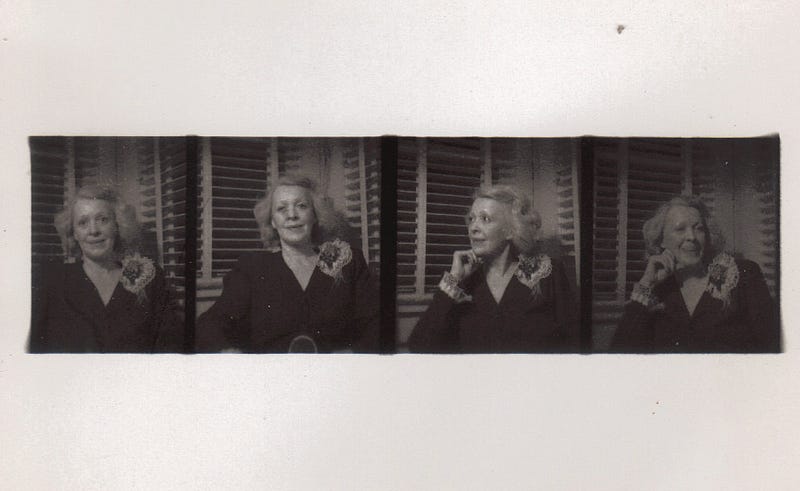
“It was an accident,” Grandpa Jack insisted. He only talked about his mother with me once in all my life and he insisted that I ignore the family members who called her death a suicide. “She loved to swim. It was just an accident.”
My mother shook her head at that. She, like me, had been born and raised in Los Angeles. “Everybody knows you don’t go swimming in the ocean at night unless you’re flirting with danger,” she’d once told me.
I certainly knew that, even at a young age. When you live in southern California, you learn there are laws when it comes to the water. If you want to stay safe, you follow the laws.
My mother believed Great-grandma was heartbroken. She adored her husband, Big Jack, and it had devastated her when he left her for a younger woman. Great-grandpa Jack barely saw his son, Little Jack, after that. He had two more sons with his new young wife, and he left all of his fortune to his wife and younger sons.
Great-grandma Gigi, it was said, lost all confidence in herself as a person, as a woman. She didn’t know what to do with herself anymore.
Great-grandma Louise, on the other hand, presumably had a decent marriage, certainly for that time, but when her husband died, she was left with nothing. They met and married in Denmark, where my great-grandfather was a philosopher and engineer, and though they were quite well-off in Copenhagen, they gave up everything to come to America. Years later, Louise, who had never had a job, found herself in her seventies having to work as a maid when she could barely use her arthritic fingers.
Why didn’t she move in with one of her three surviving children? I’ve longed to know the answer to this question, though I can only guess. Her daughter was an alcoholic in an unhappy marriage. Her youngest, my grandfather, had a young boy. But her middle child, another son, was in a stable marriage and had no children. Why did she not go to him? Why did my grandfather, also with a stable home and income, not take her in?
In his journal from the year she died, he recounted the many times his mother asked if she could come live with him and the many times she moved from one boarding house to another. Then, on the day she died, he wrote, simply, Carl called us on the telephone this evening and told us that Mamma was dead. She died around 7 o’clock P.M. After that, he went on to describe his hay fever symptoms.
Were they all so dispassionate? And yet it’s interesting to me that this journal is the only one he kept — the one from the year she died.
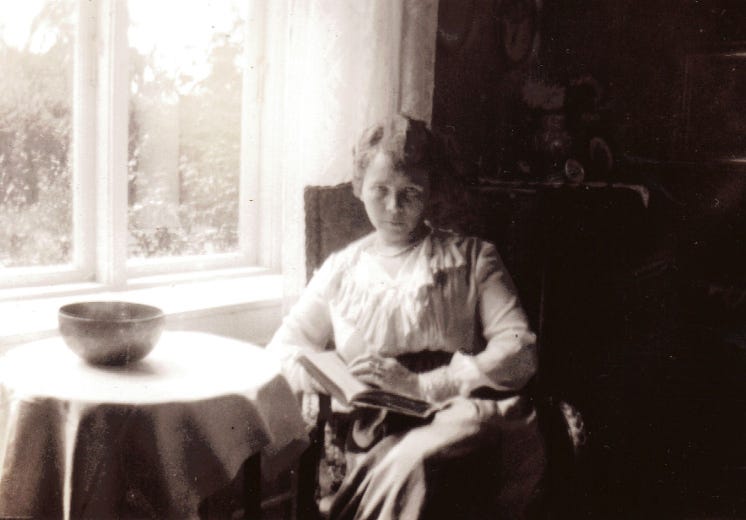
I often wonder what patterns and scars these deaths left on my DNA, which would not yet form for another 29 years. I am the first female descendant of the union of these two families. What do I carry within my body that I inherited from these women? What ghosts roam in my veins?
I, too, almost ended my own life in the wake of abandonment by a male lover. Is that a coincidence? Or was it a pattern I broke, sitting in that closet with that gun in my hand? Did I change the course of my family’s history in that moment? Or does it even matter when I don’t have children of my own?
I wonder what it would be like to go back and know these women that I never had the privilege to meet. These strong Valkyries, these brave daughters of Freya. They were, no doubt, the victims of their time, bound to their husband’s fortunes — and their whims, in Gigi’s case.
Their sons were raised to uphold the system — not to reach out in love or sympathy. Not to provide for someone other than a wife and their own children. And Louise’s daughter was stuck playing out the cultural roles of the time, as well, finding a salve from her traumatic first marriage in the bottle, and having to submit to her new husband in a subsequent union.
There was no room for a woman — a mother — in need. In the end, there was nothing left for these two women but to plunge into oblivion.
I fear that they were addled by depression and anxiety, which runs in my family, on both sides. Who would’ve recognized that back then? Who would have had the tools with which to help them at that time in history?
I fear that these women were illustrations of the collateral damage of the cultural mores of the time. They were left behind by husbands and sons. Abandoned. Made to believe their lives didn’t matter anymore. They’d passed their expiration dates.
I wonder what Louise would have done with her final years, had someone taken her in and given her the care she needed. Perhaps she would have become a companion to my father, who was five at the time of her death.
And Gigi — so young when she died — what would her life have been like had she chosen not to go on that midnight swim? She would’ve been here to meet her three grandchildren, to be an influence in their lives. And perhaps she would have lived long enough to meet her great-grandchildren, as did her sister, my beloved great-grandaunt Ruth.
It saddens me that their paths took these dark turns. And yet, I admire them both for their self-determination. No matter what inspired it. No matter how violently it manifested.
Perhaps I can take that from their stories — that I get to make my own path. That I’m strong enough to do so.
And I will choose to speak up for the women in my life, to ask for more than what our cultural traditions have given to women in the past. Sons, fathers, brothers, husbands — I will count on them to come through, to always remember to take care of the women in their lives. I will tell my own stories of depression and anxiety, of that horrifying moment that was almost the end of my life and how easy it can be to get there, and how critical it is for us to share these stories, to de-stigmatize mental illness and suicide.
I will ask for help.
I might fall but I will not plunge. And with any luck, what I do, what I say, what I choose will influence the lives of others, just as my great-grandmothers, despite never having known them, influenced mine.
© Yael Wolfe 2020


