avatarJillian Enright

Free AI web copilot to create summaries, insights and extended knowledge, download it at here

3525

Abstract

utism still talk about “<a href="https://readmedium.com/the-gold-standard-for-autistic-children-e815e9e7316a"><i>treatment</i></a>” of autism and are rife with inaccuracies and stereotypes.</p><p id="1f24">Not surprisingly, most of these courses and workshops are delivered by allistic (non-Autistic) instructors, many of whom are not involved in the Autistic community.</p><p id="ddaa">While an instructor may have strong academic background, without lived experience — or at the very least, input and knowledge gained from the community itself — the content will be incomplete at best, perpetuating stereotypes and harmful recommendations at worst.</p><h2 id="b0c0">Lack of willingness to learn from, and listen to, Autistic people and their loved ones</h2><p id="ae77">I’ve met and worked with so many Autistic adults and parents of Autistic children who had extremely frustrating experiences when trying to share information with service providers.</p><p id="a72b">Parents try to educate school staff and are shut down, told the school has its own training and resources. The bureaucratic process puts up walls between home and school, ignoring parents as the experts on their own children.</p><p id="c9e4">Employers or service providers dismiss and invalidate Autistics when they come to them with concerns. Their experiences are not taken seriously, their requests for reasonable accommodation often written off as expecting “<a href="https://twoemb.substack.com/p/accommodations-are-not-privileges"><i>special treatment</i></a>” or simply being <i>difficult</i>.</p><p id="aa37">Further to my point in the previous section, Autistics who are eager to share their knowledge and lived experience are rarely sought out to contribute to <a href="https://twoemb.substack.com/p/this-is-why-we-need-more-autistic">research</a>, training, and literature.</p><figure id="4f4d"><img src="https://cdn-images-1.readmedium.com/v2/resize:fit:800/0*5OCZ0LfHplKLp2Ek.png"><figcaption></figcaption></figure><h2 id="a00f">What can we do?</h2><p id="d950">Researchers and educators on multicultural competence offer a number of skillsets which can improve the way counsellors and others in the helping professions support clients from diverse backgrounds.</p><p id="7750">Given the extensive parallels in the barriers Autistic people face when seeking knowledgeable and competent support, I posit the Multicultural Counselling Competencies (MCCs) can be adapted to guide professionals in providing more effective support for Autistic people.</p><p id="4d75">The five main domains of MCCs are:</p><ol><li>Awareness of one’s own and of clients’ cultural heritage and the influence of culture on attitudes, beliefs and experiences;</li><li>Willingness to learn from clients and their families;</li><li>Knowledge about different cultures and cultural perspectives;</li><li>Awareness of systemic barriers faced by neurodivergent (ND) clients and families; and</li><li>Skills to utilize culturally appropriate approaches</li></ol><p id="0d82">In my following articles, I will expand on each of these, and discuss how they can be adapted and applied to training people in the helping professions, especially as regards to effectively supporting neurodivergent people.</p><p id="4622">© Jillian Enright, Neurodiversity MB</p><figure id="8d0f"><img src="https://cdn-images-1.readmedium.com/v2/resize:fit:800/0*X2lW6EMU8Z4qvgf9.png"><figcaption></figcaption></figure><h1 id="08b6">Related Articles</h1><div id="5230" class="link-block"> <

Options

a href="https://twoemb.substack.com/p/this-is-why-we-need-more-autistic"> <div> <div> <h2>This Is Why We Need More Autistic Researchers</h2> <div><h3>Also functioning labels are ableist and harmful</h3></div> <div><p>twoemb.substack.com</p></div> </div> <div> <div style="background-image: url(https://miro.readmedium.com/v2/resize:fit:320/0*vA0NlNV--1CCBjHk)"></div> </div> </div> </a> </div><div id="3b79" class="link-block"> <a href="https://twoemb.substack.com/p/barriers-to-appropriate-support-for"> <div> <div> <h2>Barriers to Appropriate Support for Autistics</h2> <div><h3>What gets in the way of schools and service providers effectively supporting Autistics?</h3></div> <div><p>twoemb.substack.com</p></div> </div> <div> <div style="background-image: url(https://miro.readmedium.com/v2/resize:fit:320/0*8vasm1gYF8d6ooOo)"></div> </div> </div> </a> </div><div id="6807" class="link-block"> <a href="https://twoemb.substack.com/p/autistic-culture-and-the-helping"> <div> <div> <h2>Autistic Culture and the Helping Professions</h2> <div><h3>How cultural competencies are highly relevant to supporting Autistics and other neurodivergent folks</h3></div> <div><p>twoemb.substack.com</p></div> </div> <div> <div style="background-image: url(https://miro.readmedium.com/v2/resize:fit:320/0*uASOYORpe7x-7SdO)"></div> </div> </div> </a> </div><h2 id="6057">Ways to support my work</h2><p id="b2fc">You can leave a “tip” on Ko-Fi at <a href="https://Ko-Fi.com/NeurodiversityMB">https://Ko-Fi.com/NeurodiversityMB</a></p><p id="1da6">Become a paid subscriber to <a href="https://twoemb.substack.com">my SubStack publication</a></p><p id="d17a">Check out my online store at <a href="https://NeurodiversityMB.ca/shop">https://NeurodiversityMB.ca/shop</a></p><p id="4a4a">Read and share my articles from <a href="https://twoemb.medium.com">twoemb.medium.com</a></p><figure id="755b"><img src="https://cdn-images-1.readmedium.com/v2/resize:fit:800/0*OvYfZReMt-OSGgQc.png"><figcaption></figcaption></figure><h2 id="d777">References</h2><p id="7bf2">Gowen, E., Taylor, R., Bleazard, T., Greenstein, A., Baimbridge, P., & Poole, D. (2019). Guidelines for conducting research studies with the autism community. <i>Autism policy & practice</i>, <i>2</i>(1 A new beginning), 29–45. <a href="https://www.ncbi.nlm.nih.gov/pmc/articles/PMC7099931">https://ncbi.nlm.nih.gov/pmc/articles/PMC7099931</a></p><p id="3e76">Nicolaidis, C., Raymaker, D., Kapp, S. K., Baggs, A., Ashkenazy, E., McDonald, K., Weiner, M., Maslak, J., Hunter, M., & Joyce, A. (2019). The AASPIRE practice-based guidelines for the inclusion of autistic adults in research as co-researchers and study participants. <i>Autism : the international journal of research and practice</i>, <i>23</i>(8), 2007–2019. <a href="https://doi.org/10.1177/1362361319830523">https://doi.org/10.1177/1362361319830523</a></p><p id="b2e2">Shebib, B. (2023). <i>Choices: Interviewing and counselling skills for Canadians </i>(8th ed.). Pearson Canada.</p></article></body>

Outdated Training for Staff Supporting Autistics

Severely out-of-date staff training programs can cause harm to Neurodivergent clients

Part three

In this article series, I expand on each of the barriers to culturally competent practice listed below. I outline how these barriers also apply to schools, community and social services, and other support services for neurodivergent students and clients.

My follow-up articles will then address the Multicultural Counselling Competencies (MCCs) and how they can be applied to more effectively supporting and respecting the differences of neurodivergent people.

This is the third article in a multi-part series. If you missed part one, you can read it here, and if you missed part two, you can read that one here.

Barriers to culturally competent practice

  1. Ignorance regarding the underlying philosophical, structural, and technological alterations that are necessary;
  2. Reluctance to develop from a “one-size-fits-all” approach (in terms of out-dated pedagogy, as well as inflexible institutional policies);
  3. Failure to recognize, accept, and honour cultural (and neurological) diversity;
  4. Lack of self-awareness regarding how one’s socialization impacts their practice;
  5. Failure of training programs to prepare staff to adequately and competently support Autistics;
  6. Lack of willingness to learn from, and listen to, Autistic people and their loved ones

This article focuses on points five and six.

Failure of training programs to prepare staff to competently support Autistics

Many training programs, including — or perhaps especially — those offered by formal academic institutions (i.e. Colleges, Universities, accredited courses, CEUs, etc.) are painfully out of date.

The language used is from a decade ago, and the approaches or supports suggested or recommended are even older.

Teachers taking their bachelor of education and educational assistants (EAs) in training are still having behaviourism stuffed down their throats, despite mounting evidence that many of these techniques are unhelpful, often harmful.

Our own so-called “inclusion” policy is based on P.B.I.S. (Positive Behaviour Interventions and Supports), which is rooted in ancient approaches based on behaviourism.

Similarly, many training programs aimed at teaching support personnel about autism still talk about “treatment” of autism and are rife with inaccuracies and stereotypes.

Not surprisingly, most of these courses and workshops are delivered by allistic (non-Autistic) instructors, many of whom are not involved in the Autistic community.

While an instructor may have strong academic background, without lived experience — or at the very least, input and knowledge gained from the community itself — the content will be incomplete at best, perpetuating stereotypes and harmful recommendations at worst.

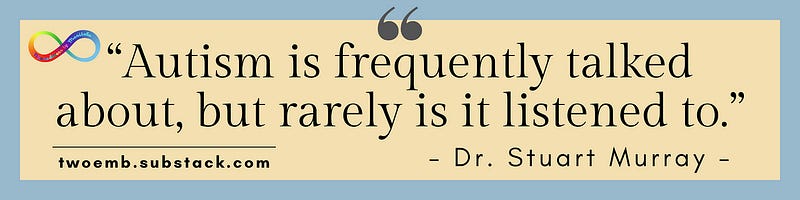
Lack of willingness to learn from, and listen to, Autistic people and their loved ones

I’ve met and worked with so many Autistic adults and parents of Autistic children who had extremely frustrating experiences when trying to share information with service providers.

Parents try to educate school staff and are shut down, told the school has its own training and resources. The bureaucratic process puts up walls between home and school, ignoring parents as the experts on their own children.

Employers or service providers dismiss and invalidate Autistics when they come to them with concerns. Their experiences are not taken seriously, their requests for reasonable accommodation often written off as expecting “special treatment” or simply being difficult.

Further to my point in the previous section, Autistics who are eager to share their knowledge and lived experience are rarely sought out to contribute to research, training, and literature.
What can we do?

Researchers and educators on multicultural competence offer a number of skillsets which can improve the way counsellors and others in the helping professions support clients from diverse backgrounds.

Given the extensive parallels in the barriers Autistic people face when seeking knowledgeable and competent support, I posit the Multicultural Counselling Competencies (MCCs) can be adapted to guide professionals in providing more effective support for Autistic people.

The five main domains of MCCs are:

  1. Awareness of one’s own and of clients’ cultural heritage and the influence of culture on attitudes, beliefs and experiences;
  2. Willingness to learn from clients and their families;
  3. Knowledge about different cultures and cultural perspectives;
  4. Awareness of systemic barriers faced by neurodivergent (ND) clients and families; and
  5. Skills to utilize culturally appropriate approaches

In my following articles, I will expand on each of these, and discuss how they can be adapted and applied to training people in the helping professions, especially as regards to effectively supporting neurodivergent people.

© Jillian Enright, Neurodiversity MB

Related Articles

Ways to support my work

You can leave a “tip” on Ko-Fi at https://Ko-Fi.com/NeurodiversityMB

Become a paid subscriber to my SubStack publication

Check out my online store at https://NeurodiversityMB.ca/shop

Read and share my articles from twoemb.medium.com

References

Gowen, E., Taylor, R., Bleazard, T., Greenstein, A., Baimbridge, P., & Poole, D. (2019). Guidelines for conducting research studies with the autism community. Autism policy & practice, 2(1 A new beginning), 29–45. https://ncbi.nlm.nih.gov/pmc/articles/PMC7099931

Nicolaidis, C., Raymaker, D., Kapp, S. K., Baggs, A., Ashkenazy, E., McDonald, K., Weiner, M., Maslak, J., Hunter, M., & Joyce, A. (2019). The AASPIRE practice-based guidelines for the inclusion of autistic adults in research as co-researchers and study participants. Autism : the international journal of research and practice, 23(8), 2007–2019. https://doi.org/10.1177/1362361319830523

Shebib, B. (2023). Choices: Interviewing and counselling skills for Canadians (8th ed.). Pearson Canada.

Counselling
Autism
Psychology
Mental Health
Neurodiversity
Recommended from ReadMedium