avatarCosmic Wonders

Free AI web copilot to create summaries, insights and extended knowledge, download it at here

4145

Abstract

w start its next complicated phase, called the triple-alpha process, and will start to expand, eventually becoming a red giant.</p><figure id="3f4f"><img src="https://cdn-images-1.readmedium.com/v2/resize:fit:800/1*tmZXJiF4lBo8zTJRXVYWLA.jpeg"><figcaption>Image by <a href="https://pixabay.com/users/myriams-fotos-1627417/?utm_source=link-attribution&amp;utm_medium=referral&amp;utm_campaign=image&amp;utm_content=3275314">Myriams-Fotos</a> from <a href="https://pixabay.com/?utm_source=link-attribution&amp;utm_medium=referral&amp;utm_campaign=image&amp;utm_content=3275314">Pixabay</a></figcaption></figure><p id="dd93">During its expansion, the sun will lose a tremendous amount of mass due to powerful stellar winds. The reason it will appear red is that its surface temperature will have decreased.</p><p id="0790">The sun will continue to manufacture elements up to carbon and oxygen, but it is not big enough and therefore not hot enough to fuse the heavier elements. The heaviest element that can be made in higher-mass stars is iron, which marks the end of element production. No star will ever produce an element heavier than iron using fusion.</p><p id="6a17">The heavier elements moving higher up the periodic table are created in supernova and kilonova explosions. In the red giant stage of the sun’s life, it will slowly swell, engulfing Mercury, Venus, and possibly the Earth itself.</p><p id="fe49">Light is something we take for granted; we give it little thought as we live out our daily lives. Within the broad spectrum of light, gamma rays are at one end with short wavelengths, right through to radio waves with longer wavelengths at the other end.</p><p id="1105">Within that broad spectrum, the wavelengths visible to the human eye occupy a very narrow band. The colours we see are governed by the wavelengths reflected from an object’s surface. An object appears black when all of the wavelengths are being absorbed and white when all the wavelengths are being reflected. We can also see the colours when light travels through a prism, and of course, we see them in a rainbow.</p><p id="c064">The first eyes found on a fossil animal can be traced back to about 540 million years ago. Animals with no eyes had to manage as best they could due to their lack of vision.</p><p id="3ce0">Over time, primitive eyes evolved so that animals were finally aware of their surroundings, which may have been the catalyst for what took place in the Cambrian explosion of life. Since then, eyes have evolved into the thousands of different and complex types that exist today.</p><figure id="188a"><img src="https://cdn-images-1.readmedium.com/v2/resize:fit:800/1*LFbXmaN7WPDp_WjNJ-sg_g.jpeg"><figcaption>Image by <a href="https://pixabay.com/users/kavowo-6764465/?utm_source=link-attribution&amp;utm_medium=referral&amp;utm_campaign=image&amp;utm_content=3374422">KAVOWO</a> from <a href="https://pixabay.com/?utm_source=link-attribution&amp;utm_medium=referral&amp;utm_campaign=image&amp;utm_content=3374422">Pixabay</a></figcaption></figure><p id="6dd8">Scientists analyse the light coming from stars and other objects in space to gain information. Within the spectrum of light, there are dark or bright spectral lines that can be observed as emission or absorption lines; they correspond to certain elements contained in the object that is being viewed. The lines can also give information about the temperature, density, and magnetic field of a star.</p><p id="d038">When a star or object is moving away from us, it is known as red-shifted because the light waves are being stretched. On the other hand, if an object is coming towards us, the light waves are being compressed, and that is known as blue-shifted. This is called the relativistic Doppler effect. Now you can see why light is so important for astronomers.</p><p id="062c">When we look at an object, say, a red rose, green grass, or blue sky, most of us would think that other animals would see the same colours, but no, other animals will see less or they may see more of the light spectrum.</p><p id="d143">When we look at an object, say a cucumber, the wavelengths of

Options

reflected light determine what colour we see. The light waves reflect off the cucumber and hit the light-sensitive retina at the back of our eye. In the retina, humans have three cone types: tiny cells that respond to red, green, and blue colours. From there, the cones send signals to the brain, which provide us with familiar colours.</p><figure id="d8ce"><img src="https://cdn-images-1.readmedium.com/v2/resize:fit:800/1*gqCnC_hxI6IL0Z8XEBWHAA.jpeg"><figcaption>Image by <a href="https://pixabay.com/users/955169-955169/?utm_source=link-attribution&amp;utm_medium=referral&amp;utm_campaign=image&amp;utm_content=1506119">955169</a> from <a href="https://pixabay.com/?utm_source=link-attribution&amp;utm_medium=referral&amp;utm_campaign=image&amp;utm_content=1506119">Pixabay</a></figcaption></figure><p id="b832">My dog Kobi will not see a red apple the way we see it; to him, the apple will look brownish-grey. Dogs, cats, and most mammals have only two cones, the missing one being red. Other animals and insects can have poorer or much better sight than what we have.</p><p id="03e0">Years before I left on this journey, I was on a fishing boat heading from Scotland to Norway. It was April 1997, the mate of the boat, who, like myself, had an interest in astronomy, called me in the middle of the night. The sea was calm and the sky was clear, which was unusual for the North Sea. From the top of the bridge, we looked up at the stars, and there it was: Comet Hale-Bopp.</p><figure id="d6af"><img src="https://cdn-images-1.readmedium.com/v2/resize:fit:800/1*hj3qwb3GWk74uq2FALs7Hg.gif"><figcaption><b>Credit:</b> A. Dimai (<a href="http://www.sunrise.it/associazioni/aac/struttur.htm#druscie">Col Drusciè Obs.</a>), <a href="http://www.sunrise.it/associazioni/aac/">AAC</a></figcaption></figure><p id="80a7">We had glimpsed the comet on previous nights, but this was different. The comet and the stars were so clear, with more visible than I had ever seen before; there was even the odd shooting star. (meteor)</p><p id="bc38">The reason the heavenly bodies were so clear and easy to see was the lack of light; therefore, there was no light pollution, just complete darkness. This must have been similar to the clear skies our ancestors had viewed, long before our towns and cities were illuminated by all the artificial light that we have come to depend on.</p><p id="73f6">Comets are icy bodies that infrequently visit us; they have highly eccentric elliptical orbits. When they venture close to the sun, they warm up and release gases and other debris that form a coma, or tail, which can be seen from the earth.</p><p id="b63d">A shooting star is just a fun name for a meteor, which is a small piece of rock or metal that enters the Earth’s atmosphere. Some can enter the atmosphere, travelling at over 250,000 kilometres per hour. That great speed causes friction within the atmosphere, causing them to burn up, leaving a streak of light behind them. If one is large enough and it reaches land or the sea, it is known as a meteorite.</p><p id="0e5b">The Hoba meteorite, which was found in Namibia, South Africa, is the largest known, with a width of 2.7 metres and a weight of over 66 tons.</p><p id="4a97">We are now in the area of space that holds the galaxy cluster, El Gordo, ACT-CL J0102–4915. It is the most massive grouping of galaxies in the distant universe, with a total mass estimated to be 3,000,000,000,000,000, which is 3 quadrillion times that of the Sun. El Gordo is positioned 7 billion light-years from the Sun.</p><p id="770c"><b>Part 15</b></p><div id="9268" class="link-block"> <a href="https://readmedium.com/our-space-journey-part-15-babbe7dea2e2"> <div> <div> <h2>Our Space Journey, part 15</h2> <div><h3>Come and join me</h3></div> <div><p>medium.com</p></div> </div> <div> <div style="background-image: url(https://miro.readmedium.com/v2/resize:fit:320/1*sXXVpS8S8LBicL7CO6NsAA.jpeg)"></div> </div> </div> </a> </div></article></body>

Our Space Journey, part 14

Image by Yuri_B from Pixabay

British spelling

To make sense of my story and obtain the best knowledgeable experience, please go to the beginning and read part 1 here.

Part 14.

We are now at a distance of 4 billion light-years from home.

The luminosity of the sun will still be increasing, and the surface temperature on the earth will be an incredible 1,300 degrees Celsius, hot enough to melt the surface rocks. The sun’s hydrogen fuel will be getting low, but there might be enough left to continue burning for another billion years.

At this time, the Milky Way and Andromeda galaxies will be so close that they will have begun to merge. Although there are billions of stars in both galaxies, star collisions will be very few due to the vast distances between them.

I wish to put the time that the universe has existed into an understandable time scale. If we scale down 13.8 billion years into one year here on Earth, then one month would equate to over a billion years, one day would represent almost 38 million years, and one hour would be over 1.5 million years.

On the first split second of January, an inexplicable explosion or expansion occurred, namely the Big Bang. Well into January, the first stars and galaxies were beginning to form. In early May, our galaxy, the Milky Way, was coming into existence. Early in September, the formation of the solar system had commenced, and by September 22, primitive life existed on our planet. At 11:52 pm, on the last day of the cosmic calendar, modern humans appeared, and they could now start to migrate to other parts of the world.
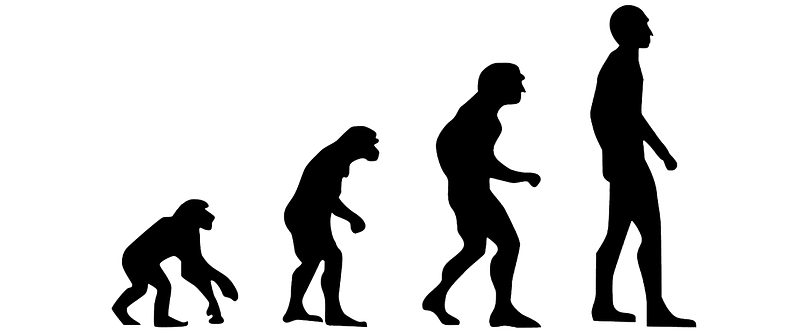
Image by MANOEL M. PEREIRA VALIDO FILHO MVALIDO from Pixabay

Absolute zero, which is minus 273.15 degrees Celsius, is the lowest temperature that is theoretically possible, but even in the farthest reaches of space, the temperature should always be a few degrees above absolute zero.

Temperatures fluctuate with the movement of atoms. The less movement of atoms, the colder the temperature; therefore, the quicker atoms move about, the hotter it becomes.

As an example, take the microwave oven. When radio waves at a set frequency are generated in the oven, the atoms inside water and fat molecules within the food vibrate, causing heat and resulting in the food being cooked.

The opposite end of the temperature scale can be extremely hot, achieving trillions of degrees Celsius. In a controlled experiment here on Earth, scientists have created the highest recorded temperature, but this record temperature of well over 5 trillion degrees Celsius would not have matched the extreme temperatures achieved at the time of the Big Bang.

The sun is changing; for 9.5 billion years, it has been in the main sequence part of its life, fusing vast amounts of hydrogen into helium. This has occurred over a very long time period, but at last, its hydrogen fuel is almost depleted. It will now start its next complicated phase, called the triple-alpha process, and will start to expand, eventually becoming a red giant.
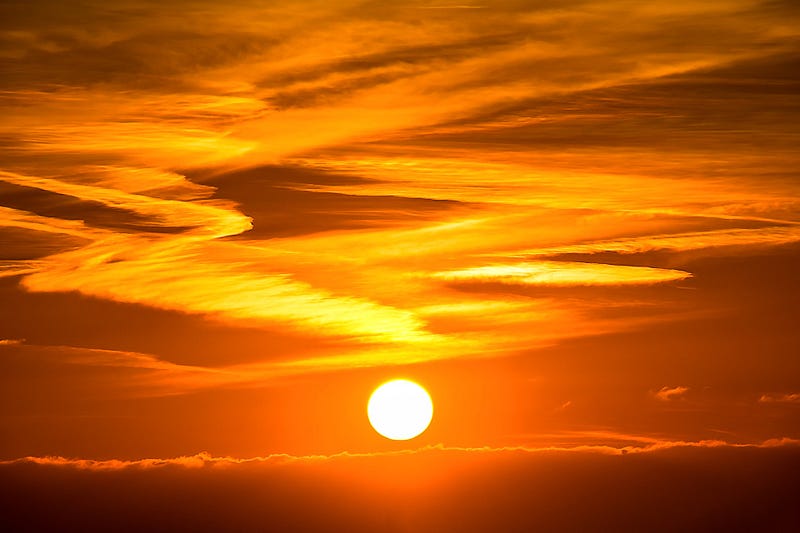
Image by Myriams-Fotos from Pixabay

During its expansion, the sun will lose a tremendous amount of mass due to powerful stellar winds. The reason it will appear red is that its surface temperature will have decreased.

The sun will continue to manufacture elements up to carbon and oxygen, but it is not big enough and therefore not hot enough to fuse the heavier elements. The heaviest element that can be made in higher-mass stars is iron, which marks the end of element production. No star will ever produce an element heavier than iron using fusion.

The heavier elements moving higher up the periodic table are created in supernova and kilonova explosions. In the red giant stage of the sun’s life, it will slowly swell, engulfing Mercury, Venus, and possibly the Earth itself.

Light is something we take for granted; we give it little thought as we live out our daily lives. Within the broad spectrum of light, gamma rays are at one end with short wavelengths, right through to radio waves with longer wavelengths at the other end.

Within that broad spectrum, the wavelengths visible to the human eye occupy a very narrow band. The colours we see are governed by the wavelengths reflected from an object’s surface. An object appears black when all of the wavelengths are being absorbed and white when all the wavelengths are being reflected. We can also see the colours when light travels through a prism, and of course, we see them in a rainbow.

The first eyes found on a fossil animal can be traced back to about 540 million years ago. Animals with no eyes had to manage as best they could due to their lack of vision.

Over time, primitive eyes evolved so that animals were finally aware of their surroundings, which may have been the catalyst for what took place in the Cambrian explosion of life. Since then, eyes have evolved into the thousands of different and complex types that exist today.
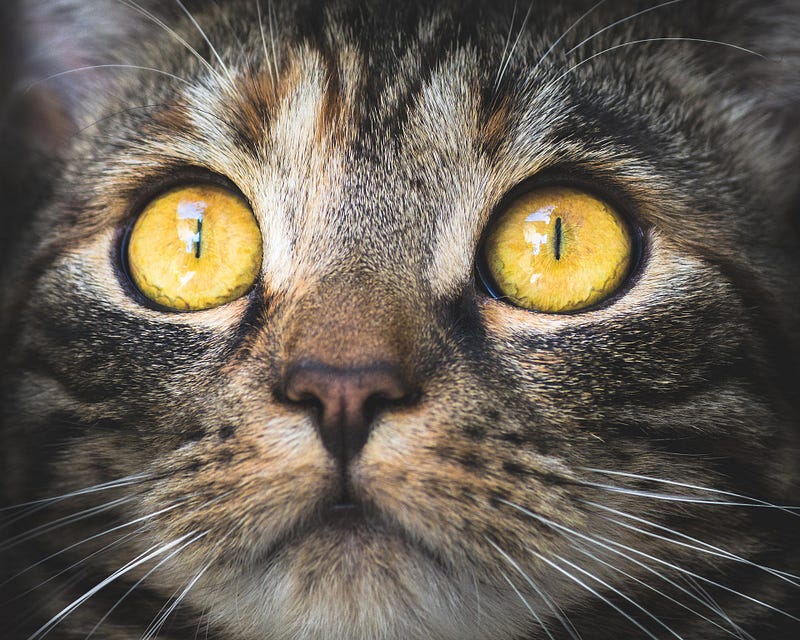
Image by KAVOWO from Pixabay

Scientists analyse the light coming from stars and other objects in space to gain information. Within the spectrum of light, there are dark or bright spectral lines that can be observed as emission or absorption lines; they correspond to certain elements contained in the object that is being viewed. The lines can also give information about the temperature, density, and magnetic field of a star.

When a star or object is moving away from us, it is known as red-shifted because the light waves are being stretched. On the other hand, if an object is coming towards us, the light waves are being compressed, and that is known as blue-shifted. This is called the relativistic Doppler effect. Now you can see why light is so important for astronomers.

When we look at an object, say, a red rose, green grass, or blue sky, most of us would think that other animals would see the same colours, but no, other animals will see less or they may see more of the light spectrum.

When we look at an object, say a cucumber, the wavelengths of reflected light determine what colour we see. The light waves reflect off the cucumber and hit the light-sensitive retina at the back of our eye. In the retina, humans have three cone types: tiny cells that respond to red, green, and blue colours. From there, the cones send signals to the brain, which provide us with familiar colours.
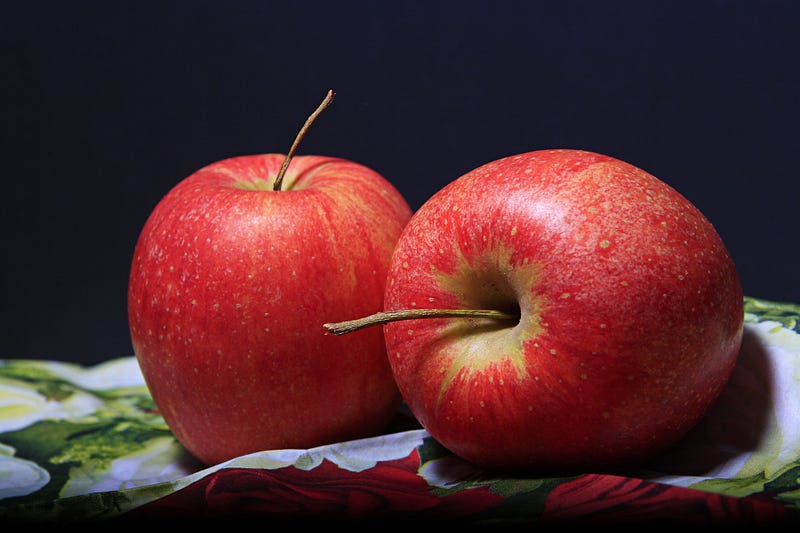
Image by 955169 from Pixabay

My dog Kobi will not see a red apple the way we see it; to him, the apple will look brownish-grey. Dogs, cats, and most mammals have only two cones, the missing one being red. Other animals and insects can have poorer or much better sight than what we have.

Years before I left on this journey, I was on a fishing boat heading from Scotland to Norway. It was April 1997, the mate of the boat, who, like myself, had an interest in astronomy, called me in the middle of the night. The sea was calm and the sky was clear, which was unusual for the North Sea. From the top of the bridge, we looked up at the stars, and there it was: Comet Hale-Bopp.
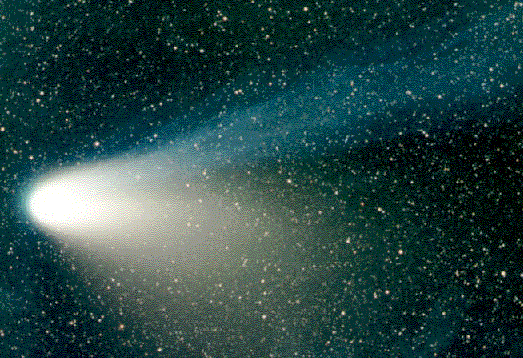
Credit: A. Dimai (Col Drusciè Obs.), AAC

We had glimpsed the comet on previous nights, but this was different. The comet and the stars were so clear, with more visible than I had ever seen before; there was even the odd shooting star. (meteor)

The reason the heavenly bodies were so clear and easy to see was the lack of light; therefore, there was no light pollution, just complete darkness. This must have been similar to the clear skies our ancestors had viewed, long before our towns and cities were illuminated by all the artificial light that we have come to depend on.

Comets are icy bodies that infrequently visit us; they have highly eccentric elliptical orbits. When they venture close to the sun, they warm up and release gases and other debris that form a coma, or tail, which can be seen from the earth.

A shooting star is just a fun name for a meteor, which is a small piece of rock or metal that enters the Earth’s atmosphere. Some can enter the atmosphere, travelling at over 250,000 kilometres per hour. That great speed causes friction within the atmosphere, causing them to burn up, leaving a streak of light behind them. If one is large enough and it reaches land or the sea, it is known as a meteorite.

The Hoba meteorite, which was found in Namibia, South Africa, is the largest known, with a width of 2.7 metres and a weight of over 66 tons.

We are now in the area of space that holds the galaxy cluster, El Gordo, ACT-CL J0102–4915. It is the most massive grouping of galaxies in the distant universe, with a total mass estimated to be 3,000,000,000,000,000, which is 3 quadrillion times that of the Sun. El Gordo is positioned 7 billion light-years from the Sun.

Part 15

Human Vision
Complex Eyes
Animals Vision
Colours Of Nature
Reflected Light
Recommended from ReadMedium