
FILM I DRAMA
‘Our Friend’ — The Truth About Real Dying is Ugly and Repulsive
Depicting the ugliness of death and the beauty of friendship.
In thirty-one years, I had my own encounters with death. I worked one year in an NHS hospital, at the A&E unit, as a porter. I’ve seen people in pain and agony, and I’ve seen people die. There is a difference between how we think of death as a concept and how it happens in real life.
Real death isn’t glorious or peaceful — it’s cruel, ugly, and repulsive most of the time.
Matthew Teague’s award-winning personal essay, The Friend, attempts to depict the sheer ugliness of death he witnessed up close. It’s a devastating confession of the last years of his wife, who died from ovarian cancer at the age of thirty-four. It’s a fascinating, emotionally heavy, and honest piece of writing about a life period he couldn’t have gotten through by himself.
Although the film adaptation, Our Friend, does no justice for it, it somehow achieves to highlight the important part: we all need a friend to lift us up when we hit the floor.
“I think I’ve hung on to the sensation of the hospital floor and being lifted away from it because it captures everything that followed in the next two years. The shock of mortality. One man’s collapse. And another man’s refusal to let it happen.” — Matthew Teague, The Friend
In my year as a hospital porter, I learned how hospitals make people feel sick. There is an inescapable aura of diseases, the smell of cleaning chemicals, and the lurking presence of death when someone walks through those corridors. When you work in a hospital as a non-healthcare professional, it takes time to adjust to all of that. Eventually, you get used to the smell, blood, and the woes — all of it. But make no mistake, every so often, something happens that reminds you of the kind of environment you spend the majority of the week.
When drunks, lunatics, and violent patients end up in the emergency department, the corridors and cubicles are loud and chaotic. But, when a newborn baby dies in the resuscitation area, everything gets quiet — death demands silence.
If you get to talk to a sixteen-year-old shy girl who attempted suicide a few times, that puts things in a different perspective. You find yourself selecting the words that come out of your mouth. It’s not intentional. Your brain just doesn’t know how to handle a situation like that because you’ve never experienced it before.
You don’t think about it, but you feel that death is constant there. It happens every day, but you try to spare yourself from seeing it. But, sometimes, there is no escaping it — it’s just part of the job.
The weight of a dead body feels strange in your hands. It’s wrapped in bedsheets, so you don’t get to see the patient and the condition he was in before passing. Still, your mind expects something else — a more impactful sensation. But, this is it, there is nothing more. You lift the body and place it on a concealment trolley to transport it to the mortuary. Then, your job is done.
However, the experience stays with you.
“We don’t tell each other the truth about dying, as people. Not real dying. Real dying, regular and mundane dying, is so hard and so ugly that it becomes the worst thing of all: It’s grotesque.” — Matthew Teague, The Friend
Cancer films have their ways to lure me in. It’s not that I enjoy watching people suffer under devastating physical and emotional pain — it’s more like I’m interested in what it brings out of them. Because, you see, death is usually surrounded by love. Cancer patients always have family and friends around them. They try to give their immense amount of love and care until they can’t.
Our Friend isn’t among the best movies about cancer, but it offers a fresh perspective. A third person, someone who voluntarily steps into the field of caretaking and support, even though he’s fully aware, it’s a war against disease and life they can’t win. But he tries, anyway.
After Matt (Casey Affleck) and his wife Nicole (Dakota Johnson) are faced with Nicole’s diagnosis and impending death, Dane (Jason Segel), their long-time best friend, moves in with them to help out. He babysits the couple’s kids, cleans the house, and even puts down the family’s dog when the vet tells him there is no other way. He does everything. Besides all the chores, he gives them the emotional support that is incomprehensible. For two years, he puts his life on hold to be there for them.
Beyond the obvious reasons, no one really understands why. Dane’s support doesn’t get acknowledged by his friends until the end because fighting cancer is an exhaustive full-time job. But that’s ok, Dane knows. He doesn’t need it, anyway. For him, being there for them is lifesaving. It gives him a purpose in a life where he couldn’t find any before — no jobs, romantic relationships, or dreams could grant him the feeling that he is needed in this world.
In two years, through thick and thin — excruciating emotional pain and heartache — Dane and Matt learn how to take care of a terminally ill person. Raise two daughters, and make sure they understand what’s happening. They both lose themselves in the fight, but they survive — together.
In the end, Our Friend ends up being much more than just another film that aims to portray the cruel and unspoken truths about cancer and death. It becomes a movie about the beauty of friendship that lies in the important and the smallest moments, too. There are no words big enough to express the gratitude that Matt feels for Dane, who was there with him all the way.
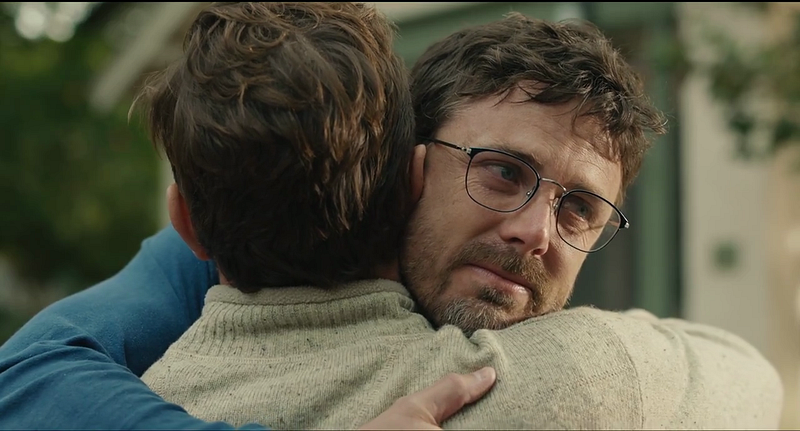
When they hug and say goodbye on the driveway, their feelings remain unsaid. Their face, though, mirrors the depths of love that is possible to be felt by human beings. And that can’t be described by ordinary words — because love and thank you just don’t do it.
“Love is not a big-enough word.” — Matthew Teague, The Friend