
‘Another Round’ Teaches Us a Lesson About Midlife Crisis and Alcoholism
Four middle-aged men try to drink themselves into a better person.
My father’s best friend was an alcoholic. He was a dumpy, smart, and jolly man who loved talking. As a kid, I became friends with his sons. We used to go on ski trips together, and I still remember laughing at his jokes while he had a grab on a beer can. I didn’t know how serious his drinking got until he passed away a few years ago. He suffered internal bleeding in his stomach and died on the toilet. One of his sons found his lifeless body on the bathroom floor.
Ever since, if he comes up in a conversation, we talk about him as a sorrowful cautionary tale. You can’t drink through your whole life with impunity — that’s the sad truth I’ve learned about alcoholism.
Thomas Vinterberg’s Oscar-worthy new drama Another Round (Druk) offers an exciting study early on. It states that Norwegian psychiatrist Finn Skårderud has theorized that having a blood alcohol content of 0.050 makes you more creative and relaxed. He claims that humans should maintain that percentage because it could help them battle depression and other mental issues.
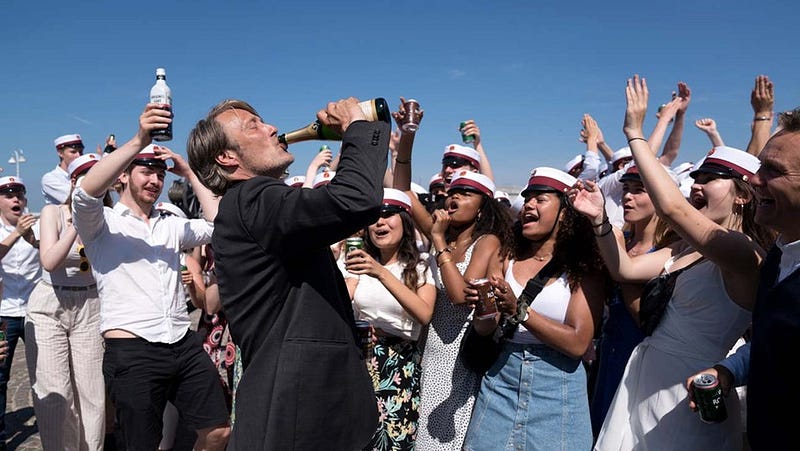
In Copenhagen, four struggling high-school teachers decide to put this study to the test and document it. They establish rules and make a schedule for drinking. Monday to Friday, strictly during work, and never after 8 p.m. It worked for Hemingway, says one of them. At first, the effect they experience by maintaining a 0.50 blood alcohol level is mesmerizing. They start performing better at school and earn the students’ attention effortlessly. The study works. They’re having a ton of fun and their personal life improves significantly.
Martin (Mads Mikkelsen), who’s verging on a midlife crisis and depression, finds his way back to his estranged wife thanks to booze. A few sips of vodka in the morning reinvigorate his tired, burnout, and boring personality. He becomes energetic, full of life. His three colleagues feel similarly, so they decide to go further and take drinking to the next level. They want to discover how far they can go without consequences.
Vinterberg’s movie is appealing because it’s self-aware. It doesn’t dismiss the seriousness of addiction, but it doesn’t define it as something inescapable in an early stage, either.
Hungary is ranked eighth on the list of countries by alcohol consumption per capita. Not many countries beat us when it comes to drinking. It’s something that is engraved in our nation’s consciousness.
I was insanely young (13) when I first got drunk on New Year’s Eve. Although, if I consider the public morals and the regulations in my country, it wasn’t that surprising. The general opinion is that drugs are wrong, but no one cares if you have a drink. People encourage you everywhere you go. Smoking a joint is evil, but if you drink yourself to death, that’s acceptable by our moral compass. It isn’t illegal, so it’s fine as far as we’re concerned. The legal drinking age is eighteen in Hungary. In Germany, it’s sixteen. How about that?
My dad’s best friend died of alcoholism, and my uncle is a recovering alcoholic. I’ve been told by a mental health professional that I have a tendency to develop any kind of addiction, including alcoholism. It’s in my genes.
The “good thing” about starting drinking at an early age, though, is that it only takes about ten-fifteen years until you face the repercussions. High blood pressure, reflux, IBS, the list goes on. I’m not saying that all of those problems come from alcohol abuse because I don’t know for sure, but I do know that booze makes them worse.
When I was young, irresponsible, and self-destructive, I didn’t treat my body as a temple but more like a weekend house for parties. I thought I was indestructible because regardless of how much I drank, my body recovered quickly. The hangover was a distant relative, and we haven’t seen each other often.
When you’re just a teen, alcohol makes everything more fun. It gives you an invisible cape of coolness. You don’t drink because you’re sad, you drink to enjoy yourself more. That’s not alcoholism, that’s just youth. It only becomes dangerous when you realize you can’t stop because you don’t want to stop. Being loose, entertaining, and easy-going is attractive if you’re at an age when impressions are the only currency you value.
Being middle-aged and blind drunk isn’t so appealing, though. It just makes you seem sad and out of control. And as an adult, there is nothing less charming than being a sad sack of crap who spirals out of control every night because he can’t miss one round in the local pub.
Vinterberg’s film is refreshing because it evokes the energy and coolness of four middle-aged men who banished every bit of fun from their lives. They became boring adults with problems and responsibilities that they had to own every single day. So, when they decide to loosen up in a series of drunken days and nights, we get to take a peek at the child inside them. Watching them feels liberating. But at the same time, we know too well that it can’t last without going off the rails and crashing into reality sooner or later.
That’s when having fun turns into tragedy. Grown men urinate into their beds, families fall apart, and feelings get hurt. But, if nothing else comes out of this, they have a chance to face their midlife crisis and appreciate the people in their lives more than ever before.


