
Our Space Journey, part 8

British spelling
To make sense of my story and obtain the best knowledgeable experience, please go to the beginning and read Part 1 here.
Part 8.
As a reminder, one astronomical unit (AU) is the distance between the Sun and the Earth.
Celer has been travelling for 50 years and has covered a distance of 3,162,000 astronomical units. The number of stars at this distance and in every direction from the Sun is an estimated 1,800; 133 of them can be seen from the Earth with the naked eye. That is because they are either similar in brightness or much brighter than our Sun. With the knowledge gained in recent years, it is almost certain that most of the stars in the universe will have various numbers of orbiting planets and moons.
Escape velocity. I briefly touched upon this subject earlier in the story. If you throw an object straight up into the sky, it will rise until the pull of gravity halts it, and then it will fall back to Earth, but the force of gravity decreases as the distance from the Earth increases.
Escape velocity is defined as the minimum speed required by an object to escape the gravitational field of the Earth or any other body of mass without ever falling back. Imagine if you were standing on the ground with a very powerful gun and a steel ball. The speed needed for that ball to escape the Earth’s gravity completely would be over 40,000 km/h.
The Saturn V rocket, one of the most powerful machines ever constructed, was used to put men into space on the first leg of their journey to the Moon. It consisted of three stages, each taking the men to a higher velocity and altitude in a controlled manner. When the first stage expended its fuel, it separated and fell away, reducing the rocket’s weight. The second stage then ignited, pushing the rocket to a greater height, and finally, the third stage completed the acceleration of over 28,000 km/h before reaching space.
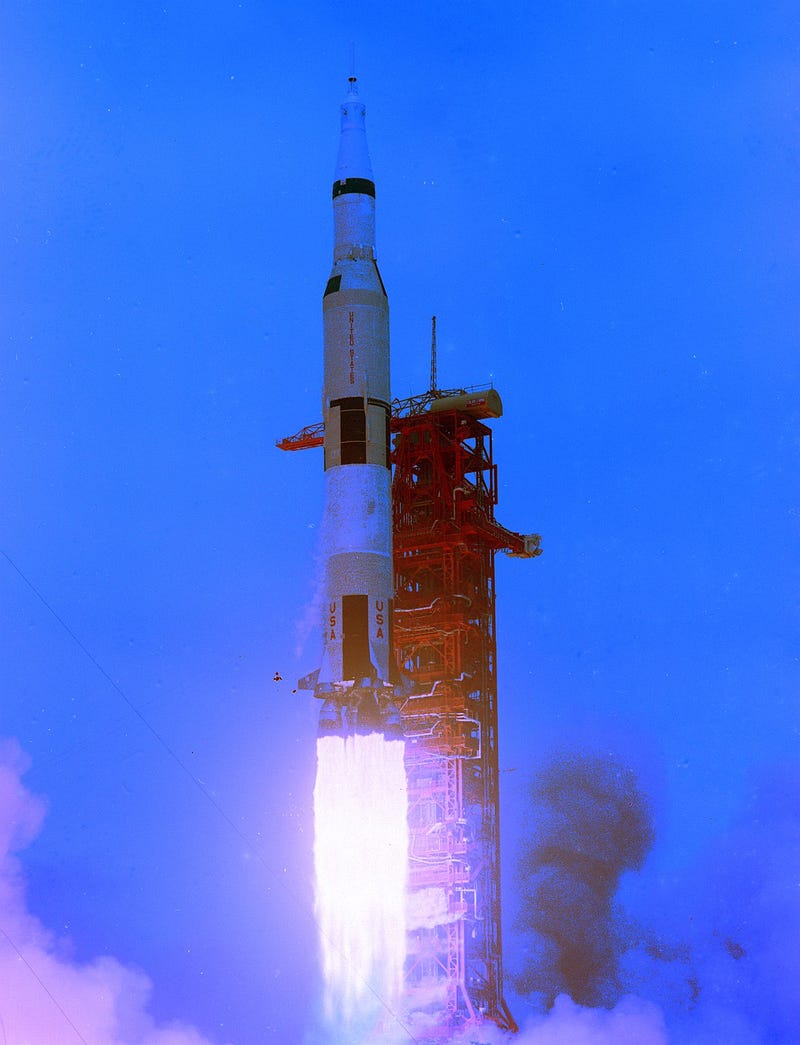
As you can see, the Saturn V rocket managed to enter space with a lesser speed as it was just going to the moon.
If you were leaving the Moon to go into space, you would only have to travel at 8,560 km/h to escape the Moon’s gravity, and if it were possible to be on the Sun, the escape velocity needed would be 2,214,000 km/h, as the more mass and gravity a star, planet, or moon has, the greater speed you need to break free from its gravitation grip.
Luna 1 was the first man-made object to enter space, way back in 1959.
Everything in the universe is moving. If you were standing on the equator, the widest part of the Earth, you would be travelling at 1,600 km/h, which is due to the Earth spinning on its axis.
The Earth orbits the Sun at 108,000 km/h, and the Solar System orbits the centre of our galaxy, the Milky Way, at 700,000 km/h.
The Milky Way is also travelling through space at an estimated 2.2 million km/h, and we don’t even notice it.
A type 1 supernova occurs in binary star systems. Binary stars are two stars that are in orbit around the same point, the barycenter. If one of the stars, a white dwarf, is close enough, it can gather matter from its companion star. Eventually, the white dwarf star accumulates so much matter and becomes so dense and unstable that it explodes, resulting in a supernova, destroying the whole star.
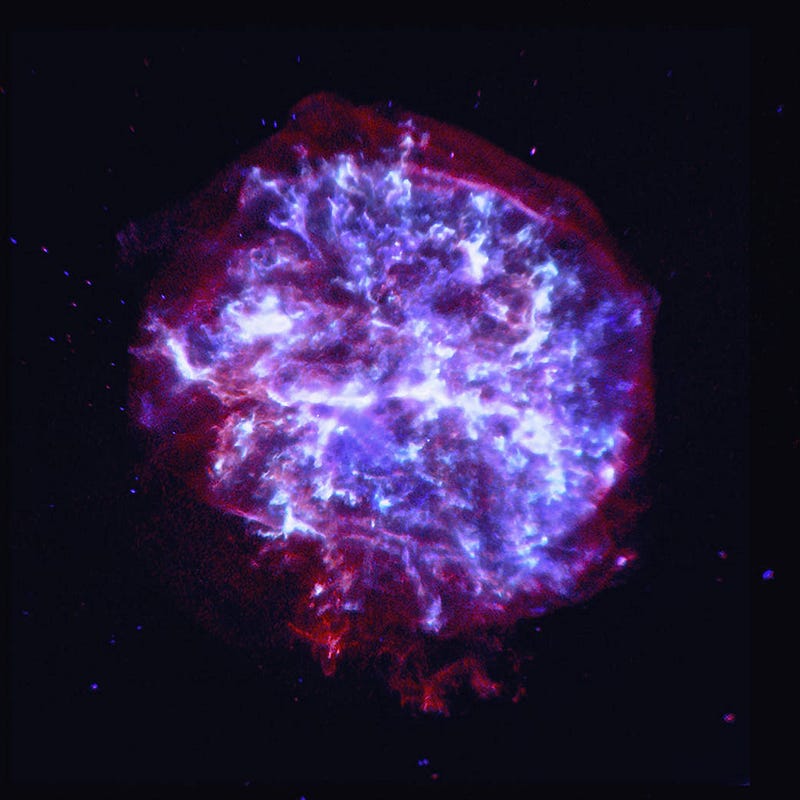
I will explain the barycenter later in the story.
The most recent supernova that took place in our galaxy was named SN 1604, or Kepler’s supernova. Although it was 20,000 light-years away, people could still see its light with their naked eye. It happened on October 9, 1604. It is thought that on average, a supernova will occur in our galaxy two or three times every century.
A type 11 supernova occurs when a single high-mass star runs out of fuel, and as a result, some of its mass moves into its core. The core gets so heavy that it can’t withstand the gravitational force and collapses, resulting in a giant supernova explosion that is so bright that it can briefly outshine the whole galaxy.
Stars create elements in their cores by a process called nuclear fusion. This starts with fusing hydrogen to helium; larger stars can create every element up to iron, which is the end of the road for element production. Elements heavier than iron are created at the time of supernova and kilonova explosions.
At the supernova stage, vast amounts of elements that a star has manufactured in its lifetime are now ejected far out into space. Sometime in the distant future, these elements will become part of new stars, planets, or other celestial objects; they might even end up being part of some life form somewhere else in the universe.
A neutron star or a black hole can be the end result of a type 11 supernova, and sometimes a pulsar can be left behind, which is a spinning neutron star.
60 years have passed since leaving the Earth on our fictional journey, and for people living on the Earth, time goes by so quickly.
My grandchildren will be reaching retirement age at this time, which makes me aware of how short our lives are. We should all make the most of the precious time we have left.
Before we left home, it was predicted that fossil fuels such as oil and gas would run out in 50 years. Maybe that time has been stretched due to other reserves being found. I trust that mankind has been able to adjust using the natural resources available, such as wind and solar power, or perhaps they are exploring some other energy alternatives. Either way, I hope that it is friendlier to the environment of our planet, for the sake of mankind and all the other life that depends on it.
Astronomers have found an exoplanet that is 13 times larger than Jupiter. This planet orbits a star called Kappa Andromedae, and this type of planet is classified as a super Jupiter; any bigger and it could be classified as a failed star or a brown dwarf. Its official name is Kappa Andromedae b, and it is located 170 light-years from the Sun.
Astronomers have identified around 3,200 neutron stars in the Milky Way galaxy, but there are many more still to be discovered.
The closest one to the Earth is nicknamed Calvera and could be as close as 250 light-years; it has approximately 1.4 times the mass of the Sun packed into a ball 20 km in diameter. On average, a neutron star’s gravity can be 2 billion times stronger than the Earth’s gravity.
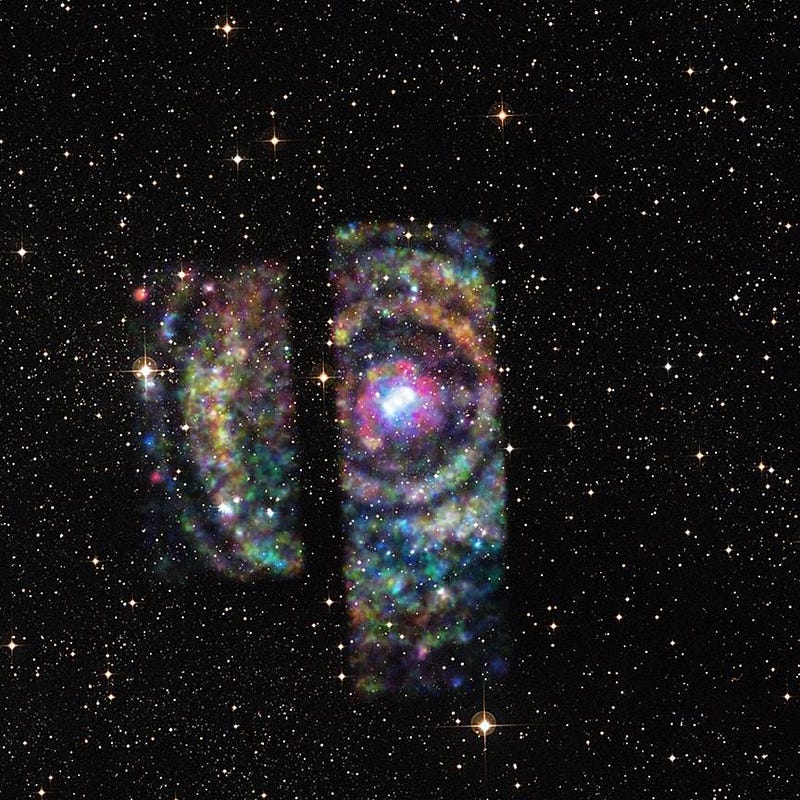
When a large star, four to eight times the size of the Sun, reaches the end of its life, it will not end peacefully; the result will be a violent supernova explosion, and the core of the star becomes so compressed that protons and electrons combine to make neutrons, hence its name, a neutron star.
It has taken us 620 years to reach this red supergiant star, Antares. The visible brightness of this star is around 10,000 times that of the Sun. Antares is only 12 million years old but is coming to the end of its life. It is expected to explode as a supernova in the next million years or so.
It is not easy to predict when a large star will run out of fuel and destroy itself in a massive explosion. It can hang on for millions of years, but when it does happen, its brightness will be unimaginable. Even at a great distance, that event would be visible in the daytime from the Earth.
The red supergiant star Betelgeuse travels through space at a speed of 30 km per second, and as observed from the Earth, it is the ninth brightest star in the night sky. It is at a distance of 642 light-years.
The mass of this star is estimated to be over ten times greater than that of the Sun. If you were to put Betelgeuse in the position of our sun, its surface would extend out to the distance of Mars. It too is reaching the end of its life; this is a star that will also end in a violent supernova explosion.
VY Canis Majoris is also a red supergiant star and one of the largest by diameter and most luminous stars in the Milky Way. It has a diameter of almost 2 billion km and a volume of 3 billion times that of the Sun. It will one day end its life in a hypernova explosion, but being 3,900 light-years from the Earth means that it is at a safe distance, therefore it will cause no problems for life on Earth.
We are 9,500 years into our journey and have reached UY Scuti. If you think the star VY Canis Majoris is big, then what about this mind-boggling red supergiant star UY Scuti, possibly one of the largest stars known? Its diameter is in the region of 2.4 billion km, and it has a volume of 5 billion times that of the Sun.
Its distance from the Earth is approximately 600 million AU. If you were to replace the sun with this star, its surface would stretch out further than Jupiter’s orbit.
Hypothetically, Celer would take about 15 seconds to fly around the sun but would take seven hours to complete one circuit around UY Scuti.
We are well on the way to our next waypoint. By the time we arrive at the centre of our galaxy, we will have travelled 246,000 trillion kilometres, which is a very small distance in comparison to the epic journey ahead.
Part 9