
Our Space Journey, part 7

British spelling.
To make sense of my story and obtain the best knowledgeable experience, please go to the beginning and read part 1 here.
Part 7
Celer log, departing Proxima Centauri, waypoint, Sagittarius A*
The distance to Sagittarius A* is an unbelievable 1,644,240,000 astronomical units. Sagittarius A* is the name of the black hole at the centre of the Milky Way. Celer will arrive and fly by the next location in 26,000 years. It is time to include a few interesting pieces of information on the way to our next waypoint.
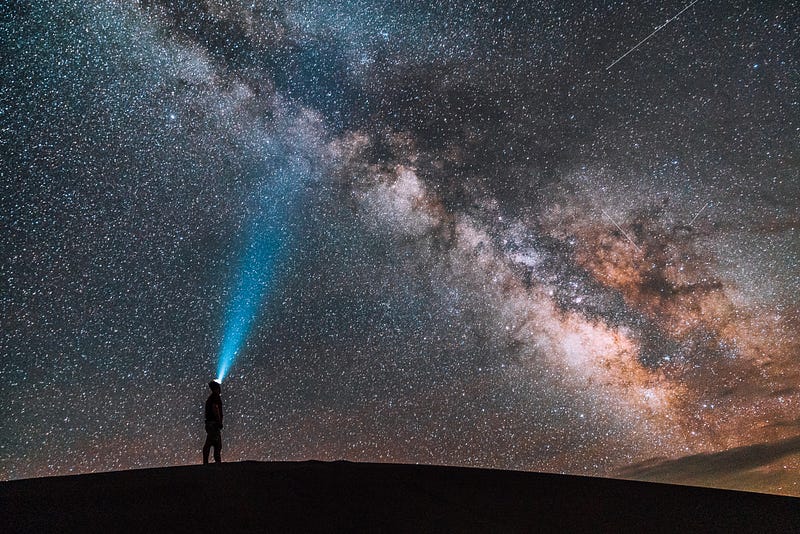
The Milky Way galaxy
The Milky Way, our spiral galaxy, is part of the local group of 50 or more galaxies, and, on a bigger scale, this local group is part of the Virgo supercluster of galaxies. Our Galaxy is over 100,000 light-years across, so it is difficult for astronomers to give an accurate assessment of how many stars there are in the Milky Way. A lower estimate would be 100 billion stars; higher estimates can be up to 400 billion stars.
Many of the star systems scattered throughout our galaxy will be similar to our solar system, which consists of all the planets, dwarf planets, moons, asteroids, and everything else that orbits the sun. The Solar System is situated approximately 26,000 light-years from the Milky Way’s centre and positioned halfway along the Orion Arm, which is 10,000 light-years in length.
Thinking about that journey of 26,000 light-years, one light-year is equivalent to roughly 9.46 trillion kilometres! A trillion is 1 followed by 12 zeros.
The total mass contained in the Milky Way galaxy is thought to add up to 1.5 trillion times the mass of the Sun. If you could mix up all the mass and empty space in the Milky Way so that it was distributed equally, then each cubic light-year of space would contain around 40% of the Sun’s mass. It may seem like a large amount of mass, but a one-light-year cube is a very large volume of space.
It is also difficult for astronomers to figure out what the Milky Way looks like. The shape of our galaxy has to be worked out from within. We can see other distant galaxies with all their complex shapes and sizes, but there has never been anyone or anything from Earth outside our galaxy to take an image, and I think it is safe to say that there never will be.
The brightest star in the night sky as seen from the Earth is Sirius; it lies at a distance of 8.6 light-years, which is almost 544,000 astronomical units from the Earth. Sirius is between 200 and 300 million years old with an apparent magnitude of minus 1.46, roughly 25 times as luminous as the Sun.
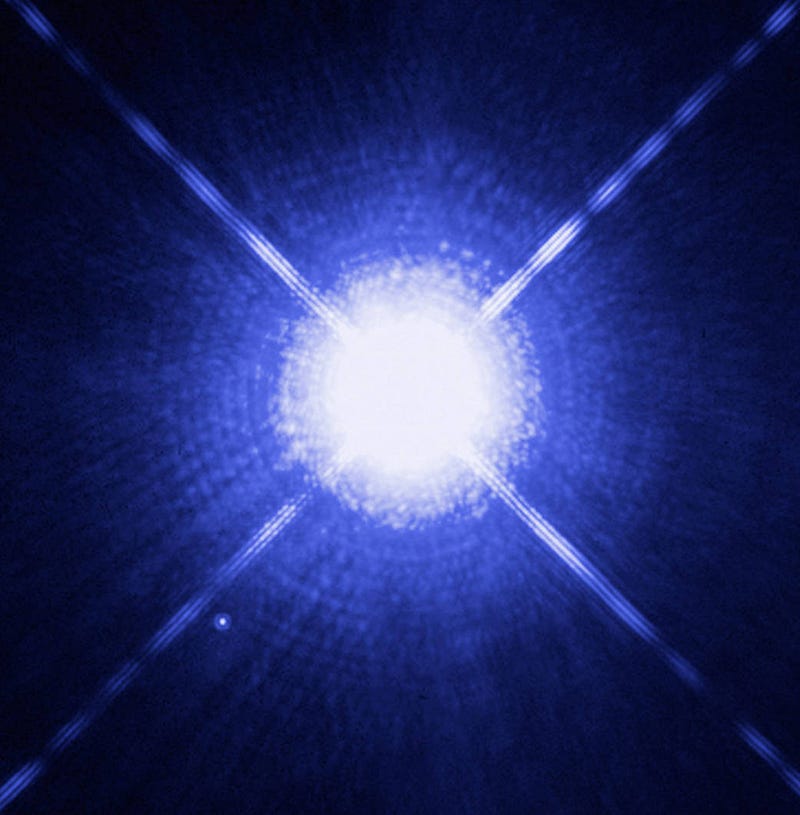
Sirius has a diameter of almost 2.4 million kilometres, much larger than the Sun, which has a diameter of 1.3927 million kilometres.
The apparent magnitude is the brightness of an object as it appears in the night sky viewed from the Earth; a minus number is brighter than a positive number on the magnitude scale.
When we look at Sirius, what the naked eye perceives as a single star is actually a binary star system consisting of a white main-sequence star Sirius and a faint white dwarf companion star Sirius B.
Considering the age of the Sun at 4.6 billion years old, Sirius is a very young star.
Atoms are the smallest particles of chemical elements that can exist and are the basic building blocks of everything that can be seen or touched. Apart from a hydrogen atom, which has a single proton and a single electron, all other atoms contain various amounts of protons, neutrons, and electrons.
A chemical element is made of the same type of atoms that have the same number of protons in their nucleus, that is, their atomic number; therefore, all the atoms in an element will have the same atomic number.
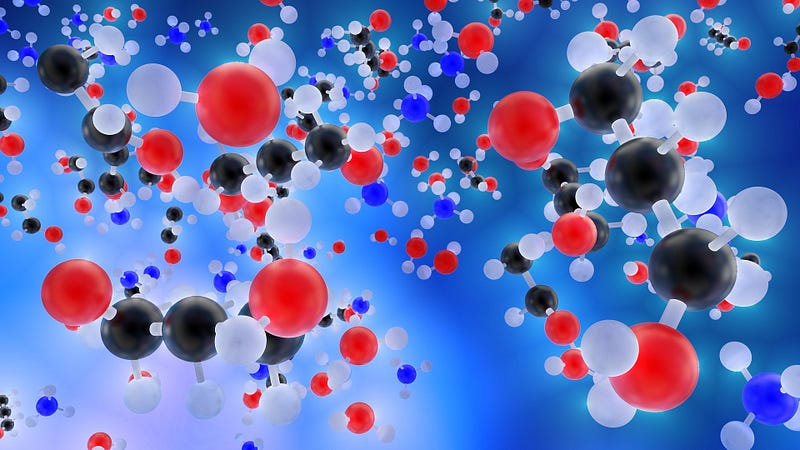
The mass of an atom is the total number of protons and neutrons combined.
To give you an idea of the size of an atom and how small they are, take a human being of say 70 kilograms in weight. The total number of atoms making up that person’s body is estimated to be 7 octillion, which is a staggering 7,000,000,000,000,000,000,000,000,000 atoms!
The most common atoms by mass that make up 99% of the human body are oxygen, carbon, and hydrogen. When we die, all the elements that we were made of will dissipate over time and eventually become part of other objects or even other living things in the future.
A molecule is an electrically neutral group of two or more atoms held together by chemical bonds. Every combination of atoms is a molecule; they can be simple or complex. To give an example, a water molecule consists of one oxygen atom and two hydrogen atoms. A carbon dioxide molecule consists of one carbon atom and two oxygen atoms.
Matter is the term for any kind of material that takes up space. It is all around us. Matter is the air you are breathing, the shoes you are wearing, the water in your glass, and everything you can touch and smell; it is what we are.
Anything that has mass is matter, and it comes in five known states: three commonly known as solid, liquid, and gas, the other two being plasma and Bose-Einstein condensates. The difference in the structure of each state is described as the densities of the particles.
Mass is a combination of the total number of atoms, the density of the atoms, and the type of atoms in an object. Every object in the universe is made up of matter, and the bigger an object is, the more mass it has.
Mass is measured in kilograms or (kg). Objects that have a lot of mass are harder to move or stop than objects with less mass. The mass of an object can only change if you add or take away matter. You can place an object in different parts of the universe, but it will always have the same mass.
Weight is not the same as mass, as you will see in the next paragraph.
Weight is the result of the force of gravity acting upon an object, which can change if the force of gravity changes. I weigh 80 kilograms here on Earth, but if I took the next flight to the Moon and weighed myself there, I would register at just over 13 kg. The reason is that the Moon’s gravity is much less than that of the Earth, and therefore I am being pulled down on the scales with less force than I would be on Earth.

On Mars, my weight would be just over 30 kg. If it were possible to stand on the sun (which I am not recommending), My weight would be over 2,165 kilograms, as the sun’s gravity is almost 28 times as strong as that of the earth, and if I were floating in outer space with no gravitational attraction from any objects, my weight would be zero.
Even the air we breathe has weight; the mass in one cubic metre of air weighs approximately 1.2 kg. On a windy day, you can feel the weight of the air acting on your face and your body. If you can imagine a column of air one-centimetre square sitting at sea level and going all the way up to space, then the weight of that air column would be classified as atmospheric pressure.
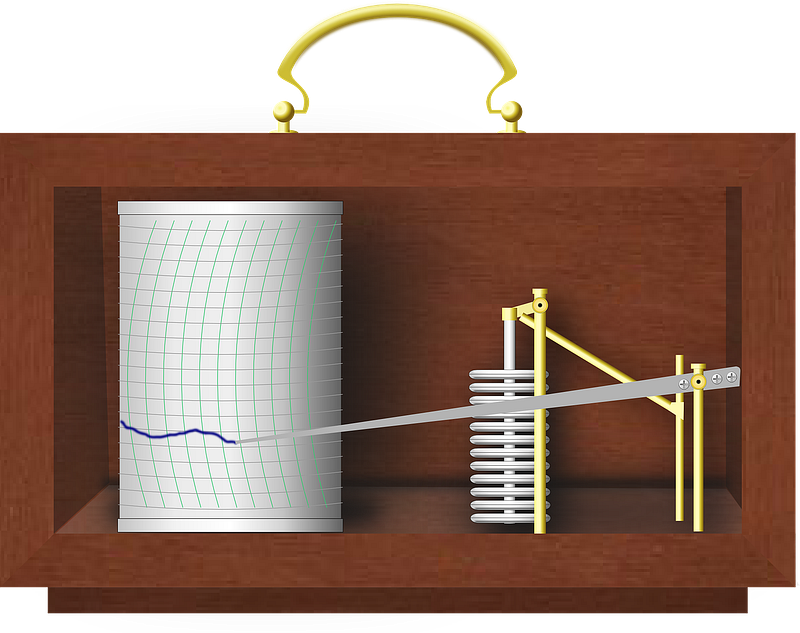
On Earth, that weight exerts a pressure of just over 1 bar per square centimetre; however, you don’t notice this weight because we are accustomed to it. If you were to climb to the top of Mount Everest, then the air pressure there would be about one-third of what it is at sea level.
Density is a measure of mass per unit volume. Here is a very simple explanation! An object made from a comparatively dense material, such as gold, will have less volume than an object that is not so dense, such as aluminium or, in the USA, “aluminum”
If you were to take 1 kg of gold and shape it into a ball, then do the same with 1 kg of aluminium, then the gold ball would be smaller in diameter than the aluminium ball of the same weight.
The highest density known outside of a black hole is a neutron star. One cubic metre of neutronium from its centre could weigh an incredible one million billion tons here on Earth, and no, that is not a typing error.
Providing an update on this leg of our journey.
Celer has been travelling for 20 years and is at a distance of 1,264,800 AU, or over 189 trillion km from home. Surprisingly, there are only 109 stars and 8 brown dwarfs at this distance and in every direction from the Sun. Brown dwarfs are substellar objects that occupy the mass range between the heaviest gas giant planets and the lightest stars; they never quite made it to a star. Only 109 stars in that area of space, which gives an understanding of how vast the distances are between them.
At this time my grandchildren would be old enough now to have families of their own. I could only hope that they would be healthy and live fruitful and meaningful lives.
When we left home, the human population was estimated to be nearing 8 billion. If estimates back then are to be believed, there could be over 9 billion people living on the planet Earth at this time.
A star system, or stellar system, is a small number of stars that orbit each other and are bound by gravitational attraction. A large number of stars bound by gravity is generally called a star cluster, or on a much bigger scale, a galaxy.
When you look up at the night sky and see the stars, some of them will be bright and others will be faint. The reason a star could be faint is that it is simply less luminous or it could be farther away. A variable star can change its brightness periodically.
Stars come in many different types, sizes, and colours, from smouldering white dwarfs to blazing red giants.
Part 8


