
Our Space Journey, part 6

To make sense of my story and obtain the best knowledgeable experience, please go to the beginning and read part 1 here.
British spelling.
Part 6.
Celer log, departing Neptune, waypoint, Pluto
The minimum distance between Neptune and Pluto is 2.8 billion km, and the maximum distance is 11.77 billion km; therefore, I will say that we have a 7 billion km journey ahead. This will be a much longer flight for Celer, taking almost 7 hours.
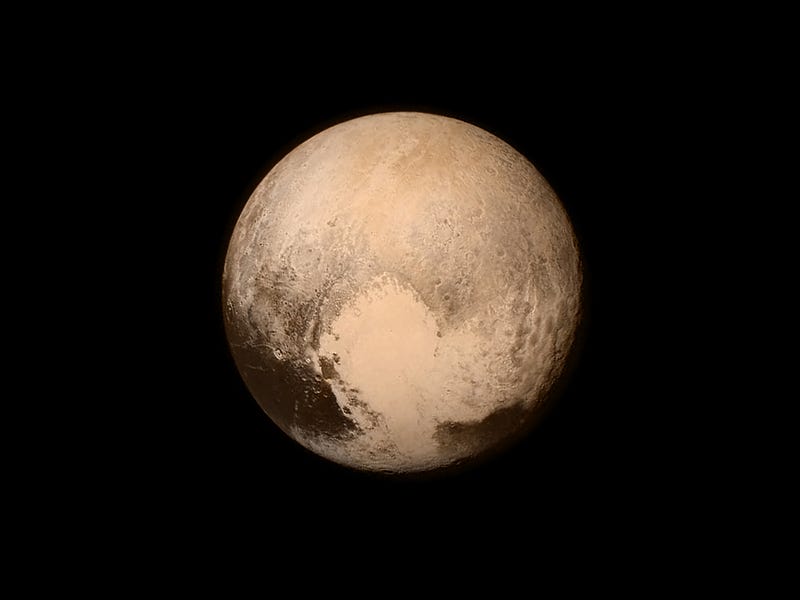
Pluto was downgraded from the official 9th planet to a dwarf planet in 2006, leaving the Sun with eight orbiting planets.
Pluto has a diameter of 2,370 km and an average distance from the Sun of almost 6 billion km. Pluto takes almost 248 Earth years to travel once around the Sun at an average speed of 17,096 km per hour.
When it was launched in January 2006, the spacecraft New Horizons achieved a speed of 58,500 km per hour, the fastest launch speed of any spacecraft that had left the Earth at that time. Even at that speed, nine and a half years passed before it reached Pluto.
The spacecraft collected a vast amount of information on its quick flyby of the dwarf planet, but the total amount of information took a long time to arrive back home and will take many years to complete a full scientific study. The surface temperature on Pluto can get as low as minus 240 degrees Celsius, just 33 degrees above absolute zero, the coldest temperature possible.
New Horizons is now heading out towards the Kuiper Belt and will hopefully continue to send information back for a long time to come. New Horizons is the only spacecraft to have visited Pluto.
We are now at the same distance from Earth as Halley’s comet, as it too travels away from the Sun on its elliptical path; it was last at perihelion, closest to the Sun in 1986, and will reach its furthest point at aphelion in November 2023, then it will begin the long 37.6-year journey back towards the Sun. Halley’s Comet has an orbital period of 75–76 years, so depending on when they were born, some people will see it twice in their lifetime. I saw it once but will never see it again.
Celer log, departing Pluto, waypoint, Voyager 1.
The distance Celer has to travel to the next waypoint is over 17 billion km.
We will arrive at the next waypoint in almost 16 hours.
Voyager 1 blasted off from Cape Canaveral on September 5, 1977, sixteen days after its twin, Voyager 2. Its objectives included flybys of the gas giants Jupiter, Saturn, and Saturn’s largest moon, Titan. This planetary mission lasted 3 years and 3 months; since then, Voyager 1 has continued to travel through space at over 60,000 km per hour.
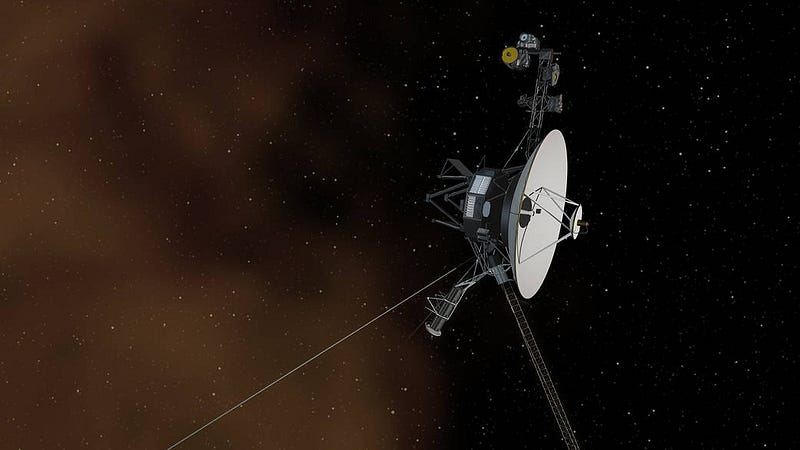
Back in 2012, it entered the heliopause and was the first spacecraft to ever enter interstellar space. The heliopause is the boundary of the heliosphere, the region around the sun that is filled with solar magnetic fields and solar winds.
This little spacecraft is the furthest-away man-made object that has ever left Earth. It carries with it a gold disc, providing information about our planet Earth, the solar system, and life on Earth. Could it be possible that an extraterrestrial life form will find it in the distant future?
As of October 2023, Voyager 1 has been travelling for 46 years and is now over 24 billion kilometres from the Earth. It would have taken Celer just over 22 hours to cover that same distance.
Voyager 1 will have its next close encounter in 38,000 years when it will pass the star AC+793888 at a distance of 1.7 light-years. If Voyager 1 were to change direction and make its way to the centre of our galaxy, the Milky Way, then that long journey would take 450 million years.
As I said, Voyager 2 was also launched in 1977; it visited all of the gas giants, and its closest approach to the most distant planet, Neptune, was on August 25, 1989. From there, it took a different route from Voyager 1 through the Solar System.
As of October 2023, Voyager 2 is over 20 billion km from the Earth and remains in contact with NASA’s deep space network.
The asteroid explorer Hayabusa 2 was launched from the LA-Y Tanegashima Space Centre on December 3, 2014. This asteroid sample return mission was operated by the Japanese Space Agency, JAXA. It follows on from the previous Hayabusa spacecraft and changes some weak points found on that mission.
Hayabusa 2 arrived at the asteroid 162173 Ryugu on June 27, 2018. The asteroid is almost 1 kilometre wide and roughly 300 million kilometres from Earth. It surveyed the asteroid for about a year and a half, then collected samples from the surface for a return journey to Earth. I am pleased to say that the sample return was a huge success. The return capsule with carbon-rich samples landed by parachute near Woomera, Australia, on December 6, 2020.
Everything in the Solar System, including the Sun and the planets, are travelling through space at 800,000 km per hour and will take roughly 230 million years to complete one orbit around the centre of the Milky Way. One orbit around the Milky Way is referred to as a cosmic or galactic year. Our Solar System has circled the centre of our galaxy more than twenty times since its birth, so we could say that the Solar System is 20 cosmic years old.
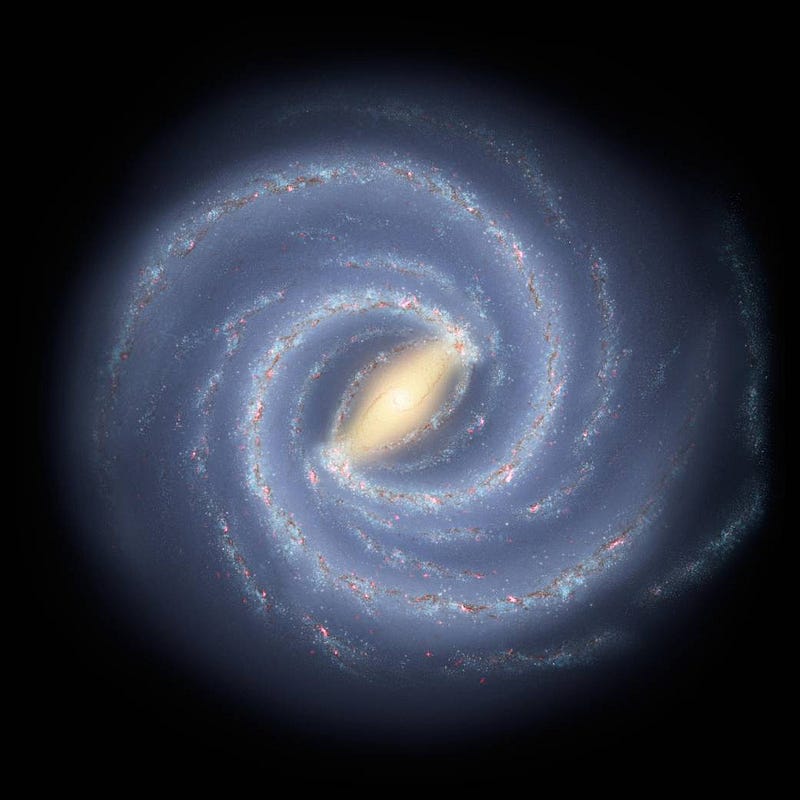
To give an idea of the size of the solar system in comparison to the Milky Way. Our fictional spacecraft, Celer, would take over 100,000 years to fly the whole width of our galaxy, but depending on the estimated solar system diameter you choose, Celer could take up to a year to travel the whole width of the solar system.
Celer log, departing Voyager 1, waypoint, Proxima Centauri.
The distance to the red dwarf star Proxima Centauri, our closest star neighbour, is 40 trillion km and is part of a three-star system. Celer will take 4.22 years travelling at almost 300,000 km per second to reach the sun’s closest star neighbour.
The distance to Proxima Centauri seems vast but is a mere footstep in comparison to the long journey ahead. It was announced in August 2016 that an exoplanet had been discovered orbiting Proxima Centauri. The exoplanet, named Proxima Centauri B, is thought to take just over 11 Earth days to complete one orbit around the star.
It has an estimated mass of at least 1.3 times that of our Earth, and although it orbits in a habitable zone, it is extremely unlikely that life could have come into existence due to the pressure of the stellar winds. An exoplanet is a name given to a planet that exists outside our solar system.
Kilometres have little meaning now. I will now use astronomical units, the AU scale, which is the distance between the Earth and the Sun, with one AU being 149.6 million km.
The Oort cloud, named after the astronomer Jan Oort, is a body of icy objects that exists in the farthest reaches of the Solar System. Long-period comets that visit the Sun are thought to originate from that area of space. Their long, flowing tails of gas and dust develop from the heat as they get closer to the sun.
You would have to travel 2,000 AU from the Earth to see the start of the icy bodies, and their outer edge could stretch out 100,000 AU, which would be well on the way to the nearest star. The most likely theory is that the material in the Oort Cloud formed closer to the young Sun as the Solar System was being created, and in particular, when Jupiter migrated to its present position, its gravitational influence is thought to have scattered many icy objects to their present position in the Oort Cloud.
It is estimated that there could be as many as two trillion icy bodies out there orbiting the Sun. These icy bodies are so far out that it would take them over a million years to orbit the Sun.
Celer is leaving the Oort cloud behind and travelling beyond the farthest reaches of our solar system, well on the way to the next waypoint.
As we approach Proxima Centauri, I have sent a message home, but I will never receive a reply. Radio waves are part of the electromagnetic spectrum and travel at the same speed as visible light; therefore, my message will take over four years to arrive back on Earth, and for me to receive a reply, I would have to stay at this same location for almost 8.5 years.
Looking back towards our sun, I am surprised to see that it looks no different from the rest of the stars in the night sky.
Part 7